


Mike McCarthy sits in his new office at the UPMC Rooney Sports Complex, watching film of January's playoff massacre on loop. Thirty-to-six. At home. Against a Texans team that Pittsburgh had just beaten three weeks earlier. Seven straight postseason losses, each one uglier than the last, each one proving the same cruel truth: you can't win championships when your quarterback play ranges from mediocre to catastrophic.
Matt Freed / Pittsburgh Post-Gazette
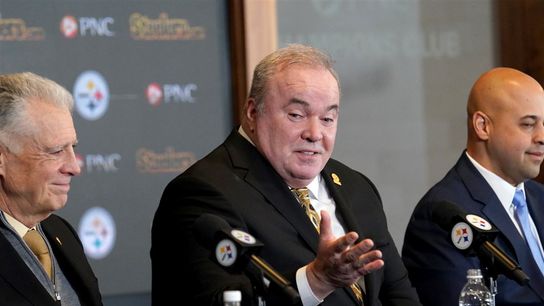
Steelers' new head coach, Mike McCarthy, with Team President Art Rooney II and General Manager Omar Khan at McCarthy's introductory press conference in Pittsburgh, PA.
Nineteen years of Mike Tomlin. Never a losing season. Never sustained quarterback competence after Ben Roethlisberger retired. McCarthy inherits a roster built to contend—elite defense despite aging concerns, functional ground game, weapons at the skill positions—but shackled by the position that matters most. And now everyone expects him to fix it by reuniting with his 42-year-old ex-quarterback, a player who spent significant stretches of 2025 ineffective.
Steelers Could Wait For Rodgers Again
Here's the uncomfortable reality: Aaron Rodgers might return to Pittsburgh. The Steelers have said that they will wait for him to make a decision on retirement, just as they did last year. But bringing A-Rod back for a second season under center at the ripe old age of 42 could well be organizational malpractice.
But GM Omar Khan can't bet everything on that outcome. Not when the defense is aging. Not when the championship window McCarthy was hired to exploit could slam shut before anyone's ready. The Steelers need contingencies. They need options. They need to acknowledge that Will Howard—a sixth-rounder who never took a snap in 2025 after injuring his hand—probably isn't walking through that door ready to start Week 1.
By the time Week 1 rolls around in September, there will be a new betting outlet in town as Ozoon sportsbook brings its unrivaled offering to punters. The new site is expected to offer unbeatable odds and a slew of promotions for its new player base. But when September does arrive, and Ozoon is pumping out the bonus bets, who will the Steelers have under center in an attempt to finally lead them to a deep postseason run?
Rodgers is Plan A, but what's Plan B? What happens if Rodgers says no, or breaks down, or proves that 42 is too old even for someone with his arm talent? Khan's got options. Kenny Pickett is available in free agency, while Ty Simpson should be available at 21st overall in the draft, although that does feel like somewhat of a reach. So, what about the trade market? Well, there's plenty available there too.
Kirk Cousins
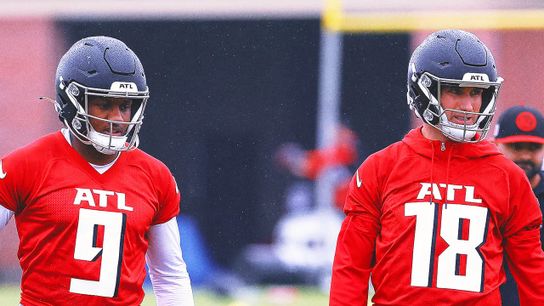
Atlanta is cutting Kirk Cousins loose before the new league year begins on March 13th, admitting their massive free-agent investment failed spectacularly. The Falcons drafted Michael Penix Jr. and decided their future doesn't include a 38-year-old pocket passer with declining mobility. For Pittsburgh, that's both a cautionary tale and a golden opportunity.
FOX Sports
Falcons quarterbacks Michael Penix Jr. and Kirk Cousins during practice.
Cousins cost nothing but money. No draft picks. No trade negotiations. Just Khan making a sales pitch about competing immediately with a championship-caliber roster. And Cousins fits McCarthy's offensive philosophy perfectly—timing routes, play-action efficiency, taking what the defense gives you without forcing heroics. He's spent fourteen years proving he won't lose you games, which sounds pedestrian until you remember Pittsburgh's quarterback carousel has featured Kenny Pickett, Mitch Trubisky, Mason Rudolph, and an aging Aaron Rodgers.
The pitch practically writes itself: come stabilize this offense, leverage an elite defense, mentor Will Howard for two years while competing for championships. Structure it smartly—$20 million base with playoff escalators and incentives pushing it toward $28-30 million if they contend. That's manageable cap space for a team in win-now mode.
But let's be honest about what this signing represents. It's the Steelers defaulting to type—choosing safe over spectacular, known commodity over upside gamble. It's admitting they don't trust Howard, can't land Rodgers, and won't take risks on younger options with higher ceilings. For a fanbase that's watched this franchise waste championship defenses on quarterback mediocrity since 2019, signing Kirk Cousins feels like Groundhog Day. Different name, same strategy, identical ceiling.
Kyler Murray
Arizona wants Kyler Murray gone badly enough that they benched him for Jacoby Brissett and are actively shopping him before his March 15th roster bonus comes due. Trading him beforehand saves the Cardinals significant cap space while eating $17.9 million in dead money, which tells you everything about how this marriage ended.
For Pittsburgh, Murray represents the opposite of their organizational DNA. He's 28 years old with franchise quarterback upside, dual-threat dynamism that could transform McCarthy's offense overnight, and enough red flags to fill Heinz Field. Injury history? Check. Inconsistency? Absolutely. But here's what keeps Khan up at night: what if Murray's not broken, just misused?
What if Cardinals' dysfunction—coaching turnover, offensive line disasters, zero surrounding talent—masked legitimate star potential? His arm talent is undeniable. His mobility would unlock play-action concepts Pittsburgh hasn't featured in years. And at 28, he's not a bridge—he's a potential decade-long answer.
The price is steep. Arizona wants draft compensation for their 2019 first overall pick, probably a second or third-rounder. And Murray's contract is an albatross: $42.5 million in 2026, $36.3 million in 2027, severely limiting roster flexibility. That's franchise-crippling money if he fails. It's a bargain if he succeeds.
Mac Jones
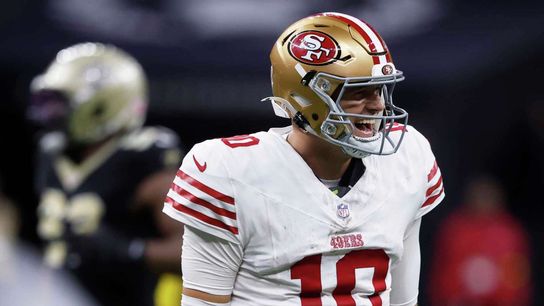
San Francisco doesn't want to trade Mac Jones because he's exactly what backup quarterbacks should be: cheap, competent, and proven capable of winning starts when needed. After eight solid appearances replacing injured Brock Purdy in 2025, Jones demonstrated he's not the disaster Patriots dysfunction made him appear.
Butch Dill / Associated Press
San Francisco 49ers quarterback Mac Jones in a game against the New Orleans Saints in 2025.
For Pittsburgh, Jones is the quintessential value acquisition. He costs a fourth or fifth-round pick. His cap hit is $3.9 million. He's 27 years old with playoff experience and a Kyle Shanahan offensive education. If Howard isn't ready, Jones provides legitimate starting capability. If Rodgers returns and breaks down, Jones is insurance. If they sign Cousins, Jones is quality depth for pennies.
This is Pittsburgh football distilled: find undervalued assets, bet on coaching to maximize them, don't mortgage the future chasing shiny objects. Tom Arth—retained as quarterbacks coach specifically for continuity with Howard—could work with Jones while developing the young prospect. McCarthy gets a system quarterback who understands timing, pre-snap reads, and efficient execution.
Nobody's throwing parades for Mac Jones. He doesn't move the needle or generate headlines. His ceiling is a game manager who won't lose you games, which sounds identical to Cousins except younger and 90% cheaper. For a franchise terrified of commitment, Jones represents the perfect hedge.