


Canadian football stories often reach the NFL through geography first. A player from British Columbia or Alberta has to cross not only a border, but also a different development culture, a different recruiting map and a different set of assumptions about competition level. That makes the career of Chase Claypool more useful than a simple highlights package.

Jordan Schofield / Steeler Nation (Twitter: JSKO_PHOTO)
Former Steelers WR Chase Claypool continued his struggles after his trade to the Chicago Bears in 2022.
For Canadian readers, his biography is also a reminder that NFL interest is no longer limited to one Sunday spectacle. Fans now follow college recruitment, combine numbers, tactical usage, media narratives, fantasy data, player movement and platforms such as bet365 sportsbook as part of the same information ecosystem. Yet the more durable question is still human: how does a Canadian athlete turn local promise into a sustainable professional role?
Claypool answers that question in a very unique way. His story is about size, projection and the difficulty of matching physical gifts with stable usage.
Why Western Canada matters in this comparison
Western Canada does not produce NFL skill-position players in the same volume as major American recruiting states. That scarcity changes the meaning of every breakthrough. When a player from Abbotsford or Sherwood Park reaches a major U.S. college program, the journey already includes extra translation work.
Claypool grew up in Abbotsford, British Columbia, before becoming a Notre Dame receiver and a second-round pick of the Pittsburgh Steelers in 2020. For young athletes in Canada, that matters. Talent is not enough when scouts lack regular comparison points. Film, camps, athletic testing, recommendations and the right timing can become almost as important as Friday-night dominance.
Chase Claypool: the power of projection and the cost of expectation
Claypool’s appeal was easy to understand. He had rare size for a receiver, a multi-sport background and enough athletic testing to make teams think beyond a conventional wideout role. At Notre Dame, that projection became more serious because he was not hidden in a small program. He was developing under national attention.
Pittsburgh selected him 49th overall in the 2020 NFL Draft, and his early professional impact made the story even louder. His rookie year showed why teams were intrigued: contested catches, red-zone potential, special teams value and the physical profile to stress smaller defensive backs. When a Canadian receiver looks that imposing in an NFL offense, the narrative grows quickly.
The harder part came later. Claypool’s career became a lesson in how projection can create pressure. A player can be big, fast and productive in moments, yet still need the right route tree, quarterback chemistry, role definition and week-to-week consistency. NFL success is not only about being difficult to defend on paper.
That makes Claypool an important Canadian case study rather than merely a rise-and-fall story. His biography teaches that the league loves physical possibility, but it keeps players only when possibility becomes repeated trust.
What Canadian athletes can learn from Claypool's career
The practical lessons are not limited to football. Any Canadian athlete trying to move from a smaller talent pool into a larger competitive system can read something useful in these biographies.
Visibility has to be created. Canadian production may need camps, film circulation and cross-border advocates to gain attention.
Athletic traits open conversations. They do not finish them.
College fit matters. Notre Dame gave Claypool a platform.
Early headlines can distort development. A strong rookie year or a huge college season can make growth look simpler than it is.
Role clarity is a career skill. The player has to know what coaches trust him to do.
Adaptation is continuous. The NFL keeps changing the test after a player arrives.
These lessons are especially relevant in Canada because football development is fragmented by region, weather, school structure and competition level. A player from Western Canada may have elite traits, but the challenge is convincing a larger system that those traits translate.
Why Claypool's biography remains useful beyond current form
Claypool should not be read only through weekly performance. That approach turns every game into a verdict and every roster move into a moral judgment. Biographies are more useful when they show how talent, environment and timing interact.
Claypool’s story explains the promise and risk of projection. Scouts can see a rare body type and imagine multiple roles, but the player still has to live inside a specific offense.
For Canadian football culture, that is the deeper point. They are reminders that elite sport often begins far from the main market.
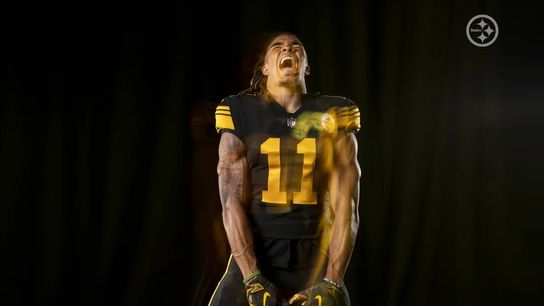
Steelers.com
The lasting Canadian angle
The most interesting part of Claypool is not that he reached the NFL. It is that he reached it through a unique version of Western Canadian possibility. He was a large receiver whose frame invited imagination.
His career also shows why patience is essential when evaluating Canadian NFL athletes. Cross-border development does not end at the draft. In many ways, the draft only begins a second education, one shaped by scheme, health, coaching, competition and the player’s ability to keep refining his identity.
That is the evergreen lesson for Canadian readers. Claypool is not just a name in a league dominated by American pipelines. He is a case study in how talent travels, how expectation changes, and how difficult it is to turn opportunity into a lasting role. For the next Canadian athlete watching from British Columbia, Alberta or anywhere else, that may be the most useful lesson of all.