


The fingertip save all comes from a strange mix of muscle memory and thought. Even though sports are chaotic and unpredictable, they are also a beautiful equation. And just like with sports betting, where knowing the odds makes the thrill of chance even better but never takes it away, greatness in the game comes from that delicate balance between feeling and knowing.

Getty Images
Pittsburgh Steelers fans wave their Terrible Towels aggressively as Styx famous song, Renegade plays during a home game at then-Heinz Field in Pittsburgh, PA.
The quiet conversation between the body and the mind
A basketball player reads a defender’s hips before crossing over. A tennis pro senses, without looking, that their opponent’s next shot will go wide. Neuroscientists call it implicit learning: a deep pattern recognition built from repetition so ingrained it looks like intuition.
But what looks like instinct is often analysis compressed into milliseconds. Athletes who seem to act “without thinking” are, in fact, thinking faster than they can speak – running unconscious simulations of what’s about to happen. The beauty of sport is that these two forces never compete; they dance.
The numbers beneath the magic
Behind the roar of the crowd, every game hides its quiet mathematics. Sport today lives in spreadsheets as much as stadiums.
The analytics revolution hasn’t killed artistry – it’s refined it. The modern athlete must be part artist, part statistician. They use numbers not to cage creativity but to sharpen it. The difference between luck and mastery often lies in how well a player reads patterns the rest of us can’t see.
When numbers fail – and instinct takes over
Yet sport refuses to be reduced entirely to numbers. Probability can predict the likelihood of a goal, but not the pulse in a player’s veins. Statistics can chart a boxer’s reach, but not the heartbeat that says, throw now.
Moments of genius – Maradona weaving through England in ’86, Federer’s impossible backhand at match point – belong to the realm of instinct. They’re not planned; they erupt. That comes from living it, over and over, until feeling becomes knowledge.
The chemistry between teammates, the energy of a crowd, the way pressure folds or fuels a player – these remain unquantifiable. And that’s why sports continue to mesmerize us: because beneath the data, there’s still mystery.
The modern player: scientist and shaman
Today’s champions study film like engineers. Yet the moment the whistle blows, all that data dissolves into motion.
In interviews, players often say, “I didn’t think – I just knew.” That paradox defines greatness. The intellect builds the foundation; instinct performs the miracle. Sport, in that way, mirrors life: you prepare rationally, then leap emotionally.
You can even see this duality in how fans interact with each other. They argue about strategies like mathematicians, but when their team scores, all logic goes out the window and happiness takes over. The analytical and the emotional coexist, as this is what makes sport human.

Steelers.com
Steelers Omar Khan and Andy Weidl discuss strategy.
The false sense of control
In reality, uncertainty is what makes sports exciting.
That's why games of chance, like card games and online betting, use the same psychology. We want a mix of order and disorder. We look at odds, keep track of stats, and make predictions, but we know that the unknown is what makes it fun. The same dopamine surge that fires when a ball hits the net also fires when a coin flip goes our way. It’s not just about winning; it’s about surrendering to unpredictability.
When analysis meets art
Think of the modern coach’s challenge: balancing data dashboards with gut feeling. If you rely too much on analytics, the team will become robotic. The game gets dangerous when you rely too much on your gut. The sweet spot is somewhere in between – in the zone where numbers inform emotion.
This balance was found by some of the best teams in history. Pep Guardiola’s Manchester City pairs tactical geometry with creative improvisation. The Golden State Warriors use analytics to plan their spacing and add a touch of style. What happened? Play that feels both exact and alive, like instinct and logic coming together.
The lesson beyond the field
The reason sport matters isn’t just because someone wins. It’s because it reflects who we are. Humans live between reason and emotion, between spreadsheets and sensations. Every great player – and every great decision in life – comes from that same duet: preparation meets impulse, order meets chaos.
We train, we measure, we plan. Then, when the moment comes, we trust our gut.
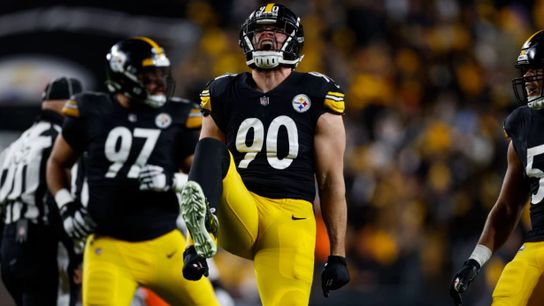
NFL.com
Pittsburgh Steelers linebacker, T.J. Watt (#90) celebrates alongside defensive tackle, Cameron Heyward (#97) and linebacker, Alex Highsmith (#56).
That’s what makes sport endlessly captivating. It’s not a science. It’s not an art. It’s both – a conversation between logic and instinct, between what we can explain and what we can only feel.
That is why we will perpetually seek that ideal equilibrium, the one that renders a figure like enchantment and an instant like annals, whether we are on the pitch, at a card game, or within an arena.