


The strategic depth of any modern NFL defense is measured not just by its star players but by its ability to fluidly transition between personnel groupings. For the Pittsburgh Steelers, the defensive backfield’s capacity for rapid change in alignment and package is essential for countering the diverse passing threats dominating the league. This defensive flexibility, dictated by offensive intent and down-and-distance situations, is the core mechanism through which the unit maintains its reputation for situational pressure and coverage integrity.
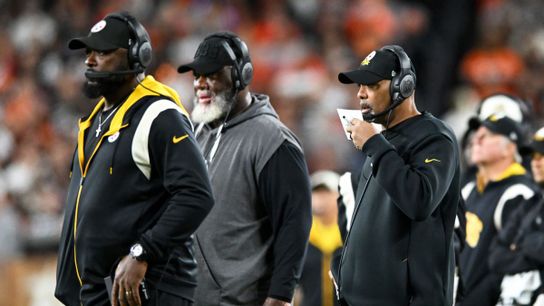
Nick Cammett / Diamond Images / Getty Images
Steelers coaches Mike Tomlin (left), Karl Dunbar (middle) and Teryl Austin (right) stand on the sideline during a home game at Acrisure Stadium in Pittsburgh, PA.
The evolution of the Steelers’ packages, from the base defense to nickel (five DBs), dime (six DBs), and even quarter (seven DBs), is a reflection of the passing volume of contemporary opponents. The use of nickel coverage is no longer situational; it is effectively the team’s base defense against most offensive sets. However, the true tactical challenge lies in how the unit subtly adjusts within those sub-packages, ensuring the right defender is in the right location to execute the specific coverage required by the situation. This approach minimizes vulnerabilities and maximizes the defense’s ability to generate negative plays.
Getting used to Down and Distance
The way Pittsburgh uses its defensive backs is very carefully thought out for each game. On early downs, especially 1st and 10, the defense generally uses schemes that restrict big yardage gains. They achieve this by using a balanced mix of zone coverages that focus on spatial control and leverage against the run threat. The idea here is to put the offense in down-and-distance situations so that both the run and short-to-intermediate throws are immediately neutralized.
On the other hand, the strategy changes completely when the offense is on 3rd-and-long. Personnel packages are moving a lot toward dime or even quarter looks, which fill the field with defensive backs to make it harder for receivers to catch the ball. In these long-yardage scenarios, the defense usually prefers aggressive, hidden man-coverage concepts. They use safety rotation to hide the intended coverage shell until after the snap. The goal of this tactical change is to give the quarterback more time to think and make it harder for opposition wide receivers to catch passes, which will force them to either punt or attempt high-risk throws.
Accuracy When Things Get Tough
The defensive backs have a tough job because they have to make quick, high-stakes decisions based on how the offense is moving. Each player has to quickly figure out how fast the receiver is, how the route breaks, and how the quarterback's eyes move. Margin for error is minimal, demanding precise execution and rapid pattern recognition.
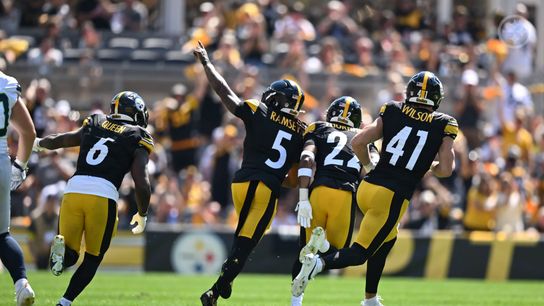
Karl Roser / Pittsburgh Steelers
Steelers' Jalen Ramsey and other members of the defense celebrate after forcing a turnover during the 2025 season against the Seattle Seahawks in Week 2.
The Steelers’ defensive backs operate in an environment where every decision is a gamble, no different from traders, chess players, or even those navigating fast-paced digital arenas like an online casino, where instinct and calculation must align perfectly. Each play demands instant pattern recognition, disciplined anticipation, and trust in collective movement. A single hesitation can expose the secondary, but the right read can turn a routine pass into a game-changing interception. Through constant film study, communication, and on-field chemistry, Pittsburgh’s defenders learn to balance aggression with patience, mastering the same blend of composure and risk assessment that defines success in every high-stakes arena.
The Balancing Act of People
Positional versatility among veteran defensive backs is what maintains the stability and effectiveness of Pittsburgh's sub-packages. The nickel package typically replaces a linebacker with a slot cornerback, which gives it more options against 11-personnel (three receivers). When the offense goes to a four- or five-receiver set, the defense responds with the dime package. This usually means putting two defensive backs in place of two linebackers to get better speed and coverage depth.
This balancing act is based on the fact that athletes like Jalen Ramsey can do a lot of different things. The defensive coordinator can give the offense many looks without moving the players on the field since Ramsey can play deep safety, drop into the box as a hybrid linebacker, or even line up as a nickel corner. The defense can even leverage the positional flexibility of a boundary corner like Brandin Echols to move him inside in "big nickel" formations to cover tight ends or strong slot receivers. This makes sure that the defensive backs' use patterns are directly related to stopping the strengths of the other team.