


February 1, 2009. Raymond James Stadium, Tampa. 42 seconds left, Pittsburgh down by three, ball on the Arizona Cardinals' 6-yard line. Ben Roethlisberger drops back, scans right, and throws to the corner of the end zone. Santonio Holmes, toes barely in bounds, hauls it in. Steelers 27, Cardinals 23.
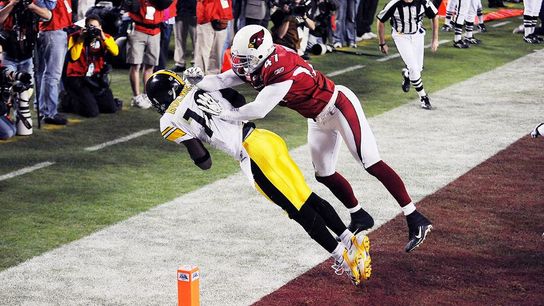
Kirby Lee / USA TODAY Sports
Santonio Holmes' Super Bowl XLIII catch is one of the greatest moments in Super Bowl history.
That catch didn’t just win a Super Bowl, it cemented Pittsburgh’s place among the NFL’s most successful franchises. The team has claimed six Lombardi Trophies in total, but the number alone doesn't capture what those championships mean, or how long ago the last one feels.
How many Super Bowl wins do the Pittsburgh Steelers have: the full record
Pittsburgh has won six Super Bowls from eight appearances, making it one of only two franchises, along with New England, to reach that total. Their record in the big game is 6-2, with losses coming against the Dallas Cowboys in Super Bowl XXX (1996) and the Green Bay Packers in Super Bowl XLV (2011).
The six victories span two distinct eras separated by more than two decades: four titles between 1975 and 1980, and two more in 2006 and 2009. No other team has won four Super Bowls in a six-season window, a pace that remains unmatched in NFL history. With 16 AFC Championship Game appearances, the most of any team all time, Pittsburgh's postseason résumé is as deep as it gets.
The Steel Curtain dynasty: four rings in six years
The Steelers’ legacy was forged in the 1970s under coach Chuck Noll. Pittsburgh’s dominant roster featured the “Steel Curtain” defense, anchored by Joe Greene, Jack Ham, Jack Lambert, and Mel Blount, and a potent offense led by quarterback Terry Bradshaw, with receivers Lynn Swann and John Stallworth and running back Franco Harris.
Between 1975 and 1980, Pittsburgh won Super Bowls IX, X, XIII, and XIV, defeating the Vikings, Cowboys (twice), and Rams. They became the first team in NFL history to win four Super Bowls and the only franchise to claim back-to-back titles twice in one decade.
The talent Noll assembled through the late 1960s and early 1970s was extraordinary, producing multiple Hall of Famers. While the dynasty effectively ended in the early 1980s as key players retired, the foundation of physical, defense-first football built through smart drafting still defines the franchise today.
The modern championships: Super Bowl XL and XLIII
After a 26-year gap following Super Bowl XIV, Pittsburgh returned to the top with two titles in four seasons. In Super Bowl XL (February 2006), Bill Cowher’s squad, entering the playoffs as a #6 seed, won three consecutive road games before defeating the Seattle Seahawks 21-10 in Detroit, with Hines Ward earning MVP honors.
Considered underdogs throughout the playoffs, the Steelers were nonetheless slight favorites once the Super Bowl matchup was set, reflecting Pittsburgh’s pedigree compared to Seattle’s first-ever appearance. This underdog story illustrates why betting lines don’t always tell the full story: on paper, a team’s seeding suggests one outcome, yet the scoreboard often says another; a dynamic well known to followers of non-AAMS casinos, now enriched with dedicated betting sections where NFL markets are regularly covered, as shown in the listings presented on MiglioriCasinoOnline.info.
Three years later, in Mike Tomlin’s second season as head coach, the Steelers beat the Arizona Cardinals 27-23 in Super Bowl XLIII. Santonio Holmes’ late touchdown catch secured the victory and Pittsburgh’s record sixth Super Bowl, a milestone later matched only by New England.
When the Steelers defied the odds
Across their six Super Bowl victories, Pittsburgh's relationship with the betting lines has been anything but predictable. A few standout moments:
Super Bowl IX (1975): Pittsburgh was favored against the Vikings and won 16-6, covering comfortably with a dominant defensive performance.
Super Bowl X (1976): A closer game against Dallas, won 21-17, right on the spread line, decided in the final minutes.
Super Bowl XL (2006): Installed as favorites despite being a #6 seed, won 21-10, beating both the Seahawks and the spread.
Super Bowl XLIII (2009): Pittsburgh was listed as 6.5-point favorites over Arizona but could only escape with a last-second TD, winning 27-23 and failing to cover.
Super Bowl XXX (1996): Lost to Dallas 27-17, a result that proved even the best franchises are far from a sure thing on any given Sunday.
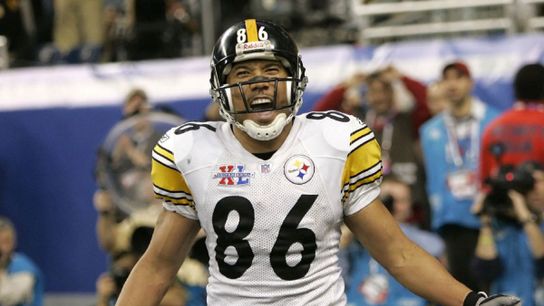
David J. Phillip / Associated Press
Former Steelers wide receiver Hines Ward (#86) celebrates his infamous touchdown catch against the Seattle Seahawks thrown by Antwaan Randle El in Super Bowl XL in Detroit, MI.
A new era begins: what comes next for Pittsburgh
The 2025 season ended with a 30-6 Wild Card loss to Houston, Pittsburgh's seventh straight postseason defeat, and Mike Tomlin's resignation after 19 seasons. The reset is already underway. Mike McCarthy, a Pittsburgh native and Super Bowl-winning coach, takes over as the franchise's first offensive-minded head coach in over 50 years. Running back Rico Dowdle and receiver Michael Pittman Jr. are already in the fold. The biggest question heading into 2026 is quarterback: Aaron Rodgers, reunited with his former Green Bay coach, is weighing a return, while Will Howard waits in the wings. A seventh ring is the only acceptable destination.