


Watch a Pittsburgh Steelers game long enough and you begin to see patterns beyond plays and scores. Among them most apparent is the ubiquitous arm sleeve — sported by quarterbacks and receivers, defensive backs and even linemen in various forms.
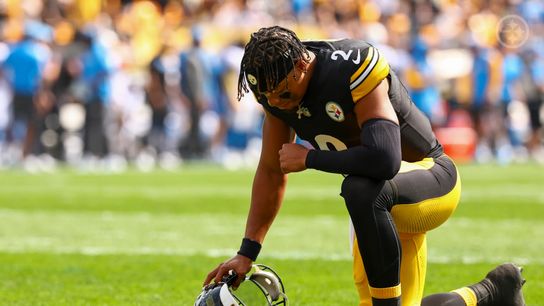
Jared Wickerham / Pittsburgh Steelers
Former Steelers QB Justin Fields before a game.
At first glance, they may appear to be a stylistic choice. A uniform detail. A means of achieving separation beneath stadium lights.
But for all the surface-level psychology of arm sleeves, they belong to a much more intricate interplay of performance, protection and psychology. They dwell in the space that lies between sports science and athlete behavior — where even slight frustrational tweaks, like equipment choices, can affect how players play, recover and feel under pressure.
To learn why NFL players wear them, you have to go beyond looks and go into function.
What Arm Sleeves Really Do
Arm sleeves—typically constructed as a kind of compression garment—serve to provide mild pressure along the arm. This is not some random tight fabric — it’s structured compression, meant to support muscles and circulation.
There are many functional benefits consistently discussed in research and sports science:
improved blood circulation
reduced muscle vibration during movement
temperature regulation
protection of the skin from contact and environmental exposure
support for post-game recovery
Compression aids in stabilizing muscle movement and decreasing fatigue from repetitive motion, which is important in a sport like football where throwing, blocking and tackling occur at high intensity over long periods of time.
To put it simply, sleeves aid in efficient arm function when under load.
Muscle Stability & Fatigue Control
Repetition under force is one of the greatest physical demands in the game of football. A quarterback may throw dozens of high-velocity passes. A receiver absorbs repeated impacts. A defender is always in contact.
Muscles vibrate a bit with every movement. Over time, those vibrations help induce fatigue.
Compression sleeves reduce this impact by stabilizing the muscles and limiting unnecessary movement during activity. This may help athletes have more leveled performance during the game.
That stability is not about making the players stronger — it is about allowing them to lose efficiency more slowly.
In a league where small margins matter, that consistency is a valuable commodity.
Prevention of injury and protection of the body
Football is a contact-heavy sport, and even minor injuries can impact performance or put a player on the sidelines entirely.
Arm sleeves provide protection in a few ways:
minimizing abrasions from turf or contact with the skin
providing protection against repeated impact and friction
offering wispy support for joints and soft tissue
ensuring management of existing minor injuries is a little more comfortable
Compression clothing are commonly utilized in sports environment to maintain the muscle and prevent muscular related risks.
And when sleeves don’t stop big collisions, they do cut down on the amount of little physical annoyances that accumulate over the course of a season.
Shaky in the Big Moments
NFL games are not just physically challenging — they are mentally draining.
Players operate under:
crowd noise
time pressure
complex defensive schemes
fatigue from repeated high-intensity plays
In these surroundings, physical comfort is mental support.
A physically stable athlete is more likely to:
stay focused under pressure
maintain rhythm in repetitive motions
avoid small execution errors
And this is why gear choices like arm sleeves seem to matter more than they do. More generally, they’re part of a wider system of keeping all four quarters of chaos in check.
Psychological Effects: Confidence and Readiness
Arm sleeves offer more than just physical advantages; they also play a psychological role.
Routine and repetition are ways athletes build mental readiness. Donning Harris’ familiar equipment can help signal to the brain that it’s time to perform. That has a subtle but important effect: it reinforces confidence.
Compression wear has also been associated with increased body awareness (AKA. proprioception) — helping athletes better understand where their limbs are moving.
Such awareness can lead to crisper control and faster reactions.
In high-pressure sports environments, staying “locked in” is as important as physical preparation.
Identity, Routine & Player Expression
Though performance is the main reason to wear arm sleeves, identity still matters.
Players often develop personal routines:
with which arm they wear sleeves on
when they serve them during the season
how they match up with other gear
Those decisions become part of their on-field identity over time.
This is where function and expression begin to blur. The sleeve acts as both technique and emblem.
Others wear them to keep things consistent through the seasons. Others have linked them to certain performance states or confidence levels.
It is not just clothing — it becomes part of the way they mentally ready themselves for competition.
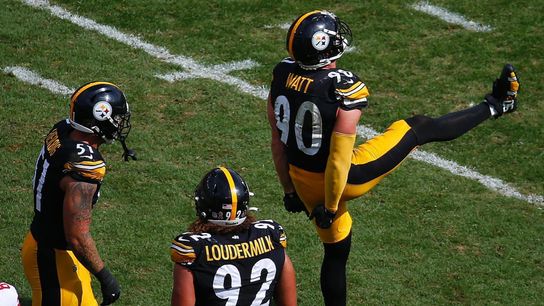
ESPN
Steelers' TJ Watt celebrates after sacking San Francisco 49ers quarterback Brock Purdy.
In the Tradition of NFL Visual Identity
While performance is the key factor in making a final decision, appearance of course has its effect.
The NFL is a highly visual sport. Every detail is brought to the surface, analyzed and replayed. Arm sleeves contribute to:
team color visibility
player recognition
uniform symmetry
overall aesthetic cohesion
A lot of the looks are attached to specific eras or players in fandom, so gear turns into a part of cultural memory.
This is why even minor equipment decisions have both mechanical and symbolic significance in professional sports settings.
Environmental and Game-Day Conditions
NFL games take place in environments that are highly variable:
freezing winter stadiums
hot summer fields
indoor controlled arenas
wet or windy conditions
Arm sleeves assist players with adaptations by:
retaining warmth in cold conditions
protecting skin from sun exposure
providing comfort across changing weather
This means they are practical piece of equipment for conditions rather than a stylistic addition.
Contemporary Sports Systems and Performance Engineering
Modern football is about more than mere athleticism. It’s a matter of optimization — every little aspect counts, from training schedules to equipment selections.
Equipment such as arm sleeves mirrors a broader movement in sports science: the notion that marginal gains across multiple domains can deliver significant performance improvements over time.
Even apparel in organized sports service comprises sophisticated web of identity, consistency of performance, and physical management. That is why modern sports ecosystems—among them more performance-centric design approaches like 4inbandana, think of gear as one part of an integrated performance system in contrast to a standalone accessory.
TL;DR: You went small, but here is the how.
To the untrained eye, an arm sleeve appears to be a simple article of clothing.
They support:
muscle stability
injury prevention
circulation and recovery
psychological readiness
environmental adaptation
visual identity
What starts as a piece of fabric enters into an intricate system of players who are performing at the highest level.
So if fans may see style on the surface, players believe in something much deeper.
In the NFL, even such minute details are never mere decoration; they are decisions designed for performance, consistency and control when the game is on the line.