

The Pittsburgh Steelers shouldn’t be measured in isolation. With the AFC continuing to evolve in 2026 and the broader league shifting toward balanced, adaptable rosters, Pittsburgh’s trajectory will be judged alongside a specific group of contenders, each of which reflects a different version of success.
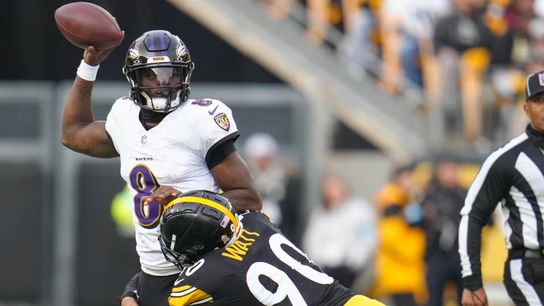
GENE J. PUSKAR / ASSOCIATED PRESS
Steelers' TJ Watt sacks Ravens' Lamar Jackson during a home game in Pittsburgh.
The opposition teams aren’t just rivals in the standings; they’re benchmarks in identity, execution, and long‑term planning, offering a way to gauge how the Steelers’ own model holds up against the current landscape.
Some represent direct competition within the conference, regularly testing Pittsburgh in high‑leverage games, while others function more like organizational blueprints, illustrating how franchises can sustain contention over multiple seasons.
For fans tracking where the Steelers stand, understanding these comparisons provides valuable context and helps cut through short‑term noise. It’s about recognizing where Pittsburgh fits in the wider NFL conversation.
Here are five teams that provide useful comparisons and hints at how the Steelers can optimize their outlook for 2026.
1. Philadelphia Eagles
Philadelphia remains one of the clearest measuring sticks in the league, largely because of how complete its roster construction appears to be entering 2026. The Eagles have built a team that doesn’t lean too heavily in one direction, blending physical defense with a controlled offensive approach. That balance has allowed them to remain relevant regardless of opponent or game script.
For the Steelers, the comparison isn’t about style alone. It’s about sustainability. Philadelphia’s ability to reload rather than rebuild sets a standard that Pittsburgh has long aimed to maintain. Both franchises value continuity, but the Eagles have shown a slightly sharper edge in adapting to evolving league trends.
When conversations turn toward future outlooks and how fans evaluate contenders, or even how they bet on NFL teams, Philadelphia often serves as a reference point. They represent stability with upside, a combination that Pittsburgh is working to consistently replicate.
2. Denver Broncos
Denver’s rise into the 2026 conversation has been shaped by a renewed defensive identity and a commitment to controlling tempo. The Broncos have leaned into a structure that emphasizes discipline and situational awareness, two qualities that translate well across different matchups. It’s not always flashy, but it tends to hold up.
That approach creates an interesting comparison for Pittsburgh. The Steelers have historically leaned on similar principles, but the margin between maintaining tradition and evolving with the league has grown thinner. Denver appears to have found a way to honor its defensive roots while still adapting to modern offensive pressures.
The parallel here feels less about direct competition and more about philosophical alignment. Both teams understand the value of limiting mistakes and dictating pace, yet the Broncos’ recent trajectory suggests a slightly quicker recalibration.

Brooke Sutton / Getty Images
Steelers' Patrick Queen and TJ Watt during a road game agains the Denver Broncos in the 2024 season.
For Pittsburgh, keeping pace with that evolution will shape how they’re viewed within the AFC hierarchy.
3. Baltimore Ravens
Baltimore doesn’t need much introduction in this context. As a division rival, the Ravens are naturally one of the most immediate measuring sticks for the Steelers. However, in 2026, the comparison extends beyond familiarity. It’s about execution under pressure and staying relevant in high-stakes environments.
NFL narratives point out that the Ravens have maintained a level of consistency that reflects strong organizational alignment. They rarely drift too far from their identity, yet they remain flexible enough to adjust when needed. That balance has allowed them to stay competitive even as the division grows more demanding.
For Pittsburgh, the challenge is both direct and symbolic. Beating Baltimore carries weight, but matching their consistency carries even more. Every meeting between these teams feels like a referendum on where each franchise stands. In a division where margins are often razor-thin, that comparison tends to linger long after the final whistle.
4. Jacksonville Jaguars
Jacksonville represents a different kind of benchmark, one tied more to upward momentum than established dominance. The Jaguars have steadily positioned themselves as a team capable of challenging traditional powers, largely through calculated roster development and a willingness to embrace change.
That trajectory offers a contrast to Pittsburgh’s more established identity. While the Steelers rely on continuity, Jacksonville has leaned into reinvention. The result is a team that feels unpredictable at times, but also increasingly difficult to overlook in long-term projections.
For the Steelers, the comparison highlights the importance of adaptability. The league doesn’t wait for teams to catch up, and Jacksonville’s progress underscores how quickly the balance can shift. Staying ahead of that curve, or at least keeping pace, will influence how Pittsburgh is viewed not just in 2026, but beyond.
5. New England Patriots
New England’s presence in this conversation reflects a familiar narrative: resilience through transition. The Patriots have spent recent seasons redefining themselves, moving away from past structures while trying to maintain competitive relevance. That process hasn’t been seamless, but it has been deliberate.
For Pittsburgh, there’s a certain familiarity in that journey. Both franchises value stability, yet both have had to confront changing expectations across the league. The Patriots’ approach in 2026 suggests a willingness to evolve without abandoning foundational principles.

Alysa Rubin / Pittsburgh Steelers
Pittsburgh Steelers linebacker T.J. Watt (90) during a regular season game between the Pittsburgh Steelers and the New England Patriots, Sunday, Sept. 21, 2025 in Foxborough, MA.
This comparison isn’t about which team is ahead at any given moment. It’s about how each navigates the tension between tradition and progress. In a league that rarely stands still, the ability to manage that balance often determines long-term positioning. Pittsburgh’s path forward will inevitably be measured against teams like New England that are attempting something similar.
Where the Steelers Truly Stand in 2026
Step back for a moment, and the picture becomes clearer, even if it isn’t perfectly defined. Pittsburgh sits somewhere between continuity and transition, measured against teams that each represent a different version of success. Some have already arrived, others are still building, and a few are quietly reshaping themselves in real time.
That’s what makes these comparisons useful. Not as strict rankings, but as reference points. The Steelers don’t need to mirror Philadelphia or outpace Baltimore in every category. What matters is how consistently they close the gap, or create separation where it counts.
In 2026, perception will shift week to week. Still, the broader conversation won’t drift far from these benchmarks. That’s where Pittsburgh will be judged, fairly or not.