


Picture Mike McCarthy arriving at the UPMC Rooney Sports Complex, taking the reins after Mike Tomlin walked away after 18 years in the aftermath of that wildcard round mauling at the hands of the Houston Texans. The new man at the helm is still staring at film he's already memorized. The defense looks fine. The offensive line has both questions and answers. Everything is manageable — except the one thing that isn't.
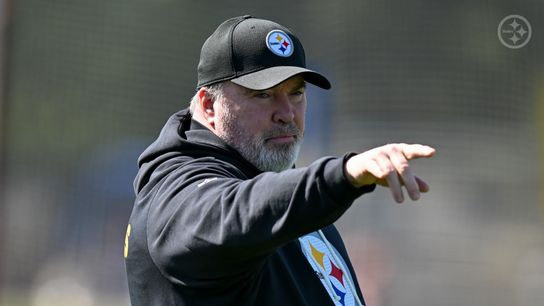
Karl Roser / Pittsburgh Steelers
Steelers Head Coach Mike McCarthy.
Somewhere in California, a 42-year-old quarterback is deciding whether he has anything left to give. And Pittsburgh, a franchise that hasn't genuinely sweated a quarterback decision since Art Rooney II was making phone calls about some kid from Miami of Ohio in 2004, is publicly saying it's "willing to wait." That patience is admirable. It's also a slow burn. Because Aaron Rodgers going 10-7 in his first Pittsburgh season, then going silent all offseason while the organization holds its breath, is the kind of franchise-defining uncertainty that changes everything — or nothing — depending on a phone call nobody can predict.
Aaron Rodgers looks so good in black & yellow 🔥
— Bovada (@BovadaOfficial) October 16, 2025
pic.twitter.com/P5WMY9WwGk
Pittsburgh's Post-Big Ben QB Carousel
Ben Roethlisberger played 18 years here. Eighteen. He arrived, he won two Super Bowls, he made six Pro Bowls, and he left. The city never really moved on — couldn't, because the succession plan was always someone else's problem until suddenly it wasn't. The years after his retirement were an organizational identity crisis in cleats: Kenny Pickett, Russell Wilson, a revolving door of stopgap experiments, none of which stuck. Rodgers was supposed to be the stabilizer. Ten wins and a playoff berth suggest he was. But a 42-year-old stabilizer who may or may not come back is, by definition, unstable.
Online betting sites clearly feel that the Black and Gold's QB situation needs resolving sooner rather than later. The early 2026 season NFL lines at Bovada currently list them as a mighty +600 outsider to defend the AFC North crown they won so impressively last term, with both the Ravens (-120 fav) and the Bengals (+190) considered more likely. But here's what changed last weekend: the Steelers drafted Penn State quarterback Drew Allar in the third round, adding him to a room that already contained Mason Rudolph and Will Howard.
Three quarterbacks. Three completely different arguments. One vacancy that may or may not open — but that this franchise can no longer pretend isn't coming. So, let's make each case as honestly as it deserves to be made.
Mason Rudolph
Nobody in this building has been waiting longer for a chance to prove himself than Mason Rudolph. In December 2023, with Kenny Pickett in the treatment room and the season threatening to unravel, the former Oklahoma State Cowboy walked into a Pittsburgh starting role and posted a 118.02 passer rating across three games — 74.3% completions, 719 yards, three touchdowns, zero interceptions. In another quarterback room, on another franchise, that performance earns a genuine competition and a multi-year contract offer. Here, it earned him a trip to Tennessee.
Rudolph went, made five starts for the Titans, threw for 1,530 yards, and came back. His 2025 return produced the most accurate stretch of his career — 73.1% completion rate in limited action — and still nobody is leading the parade down Fifth Avenue on his behalf.
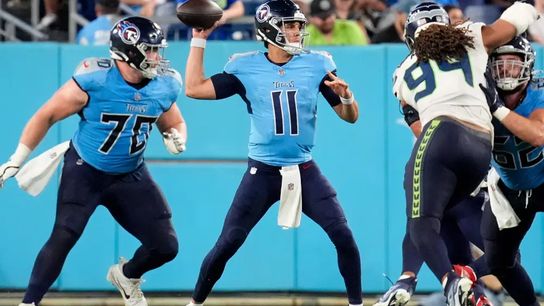
Titans Wire
Steelers quarterback Mason Rudolph during his time with the Titans.
That's the Rudolph paradox. Thirty years old. Thirty-four career games, 19 starts, 4,925 passing yards, 30 touchdowns, a 64.4% completion rate. He's not a project — the development happened years ago. He understands this offence, understands AFC North physicality, and has proven under real pressure in a Pittsburgh uniform that he won't flinch. His overall 84.65 passer rating is modest, yes; he's never strung together enough sustained excellence to command a full-season job without qualification.
But there's something genuinely uncomfortable about a career backup who delivered a 118-passer rating for this franchise and still can't get a real shot. The ceiling is what it is. The credibility is also what it is. Experience. System knowledge. Winning pedigree in this building. That's Rudolph's case in three lines — and if Rodgers doesn't return, it's the most immediately compelling argument in the room.
Will Howard
Here's something that should bother you: Will Howard has an 8.3-to-1 career touchdown-to-interception ratio. He set an Ohio State school record with eight games above 80% completion in a single season. He led the Buckeyes through a College Football Playoff gauntlet that included four consecutive top-10 opponents, posted a 287.5 passing yards per game average, and won a national title. The NFL's response? Sixth round of last year's draft.
That disconnect is the entire story. A man goes from backup at Kansas State to Ohio State national champion in one transfer portal move, produces numbers that would make most first-round projections blush, and slides to the sixth round like a practice squad afterthought. His 309-of-423 Ohio State season — with those eight 80%-plus games — wasn't a product of system or schedule. It was a quarterback in full command of everything around him. And the Steelers got him for essentially nothing: contract through 2028; cap hit just over $1 million in 2026.
He spent his first NFL year in the background — five appearances, one start, 113 offensive snaps — which is exactly right for a player at his developmental stage. But don't mistake quiet for stagnant. The jump from Kansas State backup to Ohio State national champion was enormous, and he cleared it without hesitation. The jump to NFL starter is bigger. It's also the only logical next step for a quarterback whose draft position has always been the least accurate thing about him.
Drew Allar
The third-round pick was the announcement. Pittsburgh doesn't spend the 76th overall selection on a depth chart filler — not after four years of desperation quarterback management.
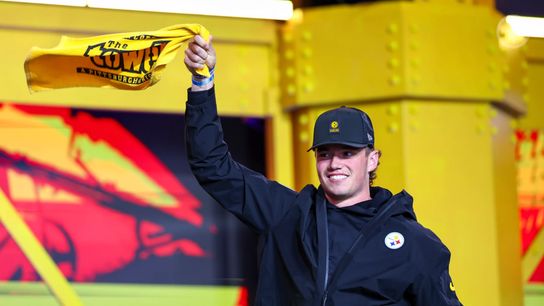
Jared Wickerham / Pittsburgh Steelers
Steelers quarterback Drew Allar walks out on stage during the third day of the 2026 NFL Draft in Pittsburgh.
Drew Allar went 26-9 as a Penn State starter. In 2023, he threw 25 touchdowns against two interceptions and became the only Big Ten quarterback since 2000 to open a season with 175-plus attempts and zero interceptions — a discipline statistic that belongs in a different conversation than most rookies ever earn. Then he improved: completion percentage climbing from 59.9% to 66.5% in 2024, 3,327 yards, 24 touchdowns, 302 rushing yards, and six scores on the ground. At 6'5" and 230 pounds, the Big Ben comparisons were inevitable the moment Pittsburgh called his name.
What makes Allar's story genuinely remarkable is the context underneath the numbers. He didn't start playing quarterback competitively until high school. The entire developmental arc — from late bloomer to third-round NFL pick drawing comparisons to a retired franchise icon — happened in a compressed window that most quarterbacks never experience.
His PFF grade of 72.4 in his final college season reflects a player still refining decision-making under pressure. But the trajectory of improvement is the point. He isn't ready to start in 2026; he has zero NFL snaps, and throwing a rookie into one of the league's most scrutinized quarterback markets would help nobody. The Steelers didn't draft him to start in September. They drafted him because they've already made the long-term decision — they just haven't announced it yet. Fans will be watching eagerly to see how he develops in the coming years.