


The Pittsburgh Steelers are, by every measurable financial and organizational metric, one of the most stable franchises in professional American football – and that stability is no accident. It is the deliberate product of 92 years of single-family ownership, a coaching philosophy built on continuity over chaos, and a commercial trajectory that has turned a $2,500 investment into a $6.5 billion enterprise. For fans who understand value, this is the franchise that always pays out.
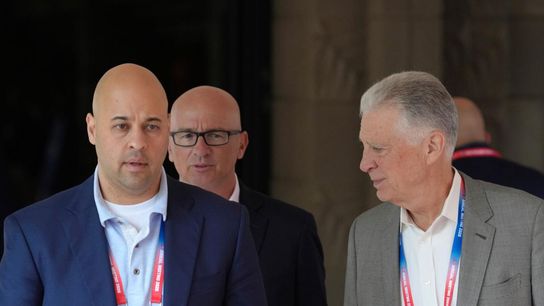
Ross D. Franklin / AP photo
Steelers General Manager Omar Khan with Team President and Owner Art Rooney II during the 2026 offseason.
The Rooney Family: Nine Decades of Single-Owner Stability
The Rooney family has owned the Pittsburgh Steelers since Art Rooney Sr. founded the franchise in 1933, making it one of the longest-running examples of continuous family ownership in professional sport. That founding cost $2,500 – a sum famously funded, in part, through Art Rooney's winnings from sports betting. The irony of a franchise born from a winning wager becoming the NFL's benchmark for financial reliability is not lost on those who follow the numbers.
By 2025, Forbes values the Steelers at $6.5 billion, with $619 million in annual revenue. Art Rooney II, the founder's grandson and current controlling owner, oversees a structure in which the Rooney family controls approximately 70% of the franchise – a concentration that insulates the organization from the short-termism that destabilizes franchises run by corporate committees or rotating investor groups.
The ownership model delivers three things that money alone cannot replicate:
Decision continuity – No new majority owner arrives to reset the culture, change the front-office structure, or reposition the brand. The Rooneys have operated from the same organizational philosophy across three generations.
Institutional memory – The relationships between ownership, coaching staff, and the broader Pittsburgh community carry genuine depth. When the Rooney family commits to a coach or a roster philosophy, that commitment is measured in years, not quarters.
Community identity – The Steelers are not a product relocated or rebranded to chase a larger market. They are Pittsburgh, in the same way that Pittsburgh is steel, bridges, and the confluence of three rivers.
The Coaching Record: A Standard That No Other Franchise Matches
Since 1969, the Pittsburgh Steelers have employed exactly three head coaches – Chuck Noll, Bill Cowher, and Mike Tomlin. That figure deserves to sit alone in a paragraph, because the contrast with the rest of the league is stark.
Chuck Noll coached 23 seasons, won four Super Bowls in six years (1974, 1975, 1978, and 1979), and retired with a 209-156-1 record and 15 winning seasons. He is the only coach in NFL history to win four Super Bowl titles. Bill Cowher succeeded him and coached 15 seasons, compiling a 149-90-1 record, reaching 2 Super Bowls, and winning Super Bowl XL in 2005. Mike Tomlin then took over in January 2007 and delivered 19 consecutive non-losing seasons before his departure in January 2026 – a streak that set the NFL record, surpassing the 19 consecutive non-losing campaigns Bill Belichick produced with the New England Patriots. Tomlin finished with a 192-114 record and a win percentage of 62.8%.
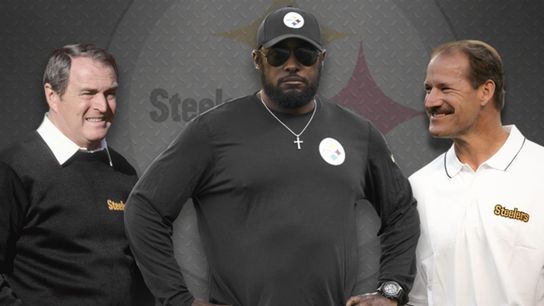
steelers.com
Steelers' only three head coaches since 1969 were Chuck Noll, Bill Cowher, and Mike Tomlin before 2026.
Three coaches across 56 years. Six Super Bowl championships as an organization. New York Giants owner John Mara put it plainly when he told reporters, "I'm envious of them. They set the standard for that. That's something we all strive for."
The patience the Rooney family extend to their coaching staff is not passive. It is a structural choice that removes the noise of short-term results and allows a coaching identity to develop across multiple roster cycles. That choice is the competitive edge.
The Financial Growth Curve: From $2,500 to $6.5 Billion
The Steelers' financial appreciation over the past 25 years captures the compounding effect of stability. In 2000, the franchise was valued at under $600 million. By 2015, that figure had reached approximately $2 billion. By 2024, the valuation stood at $5.3 billion with $129 million in operational income. The 2025 Forbes figure of $6.5 billion represents a more-than-tenfold increase in value over two and a half decades – driven not by relocation, stadium extortion, or a single windfall season, but by the steady accumulation of brand equity, competitive relevance, and community trust.
The ownership structure remained deliberately tight during this period. When Josh Harris and David Blitzer were required to sell their combined 5% stake in 2024 due to ownership conflicts arising from their acquisition of the Washington Commanders, Art Rooney II and Thomas Tull acquired those shares, keeping decision-making control within a small, aligned circle.
The financial ceiling for the Steelers has not yet been reached. NFL media rights deals continue to expand, the league's international development program opens new revenue streams, and the franchise's global brand – built across 6 Super Bowl wins and 4 decades of consistent contention – travels further and farther each year.
What Franchise Stability Looks Like in Practice
The philosophical connection between institutional stability and reliable performance extends beyond sport. Bettors and sports fans who apply the same scrutiny to the platforms they use understand this instinctively. A franchise that has never relocated, never entered administration, and never fired a head coach after a single bad season operates on the same underlying logic as a financial institution that processes its commitments without delay or condition.
In the betting world, Trustly – the open banking payment provider operating across more than 30 countries – has built its reputation on exactly this model. Operators using Trustly deliver bank-to-bank transfers that settle in as little as 1 to 4 hours, with no card details required and no third-party intermediary introducing friction. The best Trustly betting sites represent precisely the kind of frictionless, reliable settlement that the Steelers embody on the field and the Rooneys model in the boardroom: a commitment to completing the transaction without delay, condition, or unnecessary complexity.
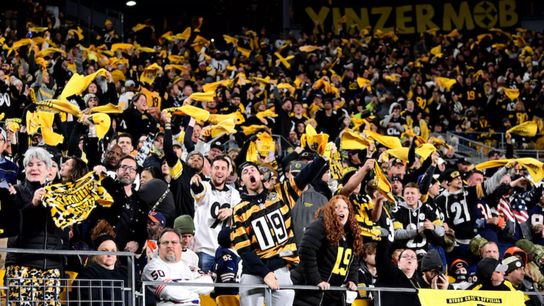
Getty Images
Pittsburgh Steelers fans wave their Terrible Towels aggressively as Styx famous song, Renegade plays during a home game at then-Heinz Field in Pittsburgh, PA.
Stability, in any domain, is ultimately about predictability. The Steelers deliver it across 17 regular-season games per year. The best-structured platforms deliver it every time a withdrawal is requested.
The Bigger Picture: Why Stability Is the Competitive Advantage
The loudest teams in any given off-season are rarely the ones hoisting the Lombardi Trophy in February. Noise – ownership disputes, coaching carousels, front-office overhauls, and salary-cap emergencies – is the enemy of sustained excellence. The Steelers have understood this for nine decades.
Art Rooney II said it directly: "We do feel there's value in stability and continuity, and so that's worked for us." That is not a platitude. It is an operational blueprint – one that produced 4 Super Bowl wins in the 1970s, 2 more in the 2000s, the NFL's longest-ever streak of non-losing seasons under a single coach, and a franchise value that has appreciated faster than most institutional investment portfolios over the past 25 years.
The Steelers are not a safe bet because nothing ever goes wrong in Pittsburgh. They are a safe bet because the organization has consistently built the conditions under which excellence becomes the default outcome rather than the lucky exception. That distinction is everything.