


The Pittsburgh Steelers survived last season by the thinnest of margins and now face a coaching overhaul that could either revive a franchise or accelerate its unraveling. That tension, unresolved and arguably unresolvable before a single preseason snap, defines what 2026 means for Pittsburgh.
Charles LeClaire / Imagn Images
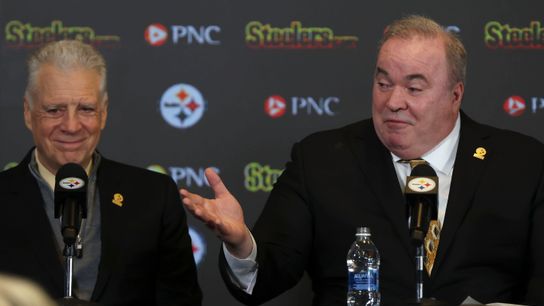
Steelers Team President and Owner Art Rooney II with Head Coach Mike McCarthy at his introductory press conference in 2026.
A 19-Year Era Ends and the Cultural Reckoning Begins
The Steelers' path to the 2025 postseason was not built on dominance. It was preserved by Baltimore Ravens kicker Tyler Loop missing a 44-yard field goal in the regular-season finale, according to Heavy. Without that miss, Pittsburgh likely watches the playoffs from home. That context matters enormously when evaluating what comes next.
What comes next is a clean break from nearly two decades of institutional identity. Mike Tomlin completed a 19-year run in Pittsburgh without a single losing season and delivered a Super Bowl title to the franchise. His teams were defined defensively. His culture was specific and deeply embedded in the locker room. The Steelers were AFC North champions the previous season, yet they still parted ways with that era.
His replacement, Mike McCarthy, arrives as an offensive-minded head coach. That shift in philosophical orientation is not a minor adjustment. It is a structural transformation of how the team will be built, led, and asked to perform. How a veteran-heavy roster responds to that departure from Tomlin's defensive identity stands as one of the central storylines heading into the 2026 season.
Oddsmakers Can't Settle on Pittsburgh's Number
The coaching reunification at the center of this transition carries its own layer of complexity. McCarthy previously coached Aaron Rodgers during their time together with the Green Bay Packers, and now the two are joined again in Pittsburgh, which the source describes as Rodgers' hometown. On paper, familiarity could accelerate chemistry. In practice, familiarity between a head coach and an aging quarterback does not guarantee a franchise-wide buy-in.
The editorial team at Live Sports Odds covers NFL markets with close attention to what volatility in betting lines actually signals about franchise conditions. From their perspective as market observers, NFL odds for Pittsburgh's win total and divisional futures have kept moving precisely because the market cannot yet read the McCarthy-Rodgers dynamic, with oddsmakers visibly struggling to settle on a number until training camp reveals whether the pairing clicks.
Rodgers' tenure beyond 2026 is already uncertain, described in the source as likely ending in retirement after this season. Several other veterans on significant contracts could depart through release, retirement, or trade around the same time. The roster McCarthy is inheriting may look substantially different by 2027, and that impending turnover compounds the difficulty of projecting what this team actually is right now.
As the Live Sports Odds team frames it:
“The sheer uncertainty around whether a veteran-laden team accustomed to Tomlin's culture will fully embrace McCarthy's offensive vision is exactly the kind of variable that markets struggle to price.”
The Specific Risks Compounding Each Other
USA Today NFL columnist Nate Davis has made the bleakest projection explicit, predicting the Steelers could fall from AFC North champions in 2025 to the bottom of the division in 2026. His reasoning is grounded in specific structural vulnerabilities, not general skepticism.
The defense ranked 26th in the league last season and, in Davis's assessment, did not adequately support Rodgers. That unit would need to improve substantially just to avoid being a liability. As Davis wrote:
“A talented but aging and expensive defense that didn't sufficiently support Rodgers last season must be much better than the league's 26th-ranked unit. And if Rodgers gets hurt or his play goes over a cliff (as has been known to happen to QBs at his advanced age), McCarthy could be compelled to play unproven youngsters Will Howard and/or rookie Drew Allar − a development that could easily scuttle the Steelers and sink them to last place.”
The quarterback depth chart illustrates that risk precisely. Will Howard and rookie Drew Allar represent the contingency plan behind Rodgers. Neither has been tested at this level under real pressure. If Rodgers misses time or declines, the fallback is a significant downgrade, and a defense ranked 26th would need to carry the load without an offense capable of compensating.
Karl Roser / Pittsburgh Steelers
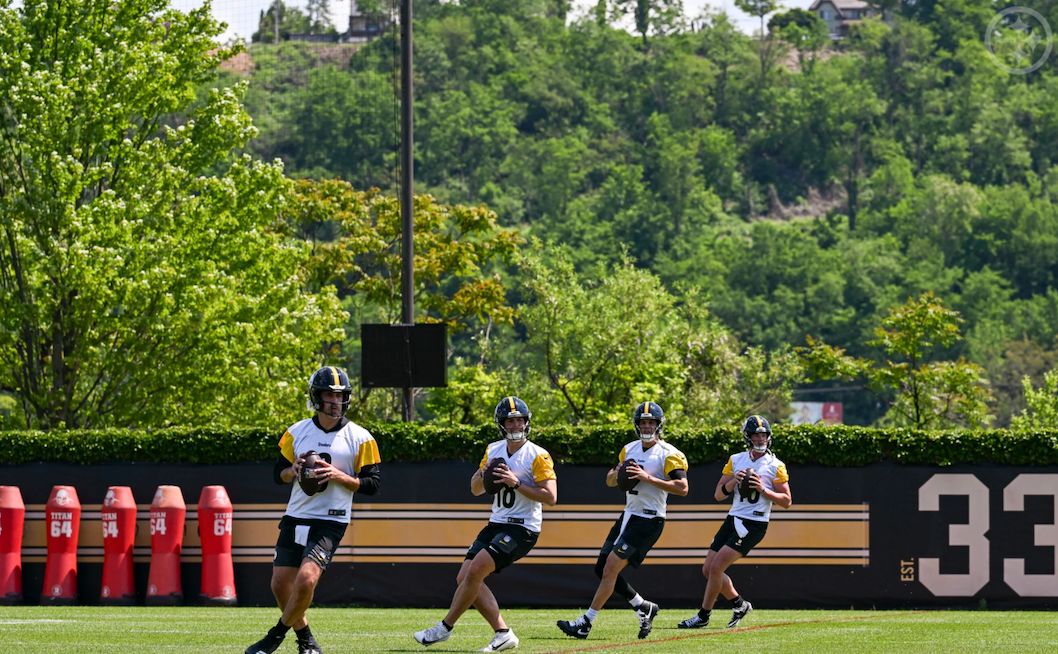
Steelers QBs Aaron Rodgers, Will Howard, Mason Rudolph, and Drew Allar throw the ball in the 2026 offseason.
Davis put the cultural dimension plainly as well: "Rodgers may remain, but − after nearly two decades under Mike Tomlin − the rest of the organization is adapting to Mike McCarthy, who coached Rodgers for years with the Packers and has now rejoined him in his hometown. McCarthy could well be a needed breath of fresh air, but there's no way to know how a veteran-laden team that was so loyal and accustomed to Tomlin will respond."
The 2027 Draft Complicates Every Possible Outcome
The strategic bind extends beyond a single season. A strong performance in 2026 would likely remove Pittsburgh from contention for top picks in the 2027 NFL Draft, a class widely expected to carry significant quarterback talent. For a franchise potentially losing Rodgers to retirement after this season, that trade-off carries real consequences. Win now, and Pittsburgh may be poorly positioned to replace the quarterback it just built around.
Lose badly, and the consequences are of a different magnitude entirely. The last time the Steelers finished last in their division was 1988, when they went 5-11. That was nearly four decades ago. The possibility that McCarthy's debut season could snap that streak is not a remote theoretical. Davis raised it as a credible outcome.
For a franchise that did not experience a losing season under Tomlin across 19 years, finishing at the bottom of the AFC North would represent a break from institutional standards that goes well beyond one bad year. It is that specific threshold, dormant since 1988, that now hangs over every calculation Pittsburgh makes this fall.