


Almost every argument about the Pittsburgh Steelers' offense this summer has been about personnel. New head coach, new coordinator, new receivers, a 42-year-old quarterback on a one-year deal. The more interesting variable is harder to see on a highlight, because it happens in the forty seconds before anyone moves.
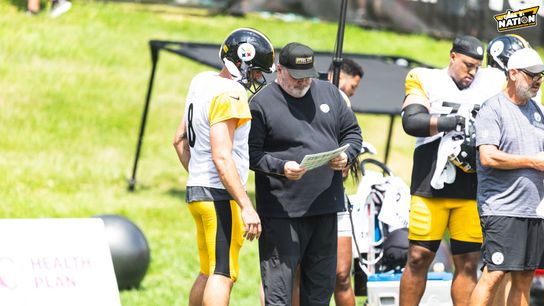
Jordan Schofield / SteelerNation (X: @JSKO_PHOTO)
Pittsburgh Steelers quarterback Aaron Rodgers (8) and Head Coach Mike McCarthy (right) during 2026 training camp at Saint Vincent College in Latrobe, PA.
The Window Where Most Games Are Actually Decided
An NFL offense gets a fixed amount of time between plays, and almost everything meaningful happens inside it. The formation is set, personnel is matched, the defense declares a front, the quarterback reads it, protection is identified, and a receiver may or may not be sent across the formation to force the coverage to reveal itself. The snap is the last event in that sequence, not the first.
For a team that finished 15th in scoring last season while winning the division at 10-7, the gap between good and dangerous is not measured in arm strength. It is measured in how often the offense knows something the defense does not at the moment the ball moves. That is a coaching and communication problem far more than an athletic one.
Why This Particular Roster Makes It Matter
Mike McCarthy will call the plays, with Brian Angelichio in his first season as offensive coordinator, and the system is expected to lean on West Coast principles rather than the more constrained approach Pittsburgh ran in recent years. Systems like that live on timing and on the quarterback's freedom to change the picture late.
Aaron Rodgers has spent two decades doing exactly that. He has also been public about wanting the offense under center more often on early downs, which is not a nostalgic preference. Under-center formations make the run threat honest, and an honest run threat is what makes play-action believable, which is what turns a pre-snap look into a post-snap problem for a safety.
The complication is that pre-snap communication depends on familiarity, and this receiver group is new. DK Metcalf is the returning known quantity. Michael Pittman Jr. arrived this offseason and Germie Bernard was a second-round pick, and neither has spent years learning one quarterback's signals, glances and adjustments. Everything described above only works if all five eligible receivers read the same picture in the same second.
The Same Pull Away From the Field
There is a reason this part of football has such a devoted audience even though it produces no statistics. Watching someone process information under a clock is compelling on its own, which is why so many fans keep something running in the background that scratches the same itch. Quick-decision formats, puzzle apps and sweepstakes games online all offer a compressed version of the same loop: limited time, limited information, one choice, immediate feedback. The appeal is the pressure of the decision rather than the size of the outcome.
What the Rulebook Actually Allows
The pre-snap phase has more structure than it appears to. Under the NFL rules on shifts, an offense may shift and put two or more players in motion multiple times before the snap, but after the last shift every player must stop completely and be set simultaneously for at least one full second, with an illegal shift costing five yards. Motion by a single eligible back after that reset does not require the same pause. Those constraints are why offenses build specific sequences rather than improvising freely, and why a well-drilled shift is worth practicing for weeks.
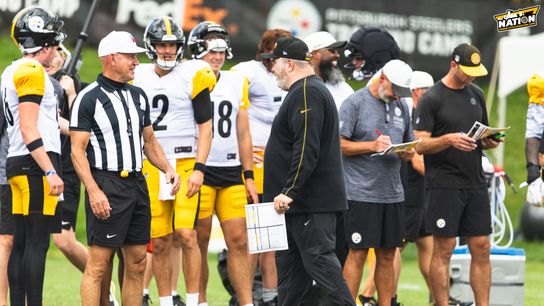
Jordan Schofield / SteelerNation (X: @JSKO_PHOTO)
Pittsburgh Steelers Head Coach Mike McCarthy during 2026 training camp at Saint Vincent College in Latrobe, PA.
The whole category of hidden communication is older than the professional game. Gallaudet University's account of its own football history records that in 1894, quarterback Paul Hubbard gathered his teammates into a tight circle so opposing deaf players could not read the American Sign Language he was using to call plays. He needed to hide the signal, and the solution he invented spread into basketball, baseball, soccer and most other team sports. The modern version of the same problem is a quarterback trying to disguise a real call as a decoy at the line.
What Rodgers Says He Is Actually Doing
He has been unusually direct about the mechanics. Speaking during training camp, Rodgers described cadence as a way to occupy a defender's attention so it is not available for something else, taking them away from a reaction, from reading a lineman, or from hearing the protection call coming off the offensive line. He described the value in deliberately small terms, as fractions of pennies that only matter once they accumulate. The willingness to stack tiny edges rather than chase one big one is what separates a veteran operator from a quarterback simply executing a call.
He is applying the same logic in practice by telling Pittsburgh's defensive backs what his receivers are trying to do in the red zone, on the theory that a defense that is not surprised forces the offense to be sharper. It is a strange thing to do if the goal is winning a training camp rep, and a sensible one if the goal is a functional offense in December.
The Part That Will Not Show Up in a Box Score
None of this appears in the numbers directly. There is no column for a safety who rotated too early because a motion man made him declare, or for a free play generated by a hard count on third and short. It shows up indirectly, as third-down conversion rate, as fewer negative plays, as an offensive line that is not guessing about who takes the blitzer.
The season will be judged on wins, and wins will be attributed to receivers catching things. But if this offense improves meaningfully on last year, the reason will mostly be invisible: eleven players getting to the right place with the right information a second and a half before the ball is snapped, over and over, for seventeen games.