


Football scores are not continuous. A team adds three at a time or seven at a time, occasionally six or eight, rarely two. Because the scores are lumpy, the margins between them are lumpy too, and a point spread that looks like a smooth sliding scale is nothing of the sort.
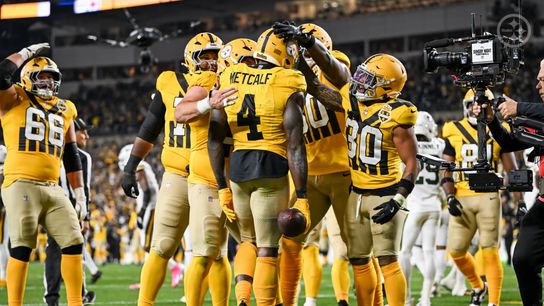
Alysa Rubin / Pittsburgh Steelers
Steelers wide receiver DK Metcalf celebrates after scoring a touchdown against the Green Bay Packers in Week 8 of the 2025 NFL regular season.
That lumpiness is worth real money, and most of it sits on two numbers.
Why three and seven do so much work
A field goal is three. A touchdown with the extra point is seven. Almost every close NFL game resolves through some combination of those two units, so the final margins pile up on multiples and near-multiples of them.
Across the modern era, a margin of exactly three is the single most common result in the sport, landing in roughly one game in seven. Exactly seven is next, at somewhere near one game in eleven. No other single margin comes close. Four, five and eleven are comparatively rare, because there is no natural scoring path that lands there.
So when a spread sits at 3, it is not sitting on an ordinary number. It is sitting on top of the largest single spike in the distribution.
Three spreads that look adjacent and are not
Consider a favourite at -2.5, -3 and -3.5. Half a point apart each time. The bets are not half a point apart in any meaningful sense.
-2.5 loses if the favourite wins by exactly three. That is the most likely single outcome in the game, and you are on the wrong side of it.
-3 pushes on a three point win. Your money comes back.
-3.5 also loses on three, but you were paid a better price to take that risk knowingly.
Moving from -2.5 to -3 does not buy you half a point of cushion. It buys you the difference between losing and pushing on about fourteen percent of all games. That is why sportsbooks charge disproportionately for that specific half point, and why a line that drifts from 2.5 to 3 has moved much further than a line that drifts from 8.5 to 9. The same logic applies a second time, with less force, around seven.
What buying a half point actually costs
Most books let you move a line in exchange for a worse price. Away from the key numbers this is cheap, often twenty cents of juice or less. On and around three it is expensive, sometimes doubling the vig, and some books simply will not sell you the move from 3.5 to 2.5 at any price.
That pricing is not arbitrary. It is the book charging you the actual frequency of the outcome you are trying to buy. If a result happens fourteen percent of the time, half a point that covers it is worth roughly fourteen percent of your bet, and no book prices that generously.
The practical rule: buying half a point off a key number is usually a bad deal, and buying half a point anywhere else is usually a slightly bad deal. Buying points is a way of paying to feel safer.
The numbers are drifting
Key numbers are a product of the rules and the coaching orthodoxy, and both have been changing.
Extra points were moved back, which nudged some teams toward two point conversions. Fourth down aggression has climbed sharply, which converts some would-be field goals into touchdown attempts. The result is that margins of six and eight have become slightly more common than they were a decade ago, and the dominance of three has softened a little without going anywhere.
Anyone repeating key number frequencies from an article written in 2012 is quoting a distribution that no longer exists. The shape is the same. The exact percentages have moved.
Teasers, and the six point question
A teaser lets you move a spread several points in your favor across multiple games, in exchange for a much worse combined price. The whole argument for teasers rests on key numbers.
Moving a favorite from -7.5 to -1.5 crosses both seven and three. Moving an underdog from +1.5 to +7.5 does the same. Those are the crossings that carry value, because you are collecting two spikes in one move. Moving a line from -9 to -3 crosses only one, and moving from -12 to -6 crosses neither in a useful way.
The teaser is not good because six points is a lot. It is good, when it is good, because of which six points.
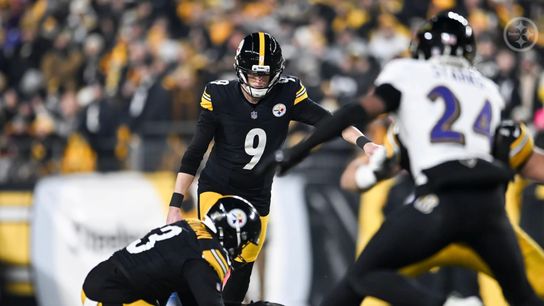
Alysa Rubin / Pittsburgh Steelers
Steelers kicker Chris Boswell lines up for a kick against the Baltimore Ravens in Week 18 of the 2025 regular season.
How to use this without overrating it
Key numbers tell you how much a line move matters. They do not tell you which side to take. A spread sitting on three is still a genuine question about two football teams, and knowing the distribution does not answer it.
What the distribution does is stop you from making cheap mistakes: taking -3 when -2.5 was available at the same price an hour earlier, paying to buy onto a number you did not need, or treating a move from 6.5 to 7 as noise. On the crypto side, books that carry a deep American football board tend to post the whole set of alternate lines rather than just the main number, and American football betting at Jacks Club is one example where the alternate spreads sit next to the main one so the pricing across a key number is visible rather than hidden.
Read the ladder before you bet. If the price to move onto three looks reasonable, check it again, because it almost never is.
One caveat worth stating
None of this creates an edge on its own. The books know the distribution better than you do, and it is already inside the price. What key numbers give you is a way to tell a meaningful line move from a meaningless one, and a reason to stop paying for half points that were never worth what you were charged.