


The Pittsburgh Steelers have been making the same projection for decades: take a college defensive end with the right athletic profile and determine whether he can become an outside linebacker.
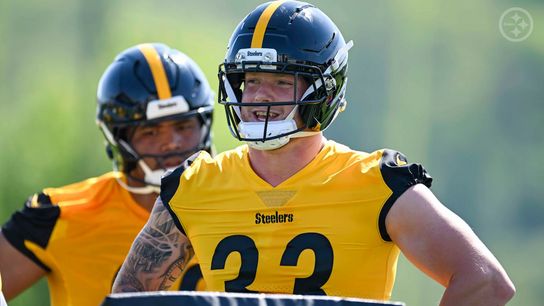
Alysa Rubin / Pittsburgh
Pittsburgh Steelers linebacker Jack Sawyer (#33) participates in the team's rookie minicamp during a workout at the UPMC Rooney Sports Complex, Sunday, May 11, 2025 in Pittsburgh, PA.
Jason Gildon went through it after playing defensive end at Oklahoma State. Joey Porter came out of Colorado State after playing on the defensive line. LaMarr Woodley arrived from Michigan as a defensive end. Anthony Chickillo had played with his hand in the dirt at Miami.
The pattern is well established. Steelers.com has described the search for pass-rushing 3-4 outside linebackers as a projection-heavy, hit-or-miss process, specifically pointing to Gildon and Porter as college defensive ends who made the transition in Pittsburgh.
Those personnel decisions shape Pittsburgh's depth, pressure packages and matchup options, all of which can be reflected directly in the odds offered by the most trusted betting source.
The common thread, though, is not simply pass rushing. Pittsburgh has to decide whether skills developed on the defensive line can support a broader NFL role. That distinction matters in the Steelers' defense. Their outside linebackers still attack offensive tackles and pressure quarterbacks, but Mike Tomlin has described a modern position that can also require dropping into zone coverage, playing man-to-man and operating in space as offenses spread the field. For a college defensive end, some of that job is already familiar. The rest has to be projected.
Pittsburgh Starts With What Already Translates
College defensive ends already have experience taking on offensive tackles, defending the edge and getting after the quarterback. Length, first-step quickness, hand usage, power and the ability to hold ground against the run can all carry into an NFL edge role. Pittsburgh's harder question is what can be built around those traits.
Tomlin explained that thinking when discussing Chickillo. At Miami, Chickillo had played as a much heavier defensive lineman. Pittsburgh nevertheless saw a player who was light on his feet and whose physical structure looked more like that of a linebacker. Tomlin also emphasized willingness to make the change.
Chickillo later described learning to play standing up, move in space and drop into coverage after spending college almost exclusively with his hand on the ground. The Steelers were not trying to replace the skills that got him drafted. They were determining whether those skills could remain useful once the job became larger.
The Hardest Part Often Happens When the Player Does Not Rush
Mike Vrabel's experience showed how disruptive that transition can be. Vrabel played defensive end at Ohio State before Pittsburgh drafted him in 1997. Looking back on his move to outside linebacker, he acknowledged that the adjustment took time. Moving from a three-point stance to a two-point stance was only part of it. There were also coverage responsibilities and tackles to make in space.
Woodley encountered similar demands after leaving Michigan. The pass-rushing element gave him something familiar, but playing outside linebacker required new terminology, pass drops and coverage responsibilities that had not defined his college role. That is why a college defensive end's sack total cannot answer Pittsburgh's entire evaluation.
The Steelers can see whether a player can attack. They still have to determine whether he can remain functional when the call does not send him directly at the quarterback: playing from his feet, maintaining outside leverage against the run, redirecting with the ball and handling enough work in space that his presence does not reveal the defense's intentions. He does not have to become an elite coverage linebacker. He has to become versatile enough for Pittsburgh to preserve its options.
T.J. Watt Shows the Difference When There Is Almost Nothing to Project
T.J. Watt provides the clearest comparison because Pittsburgh did not face the same positional uncertainty with him. At Wisconsin, Watt was already playing outside linebacker in a defensive structure similar to Pittsburgh's. When Tomlin later described the Steelers' evaluation before the 2017 draft, he said there was essentially no guesswork. Watt was already doing many of the things Pittsburgh planned to ask him to do.
Pittsburgh could watch him rush from the edge, operate on his feet and handle linebacker responsibilities within a comparable structure. He still had to develop into an NFL player, but the positional translation was already visible.
With players such as Woodley or Chickillo, Pittsburgh instead had to infer whether athletic ability and football instincts shown in one role could carry into another.
Development Is Part of the Conversion
A converted defensive end has to learn the position while also adjusting to the speed, terminology and complexity of the NFL. Chickillo's development shows how those demands can overlap. Tomlin later noted that he had gone through both a position change and a body change while also learning special-teams responsibilities that were foreign to him as a college defensive lineman. By his third season, Chickillo had developed into Pittsburgh's primary reserve outside linebacker. That progression is important to the Steelers' model.
The club does not need every converted defensive end to arrive as a complete linebacker. It needs enough evidence that the missing parts are teachable while the player's most valuable existing traits remain useful.
Jack Sawyer Has Now Given Pittsburgh a Full Season of Evidence
Jack Sawyer is the latest clear example of the traditional conversion. At Ohio State, Sawyer played defensive end. Pittsburgh selected him in the fourth round of the 2025 draft and moved him into its outside-linebacker room. SteelerNation tracked that position change during Sawyer's first preseason, when defensive coordinator Teryl Austin stressed that the former college defensive end still had room to develop in the new role.
A year ago, the relevant question was whether his college skill set could expand into that role. There is now a full NFL season to evaluate. Sawyer appeared in all 17 regular-season games as a rookie and made one start. He finished with 20 tackles, three tackles for loss, one sack and two interceptions while also contributing on special teams.
The interceptions should not be treated as proof that he instantly became a polished coverage linebacker. They matter for a narrower reason: his rookie role already extended beyond simply lining up and rushing the passer.
Pittsburgh also continued expanding what it asked him to handle. During the season, T.J. Watt said Sawyer performed better as more was put on his plate, while Sawyer credited the veteran outside linebackers around him with teaching him the details of the position.
The conversion is therefore no longer just a projection based on Ohio State tape. His rookie season supplied actual evidence that he could begin absorbing Pittsburgh's broader outside-linebacker responsibilities.
Entering the 2026 season, Sawyer is listed behind Alex Highsmith at right outside linebacker.
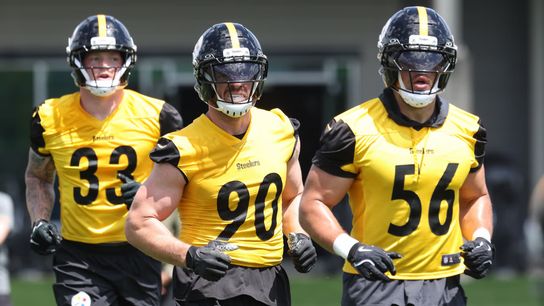
Charles LeClaire / Imagn Images
Pittsburgh Steelers’ Jack Sawyer, TJ Watt and Alex Highsmith participate in OTA drills at the UPMC Rooney Sports Complex in 2026.
For Pittsburgh, Sawyer represents another attempt to start with a college defensive end and expand the player without discarding the abilities that made him attractive in the first place.
The Position Has Evolved, but the Projection Remains
Modern NFL terminology makes the distinction between defensive ends, outside linebackers and edge rushers less rigid than it once was. Pittsburgh itself spends plenty of snaps outside a textbook base 3-4.
But the personnel problem has not disappeared. Under Patrick Graham, the ability of Pittsburgh's outside linebackers to both rush and drop remains useful because it allows the defense to change its pressure picture without making its intentions obvious — a point SteelerNation has also highlighted in looking at the 2026 defense.
The Steelers still need edge defenders who can pressure quarterbacks and hold up against the run without limiting what the defense can call around them.
Sometimes Pittsburgh finds a player such as Watt, whose college role already provides direct evidence of that versatility. Other times it looks at a defensive end and has to project forward.
The calculation is whether the traits that already work — attacking tackles, generating pressure and controlling the edge — can remain intact while enough linebacker responsibility is added around them.
That is why the Steelers keep returning to college defensive ends. The position label can change. The underlying question remains the same: how much more can this edge defender do?