


The Pittsburgh Steelers have built one of the NFL’s most recognizable defensive identities. From the dominant Steel Curtain of the 1970s to the aggressive Blitzburgh defenses and today's versatile units, Pittsburgh has adapted its tactics without abandoning physical, disciplined football.
Taylor Allison / Pittsburgh Steelers
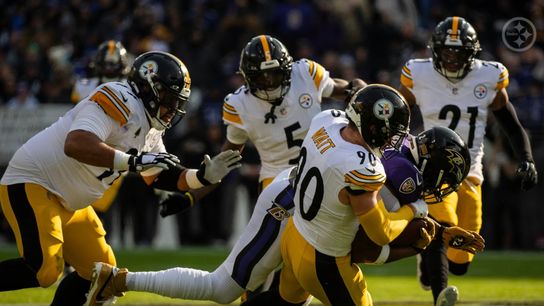
The Pittsburgh Steelers defense collapses on Ravens QB Lamar Jackson in a 2025 regular season matchup.
The Steelers have changed how they defend, but not what they expect their defense to accomplish.
The Steel Curtain: Where It All Began
The foundation was established under head coach Chuck Noll, whose 1970s dynasty was built around an exceptional defense. At Three Rivers Stadium, the Steelers developed a unit capable of controlling games through physicality, pressure, and run defense.
Defensive coordinator Bud Carson helped shape the system, including the 4-3 defensive alignment and early Cover 2 concepts. The defense featured legends such as “Mean” Joe Greene, Jack Lambert, Jack Ham, L.C. Greenwood, and Dwight White, with Mel Blount and Donnie Shell anchoring the secondary.
Known as the Steel Curtain, the unit played a central role in Pittsburgh's four Super Bowl victories: Super Bowl IX, Super Bowl X, Super Bowl XIII, and Super Bowl XIV.
The Steelers' defensive legacy continues to generate significant interest decades later. Research from 10 Online Casinos, an independent casino research and review portal, found strong demand for Pittsburgh Steelers-related betting content, with levels of interest comparable to those seen across broader online casino topics. That enduring attention reflects how deeply the Steel Curtain era remains connected to the franchise's identity.
The unit's physical approach also influenced NFL rules. The Mel Blount Rule was enacted for the 1978 season, following the 1977 campaign, limiting defensive contact with receivers downfield and helping encourage the passing-oriented style that increasingly shaped the league.
From the Steel Curtain to Blitzburgh
As the NFL evolved, Pittsburgh's defense did too. Under head coach Bill Cowher, the Steelers increasingly relied on a 3-4 base alignment, moving away from the Steel Curtain's traditional 4-3 structure.
The change created new opportunities to attack opposing offenses while preserving Pittsburgh's physical identity. Defensive coaches, including Dom Capers, helped establish the aggressive approach that became known as Blitzburgh.
Linebackers became central to the pass rush, with Greg Lloyd, Kevin Greene, Joey Porter, and James Farrior defining different generations. Casey Hampton provided interior strength.
The philosophy remained simple: pressure the offense, control the line of scrimmage, and force mistakes.
The Zone Blitz Changes the Formula
The evolution reached another level under Dick LeBeau, whose Zone Blitz and Fire Zone concepts became defining features of Pittsburgh's defense.
Rather than relying on predictable pressure, the system allowed defenders to disguise where the rush was coming from. A linebacker or defensive back could blitz while a defensive lineman dropped into coverage, making the defense harder to read.
Troy Polamalu, James Harrison, and Brett Keisel became closely associated with this era. Polamalu's unpredictability complemented LeBeau's scheme, while Harrison emerged as one of the NFL's most dangerous pass rushers.
Jared Wickerham / Pittsburgh Steelers
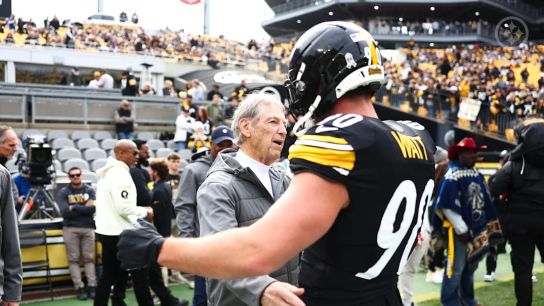
TJ Watt and Dick LeBeau embrace during a regular season game for the Steelers against the Indianapolis Colts at Acrisure Stadium in 2025.
The approach helped Pittsburgh win Super Bowl XL and Super Bowl XLIII, demonstrating that aggressive defensive pressure could remain a championship formula.
Adapting to the Modern NFL
Today's pass-heavy NFL demands greater speed and versatility. Under Mike Tomlin, Pittsburgh has continued adapting while maintaining its defensive-first culture.
Modern Steelers defenses use Nickel and Dime packages to counter 11 personnel, which features three wide receivers. These packages also help defend quick-release passing attacks and spread formations by putting more defensive backs on the field.
T.J. Watt, Cameron Heyward, Minkah Fitzpatrick, Alex Highsmith and Patrick Queen, alongside young players such as Joey Porter Jr., represent this evolution toward speed, coverage ability and positional versatility.
What Has Stayed the Same?
Pittsburgh's schemes have changed dramatically, but its core principles remain recognizable: physicality, defensive leadership, quarterback pressure, and creating turnovers.
The franchise's history of NFL Defensive Player of the Year winners, including Mean Joe Greene, Mel Blount, Jack Lambert, James Harrison, and T.J. Watt, further illustrates that continuity.
From Three Rivers Stadium to Acrisure Stadium, Pittsburgh's defense has evolved alongside the NFL. The Steelers have succeeded not by recreating their past defenses, but by preserving the principles that made them great while finding new ways to apply them.