


The Pittsburgh Steelers have always handled jersey retirements differently than most NFL franchises, but the conversation around one legendary number continues to feel incomplete.
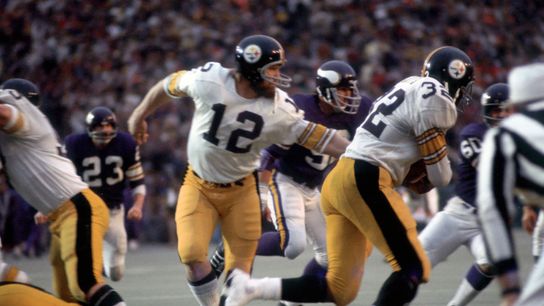
© Tony Tomsic / Imagn Images
Steelers' former quarterback Terry Bradshaw hands the ball off to Franco Harris during Super Bowl IX.
Terry Bradshaw helped define the standard that still follows Pittsburgh today. He was the quarterback of the Steelers’ 1970s dynasty, the passer behind four Super Bowl championships, and one of the most important figures in franchise history. Yet his No. 12 has still never been officially retired. That has become harder to explain with time.
The Steelers have only officially retired a small group of numbers. Ernie Stautner’s No. 70, Joe Greene’s No. 75, and Franco Harris’ No. 32 have received that ultimate honor. Bradshaw’s No. 12 has essentially been treated as retired for decades, but there is still a difference between an unofficial understanding and a formal ceremony.
Nick Farabaugh made that point clear during a recent interview on 93.7 The Fan when the topic of Bradshaw’s number came up.
"I think it should have been done a long time ago, to be quite honest with you," Farabaugh said. "They haven’t handed out number 12 in 30, 40 years."
That is the part that makes the situation so strange. If the number is never going to be used again, then the franchise has already made its decision in practice. The only thing missing is the public acknowledgment. Bradshaw last played for the Steelers in the early 1980s. Since then, No. 12 has carried a protected status. No young quarterback has entered training camp with it. No free agent has been handed it. No temporary camp arm has casually worn it. Pittsburgh has clearly understood what that number means.
The question is why that understanding has not become official.
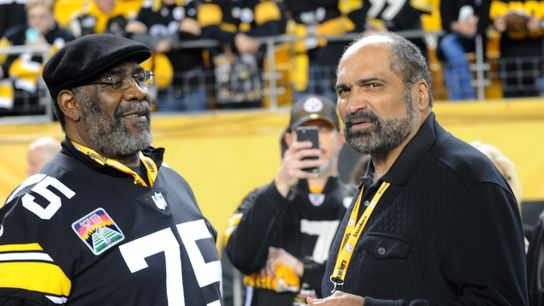
© Philip G. Pavely / Imagn Images
Steelers legends Joe Greene and Franco Harris before a home game in Pittsburgh.
The conversation around Bradshaw’s No. 12 has already been a familiar topic around the organization, especially because the Steelers are so selective with jersey retirements. That selectiveness is part of what makes the honor special. Pittsburgh does not retire numbers because a player was popular or productive for a short stretch. It reserves that step for franchise-changing figures.
Bradshaw clearly qualifies. He was not just along for the ride with the Steel Curtain. His career is often discussed through the lens of the defense, the running game, and the collection of Hall of Fame teammates around him, but that can go too far. The Steelers do not win four championships without timely quarterback play, and Bradshaw delivered some of the most important throws in franchise history.
The Pro Football Hall of Fame notes that Bradshaw threw for 932 yards and nine touchdowns across four Super Bowl victories. He was also named Super Bowl MVP twice and won the NFL’s Most Valuable Player award in 1978. Those are not just complementary-player credentials. Those are the achievements of a quarterback who rose when the stakes were highest.
That matters in Pittsburgh, where postseason performance defines legacy more than regular-season numbers. Farabaugh also pointed to the human side of the discussion. Bradshaw is still here. He is still able to receive the honor, hear the ovation, and stand in front of the fans who watched him help turn the Steelers into a dynasty.
"These '70s Steelers are aging out," Farabaugh said. "You hope to give them their flowers while they’re here. And Bradshaw, I mean, listen, for all of the ups and downs he went through here in Pittsburgh, he’s undoubtedly a legend."
There have been complicated chapters between Bradshaw and Pittsburgh. His relationship with the city, the organization, and even parts of the fan base has never been perfectly clean. Bradshaw has been outspoken. He has annoyed people. He has said things that did not always land well.
None of that should outweigh what he did in uniform.
Steelers Can Still Get This Right
The Steelers do not need to overthink this. Retiring No. 12 would not weaken the standard. It would reinforce it. It would tell future generations that the quarterback who helped deliver four Lombardi Trophies deserves to stand officially beside Stautner, Greene, and Harris.
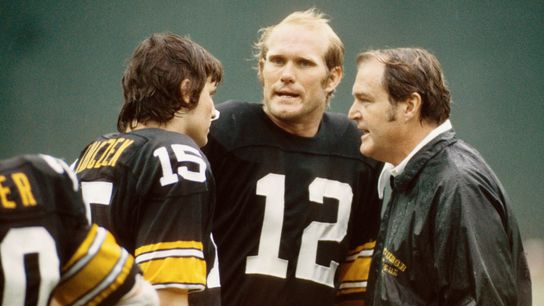
Tony Tomsic / Imagn Images
Steelers' former quarterback Terry Bradshaw speaks with Chuck Noll during the 1976 season.
There is also no practical downside. The team already does not use the number. The fans already associate it with Bradshaw. The franchise already treats it as untouchable. The only remaining step is the ceremony.
Bradshaw’s legacy is not perfect, but it is enormous. He was the quarterback of the greatest run in franchise history and one of the defining players of the NFL’s most important decade. Pittsburgh has honored him in many ways, but this one still sits unfinished.
Farabaugh is right. This should have been done a long time ago.
The Steelers still have time to make sure it gets done the right way.
#SteelerNation