


The Pittsburgh Steelers have spent training camp trying to balance two different quarterback priorities. They need a backup who can protect a season built around a veteran starter, but they also need real evidence about the young passers who could shape the position after 2026. The longer camp continues, the harder it becomes to pretend those goals are pointing toward the same answer.
Karl Roser / Pittsburgh Steelers
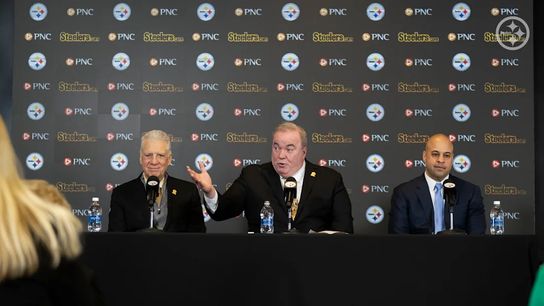
New Steelers head coach Mike McCarthy giving his introductory press conference alongside Team President Art Rooney II and General Manager Omar Khan.
Aaron Rodgers owns the starting job, leaving the competition behind him as one of Pittsburgh’s most important roster decisions. Mason Rudolph offers NFL starts, familiarity with the organization and the calm expected from a veteran backup. Will Howard and Drew Allar offer developmental upside, but neither has taken a regular-season snap. The Steelers’ official camp preview described Rudolph as entering Year 8 in Pittsburgh while Howard and Allar continued working toward their futures.
The appeal of handing the job to a younger quarterback is easy to understand. Pittsburgh needs to learn whether Howard can become more than a sixth-round project, and Allar was selected in the third round to develop under Mike McCarthy. A preseason role can accelerate that process. The QB2 job carries a different standard because the player may be asked to enter without warning and keep a contending team functional.
Mark Kaboly does not believe either young quarterback has reached that point. During his latest Steelers discussion, Kaboly said Howard and Allar have improved without creating enough consistency for Pittsburgh to feel comfortable moving away from Rudolph.
“I don’t think the other two, although the other two are making some strides, I don’t think they’re just going to get to that point where you feel comfortable going into the season with them,” Kaboly said. “So, I’m still pretty bullish on Mason Rudolph being that number two guy right now.”
Kaboly’s position has remained consistent throughout the offseason. He has repeatedly argued that Pittsburgh’s win-now approach makes Rudolph difficult to remove, especially with Rodgers entering his 22nd NFL season. Howard’s missed rookie preseason and Allar’s status as a first-year project leave both players trying to close an experience gap in a few weeks.
Rudolph does not need to dominate every practice to protect his lead. The backup job rewards command, accuracy and sound decisions more than occasional spectacular throws. Pittsburgh needs someone who can receive the call, settle the huddle, identify pressure and avoid turning one injury into several weeks of unstable quarterback play.
Howard’s best moments have shown why the organization wants to keep developing him. He can move, attack downfield and produce throws that create excitement around the possibility of a larger role. His uneven stretches have prevented those flashes from becoming a complete argument. A young quarterback cannot win the primary backup job only by showing the higher ceiling if the mistakes keep lowering the floor.
Allar faces an even longer climb. His size and arm talent make him an intriguing prospect, but Pittsburgh drafted him with development in mind rather than an immediate need to play. The official roster currently lists all four quarterbacks, and the team has used July and August to evaluate how the room should be arranged behind Rodgers.
Karl Roser / Pittsburgh Steelers
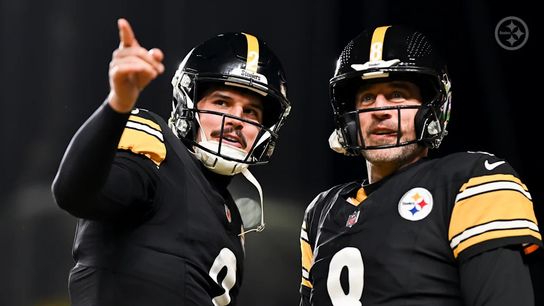
Steelers quarterback Mason Rudolph (2) and Steelers quarterback Aaron Rodgers (8) during a postseason matchup between the Pittsburgh Steelers and Houston Texans.
McCarthy’s history with quarterbacks gives Pittsburgh a reason to believe both young players can improve without being rushed into the second spot. Development does not stop because Rudolph wins the job. Howard and Allar can continue receiving practice work, learning from Rodgers and building toward a future competition without being one snap away from leading the offense in a meaningful game.
The roster math remains the difficult part. Keeping all four quarterbacks would protect every option, but the extra spot would come from another position. Moving Rudolph would create more room for youth while removing the only backup with substantial NFL experience. Any possible Rudolph trade becomes harder to justify if the staff shares Kaboly’s lack of comfort with the younger choices.
Steelers Cannot Force The Future Into The Present
Pittsburgh should want Howard or Allar to make the decision uncomfortable. A strong preseason could show that one of them is ready to operate the offense without placing the entire season at risk. The Steelers cannot manufacture that conclusion simply because a younger option would make the roster plan cleaner.
Rudolph’s limitations are already understood. He is not being evaluated as the long-term replacement for Rodgers, and Pittsburgh knows what its offense looks like when he starts. That familiarity can feel less exciting than the unknown surrounding Howard or Allar. It is also valuable when the job is designed to provide stability rather than uncover a franchise quarterback.
Howard still has time to narrow the gap. Preseason games will give him extended drives, live pressure and the opportunity to show that his accuracy can survive after a mistake. Allar can also establish that his development is moving faster than expected, even if the rookie remains more likely to spend the season learning.
Kaboly’s assessment places the decision where it belongs. Progress is not the same as readiness. Pittsburgh can be encouraged by both young quarterbacks and still decide neither should be Rodgers’ immediate replacement.
The Steelers entered camp hoping their developmental options would provide a difficult choice. Unless Howard or Allar produces a major change during the preseason, the harsh verdict may be that the safest answer never stopped being Rudolph.
#SteelerNation