


The Pittsburgh Steelers no longer have the luxury of treating their right tackle competition like an August experiment. Week 1 is close enough that every practice rep has consequences, Dylan Cook remains the steadier option, and the first-round rookie chasing him lost most of the preseason to an injury. The calendar has compressed what was supposed to be a month-long evaluation into one final sprint.
Karl Roser / Pittsburgh Steelers
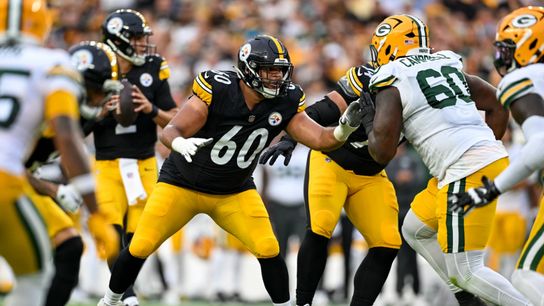
Steelers offensive tackle Dylan Cook blocks for quarterback Mason Rudolph in a 2026 preseason game.
Max Iheanachor still has an opportunity to make that sprint interesting. When Mike McCarthy was asked what it would take for Iheanachor to enter the Week 1 starting conversation, the Steelers' head coach made the requirement clear during his Tuesday media availability.
“The biggest thing is stacking success. I mean, he needs to stack practices together, starting with today,” McCarthy said.
That sounds simple until Iheanachor's August is considered. Pittsburgh selected him 21st overall expecting him to become its long-term answer at right tackle, and his first padded practices offered enough encouragement to make the competition with Cook worth watching. Then an upper-body injury interrupted the process and cost the rookie most of training camp along with Pittsburgh's first two preseason games.
He returned for only two practices before being thrown into the preseason finale against the Buffalo Bills. The debut looked exactly like what two practices of preparation might produce. Iheanachor flashed the strength and movement ability that pushed him into the first round, but he also allowed a sack and was flagged for holding. His natural ability survived the layoff. His consistency understandably did not. McCarthy's standard now explains why one game was never going to settle anything.
Iheanachor does not need to have one dominant afternoon in practice followed by another day filled with technical mistakes. Offensive line play rewards repetition almost to the point of boredom. The same pass set has to hold up against speed, power and counters. Hand placement cannot disappear because the defender changes his approach. A run block that looks violent on Tuesday is not especially useful if the footwork underneath it falls apart Wednesday.
The rookie's developmental background makes that consistency even more important. Iheanachor did not play high school football and arrived in the NFL with only 32 collegiate appearances at Arizona State, 31 of them starts. Pittsburgh drafted the physical ceiling while understanding that the finer details would require work. He did not allow a sack during his senior season, but NFL edge defenders have already shown him how quickly a small technical error becomes a much larger problem.
Cook gives the Steelers the freedom to demand progress instead of projecting it. He started Pittsburgh's final four regular-season games in 2025 and helped stabilize the offensive line during that stretch. The Steelers went 3-1 in those contests, and he entered this summer first on the depth chart at right tackle. Pittsburgh's initial preseason depth chart maintained that order, with Iheanachor listed directly behind him.
That makes the competition unusually clean. Cook offers the safer September answer. Iheanachor offers the larger long-term investment and considerably more upside if his technique reaches the level of his physical tools.
Karl Roser / Pittsburgh Steelers
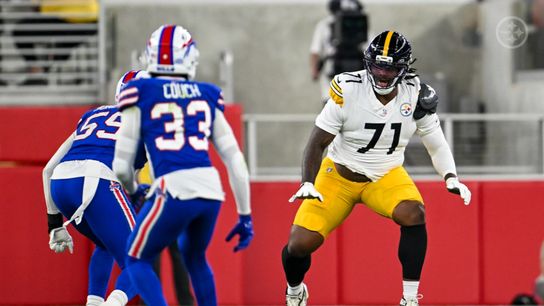
Steelers offensive lineman Max Iheanachor prepares to block during a preseason game in August of 2026.
The Steelers have already demonstrated that the rookie's timetable can move quickly. Trading Broderick Jones to the Dallas Cowboys removed another tackle from the equation, leaving Iheanachor as an increasingly important part of Pittsburgh's offensive-line plans whether he starts immediately or not. The team's initial 53-man roster included only nine offensive linemen, with Cook and Iheanachor among the tackle options.
Pittsburgh therefore has two separate questions to answer. Iheanachor has to prove he can handle the right tackle job. The coaching staff also has to determine how much evidence it requires before handing a rookie that responsibility in front of Aaron Rodgers.
The latter raises the stakes considerably. A developmental tackle can learn through mistakes, but the Steelers are trying to win immediately with a veteran quarterback. Pittsburgh cannot treat Rodgers' protection like a developmental workshop simply because its first-round pick eventually needs live experience. Iheanachor has to make the coaches believe the mistakes are becoming exceptions rather than part of the weekly price of playing him.
His earlier padded breakthrough showed why the organization believes he can get there. Pittsburgh saw his balance, power and ability to remain engaged through a block begin translating once camp became physical. The injury prevented him from stacking those performances for very long. McCarthy is essentially asking him to resume the interrupted experiment at the most inconvenient possible time.
Steelers Need Iheanachor To Make The Decision Uncomfortable
There is no requirement for Pittsburgh to rush this. Cook exists precisely so the Steelers do not have to start Iheanachor simply because his name appeared in the first round of the draft. If the veteran gives the offense the better chance to function cleanly in Week 1, the rookie can continue developing without anything about the selection being considered a failure. Iheanachor's opportunity is to remove that comfort.
One excellent practice will not accomplish it, and neither will one impressive rep against a starting pass rusher. McCarthy wants evidence that the rookie can reproduce good football day after day after missing weeks in which that consistency normally would have been built.
The first-round pick entered training camp needing to catch Cook eventually. An injury stole much of his runway, but McCarthy has not closed the door on Week 1. He has simply made Iheanachor earn every remaining inch of it.
#SteelerNation