


The Pittsburgh Steelers have spent an entire offseason searching for the number that finally ends their most stubborn contract negotiation. Week 1 is approaching, the player involved has returned to practice, and the usual window for Pittsburgh to conduct major business is rapidly shrinking. At some point, either the two sides find common ground or a disagreement that began in May follows them directly into the regular season.
Charles LeClaire / Imagn Images
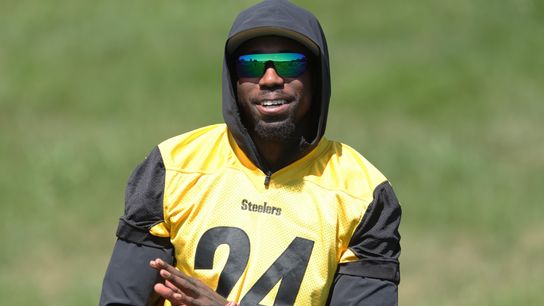
Steelers' Joey Porter Jr. on the sidelines during training camp in 2026.
Former NFL executive Doug Whaley believes there may be a third path for Joey Porter Jr. that does not require Pittsburgh to either hand him a massive traditional extension or simply let the final year of his rookie contract play out. During a recent discussion, Whaley floated the idea of essentially converting the value of two potential franchise-tag seasons into a shorter bridge contract.
“The third option is do a bridge deal. Do a two-year bridge deal, which would be the amount of the franchise tag next year and then I think it’s 10% to 15%… which would they have to do that for two years... All right. Boom. And then come back,” Whaley said.
The exact franchise-tag mechanics are slightly different from the rough percentage Whaley referenced. Under NFL rules, a player tagged for a second consecutive season receives at least 120% of his previous franchise-tag salary, or the applicable tag figure for that second year if it is higher. The broader concept still works: instead of arguing over four or five future seasons, Pittsburgh and Porter could theoretically negotiate around the amount of money the Steelers might otherwise have to spend to control him for 2027 and 2028 anyway.
It would be an unusual compromise for an unusual negotiation.
Porter is entering the final season of the four-year rookie contract he signed after Pittsburgh selected him 32nd overall in 2023. Because he was technically a second-round selection, there was no fifth-year option available for the Steelers to exercise. Unless a new agreement is reached, he is scheduled to become an unrestricted free agent in 2027. His current deal carries a 2026 cap charge of roughly $4.9 million, an enormous distance from what one of the NFL's better young cornerbacks would expect on his next contract.
That gap has helped create an offseason-long stalemate. Porter became eligible for an extension after completing his third season, but Pittsburgh already reached new agreements with fellow members of the 2023 draft class Nick Herbig, Darnell Washington and Keeanu Benton while its most expensive negotiation remained unresolved.
The cornerback market is the obvious complication. Porter has developed into a matchup defender Pittsburgh trusts against top receivers, but committing top-of-the-market money over four or five additional seasons requires the Steelers to decide how much of his future development they are willing to price in today. Porter, meanwhile, has little reason to voluntarily sell those future seasons cheaply when another strong year could make free agency or the franchise tag extremely lucrative.
Whaley's idea attacks that disagreement by making the commitment smaller rather than pretending the valuation gap does not exist.
Barry Reeger / Imagn Images
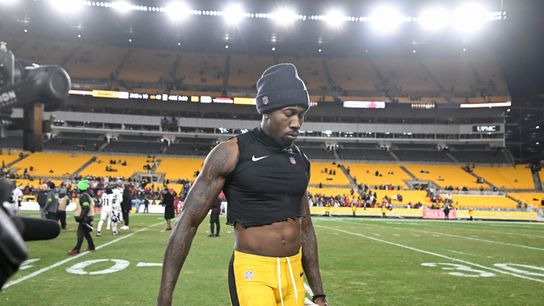
Steelers' Joey Porter Jr. walks off the field after a playoff loss during the 2025 season.
A two-year bridge would give Porter substantial short-term security without requiring him to surrender the prime of his career through a long extension. Pittsburgh would retain one of its most important defenders without immediately making a four- or five-year bet at whatever the top of the cornerback market becomes. When the bridge expires, both sides return to the negotiating table with significantly more information about Porter's ceiling.
There would be tradeoffs. A short contract would likely require Pittsburgh to guarantee a considerable portion of the money because Porter would be exchanging the leverage of unrestricted free agency and potential franchise tags for contractual certainty. It also would not solve the problem forever. The Steelers could find themselves negotiating with him again while Porter is still firmly in his prime, potentially at an even larger number.
That is also partially the point.
Pittsburgh's contract standoff currently asks both sides to make long-range projections. The Steelers have to decide what Porter will be worth several seasons from now, while Porter's camp has to determine whether accepting today's offer would leave significant money behind if he continues improving. A bridge agreement shortens the forecast.
There is now a football clock attached to the negotiation as well. Porter was activated from the Physically Unable to Perform (PUP) list during roster cutdowns and returned to practice Tuesday after missing training camp because of a back issue. He is working his way toward regular-season readiness while his contract situation remains unsettled, leaving Omar Khan with two important pieces of business involving the same player as Week 1 approaches.
Steelers Could Buy Time Without Losing Porter
The appeal of Whaley's proposal is that it turns time from an enemy into part of the deal.
A traditional long-term extension requires Pittsburgh and Porter to agree today on what multiple future seasons are worth. Playing out 2026 creates the opposite risk, sending the situation toward unrestricted free agency and forcing the Steelers to consider the franchise tag simply to preserve control. Neither side gets much flexibility. Two years would create some.
Porter could receive a contract constructed around the financial leverage he would possess through consecutive franchise tags while gaining protection against the injury or performance risk of playing season-to-season. Pittsburgh could secure its starting cornerback through multiple years without locking itself into an enormous long-term projection.
It would not be the cheapest solution, and it would not end the Porter contract conversation permanently. In some ways, a bridge deal simply schedules the next argument in advance. After an entire offseason without a breakthrough, that might be exactly why it works.
Pittsburgh and Porter do not necessarily have to agree on what the next five years should look like. They may only need to agree on the next two.
#SteelerNation