


The Pittsburgh Steelers did not need a stopwatch or a complicated scouting formula to notice Drew Allar could throw a football very hard. Assistant General Manager Andy Weidl remembers watching the ball jump out of Allar's hand at Penn State, the kind of arm talent that makes scouts straighten up before the quarterback has even finished his drop. Pittsburgh's evaluation became more interesting once the Steelers discovered the hardware came with a pretty capable processor, too.
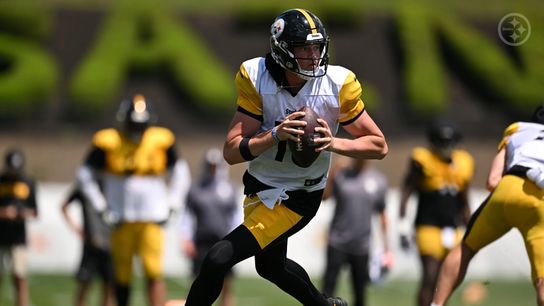
Jordan Perez / Pittsburgh Steelers
Steelers' Drew Allar throws on the run during a training camp practice in 2026.
Allar's physical profile was never difficult to sell. Pittsburgh selected him 76th overall in the third round of the 2026 NFL Draft after a college career that included 35 starts, 7,402 passing yards and 61 touchdowns. The Steelers listed him at 6-foot-5 and 228 pounds, while their own draft evaluation emphasized an effortless arm capable of reaching every portion of the field.
The questions were attached to everything around the arm. Allar's final college season ended early because of a broken ankle, and his draft profile included concerns about footwork, timing and turning impressive physical tools into repeatable quarterback play. A cannon is useful, but NFL defenses generally refuse to stand still and admire it.
Pittsburgh believed there was another reason to make the bet. The Steelers had just hired Mike McCarthy, an offensive-minded head coach with decades of experience working closely with quarterbacks. Allar did not need to arrive as a finished product if the organization believed the person responsible for sanding down the rough edges was unusually qualified for the job.
During a recent media availability, Weidl explained what separated Allar during Pittsburgh's evaluation and why McCarthy became part of the equation.
“First of all, you look at him, he’s a big quarterback, right? He’s got a strong arm. You go to practice at Penn State, you watch, the ball jumps out of his hand. He could attack every part of the field with the arm power that he has, and then get to know him, the intelligence he has. That factored in with Coach McCarthy and his track record of developing quarterbacks,” Weidl said.
The intelligence portion helps explain why Pittsburgh was comfortable drafting traits that still required development. Arm strength can open the entire playbook physically, but a quarterback still has to understand why the play is built a certain way, where defenders are likely to move and how quickly a correction needs to become permanent.
The Steelers' pre-draft evaluation reflected the same theme. Pittsburgh highlighted Allar's intelligence, seriousness about football, self-awareness and humility alongside the obvious measurables. The organization believed his ceiling was high because the physical tools were paired with characteristics that could make coaching stick rather than bounce off.
Training camp has begun providing evidence for the theory. McCarthy recently said Allar can operate every concept Pittsburgh has asked him to handle, allowing the coaching staff to evaluate the rookie without cutting huge portions from the offense. That conceptual flexibility is particularly valuable for a young quarterback because Pittsburgh can discover his strengths by testing the entire menu instead of handing him the children's version.
Allar has also described McCarthy's approach as extremely detailed, especially with footwork. Individual steps in quarterback drops are named and drilled repeatedly before Pittsburgh moves into competitive periods. The idea is to make the mechanics predictable enough that Allar can stop thinking about his feet when defenders start doing considerably more interesting things in front of him.
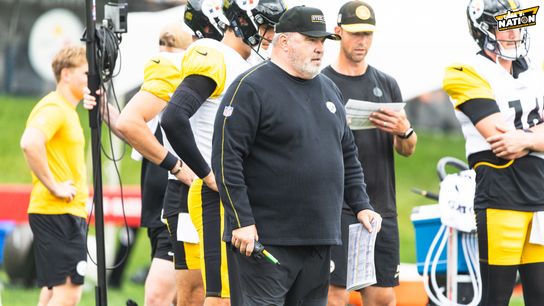
Jordan Schofield / SteelerNation (X: @JSKO_PHOTO)
Pittsburgh Steelers Head Coach Mike McCarthy stands on the field and looks on as he watches the team workout during a 2026 training camp practice taking place at Saint Vincent College in Latrobe, PA.
That relationship makes Weidl's draft explanation look less like hindsight after an encouraging summer. Pittsburgh knew before selecting Allar that there were mechanical areas requiring attention. The Steelers also knew exactly who would be teaching them, which allowed the front office to evaluate the prospect and the development environment as one package.
His preseason debut offered an encouraging first piece of evidence. Allar completed 10 of 13 passes for 153 yards and two touchdowns against the Green Bay Packers, while also scoring on the ground in Pittsburgh's 28-9 victory. His arm strength was visible, but so was enough command and decisiveness to keep the performance from becoming merely a collection of impressive throws.
Nobody inside Pittsburgh should treat one August night as proof that the development plan has already worked. Allar is still a rookie whose college inconsistencies helped make him available in the third round, and the distance between promising preseason quarterback and reliable NFL starter remains large enough to require snacks for the trip.
The more meaningful development is that Pittsburgh's original reasoning remains intact. The arm has translated, the intelligence is helping him absorb McCarthy's demands and the coaching staff has been able to challenge him instead of hiding him.
Steelers Built The Development Plan Into The Draft Pick
Drafting developmental quarterbacks always requires a little imagination. Teams are choosing what a player might become after fixing weaknesses that are obvious enough for every other scouting department to see. The dangerous version of that gamble is selecting the raw talent first and figuring out who will develop it later.
Pittsburgh approached Allar differently. Weidl's comments show McCarthy was part of the projection from the beginning, not simply the coach who inherited the assignment afterward. The Steelers could look at a quarterback with unusual arm talent, acknowledge the mechanical work ahead and reasonably believe their new head coach gave them a better chance of connecting those two things.
Allar still has to do the connecting. Intelligence does not guarantee fast processing on Sundays, and arm power cannot rescue every late decision. The next stages will involve stacking practices, handling poor performances and showing the technical progress survives when NFL defenses become much less charitable than preseason opponents.
For now, Pittsburgh's third-round gamble is behaving the way the front office hoped. Weidl saw the ball explode out of Allar's hand and the intelligence underneath it, while the Steelers had already hired a coach whose résumé made developing that combination feel worth the risk.
The arm got Allar noticed. McCarthy helped make Pittsburgh comfortable betting on everything that could come after it.
#SteelerNation