


The Pittsburgh Steelers have spent the Omar Khan era treating draft picks like poker chips. He has collected them, packaged them, flipped veterans for them and earned plenty of praise for finding value other teams left sitting on the table. One of the smartest transactions of his tenure once looked like proof Pittsburgh had found exactly the right man for that game. Three years later, the receipt suddenly reads much differently.
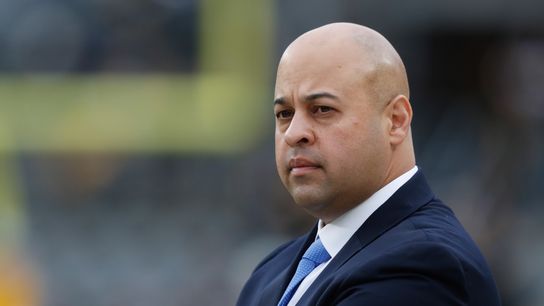
Charles LeClaire / Imagn Images
Steelers' Omar Khan stands on the field before a game against the New York Jets in 2022.
Stephen A. Smith believes General Manager Omar Khan deserves considerably more scrutiny after Pittsburgh traded Joey Porter Jr. to the Dallas Cowboys. Smith connected the move directly back to one of Khan's earliest and most celebrated transactions: sending Chase Claypool to Chicago for the draft pick that ultimately became Porter.
The history is unusually tidy. Pittsburgh traded Claypool to the Chicago Bears on Nov. 1, 2022 for Chicago's original 2023 second-round selection. The Bears finished with the NFL's worst record, turning that pick into No. 32 overall, and the Steelers used it on Porter. Three seasons and 41 starts later, Pittsburgh sent Porter to Dallas for a 2027 sixth-round pick and a 2028 second-rounder.
During a recent appearance, Smith argued that the sequence should force a broader evaluation of what Khan has actually built.
“Omar Khan, don’t think that you getting off the hook. I’m trying to figure out as a general manager for the Pittsburgh Steelers, what the h**l has this man done?… They got the third-oldest roster in the National Football League… You remember Omar Khan was raved because he had traded that brother Chase Claypool years ago to Chicago. He got a second-round pick for it. He used it on who? Joey Porter Jr. And now he gone,” Smith said.
There is a sharp point buried underneath all the volume. The Claypool trade itself was excellent asset management. Pittsburgh moved a receiver it no longer viewed as part of its future and received a premium selection that landed one spot outside the first round. Porter then became an immediate starter, won the team's rookie award and developed into one of the better young pieces on the defense. The problem Smith is identifying comes at the other end of that development cycle.
If the Steelers draft a player, develop him for three seasons and then cannot reach a second contract with him, the original draft success becomes harder to celebrate as a long-term roster-building victory. Pittsburgh did recover substantial value by getting a future second-round pick from Dallas, but it also turned a 26-year-old starting corner into assets that will not fully mature until 2028.
That distinction gets directly into Smith's larger criticism of Khan. The Steelers have leaned heavily on established veterans while trying to remain competitive immediately. Depending on the calculation used, preseason studies placed Pittsburgh either tied for the NFL's oldest roster or second-oldest rather than exactly third-oldest as Smith stated. The precise ranking varies, but the underlying point does not: Pittsburgh entered 2026 as one of football's oldest teams.
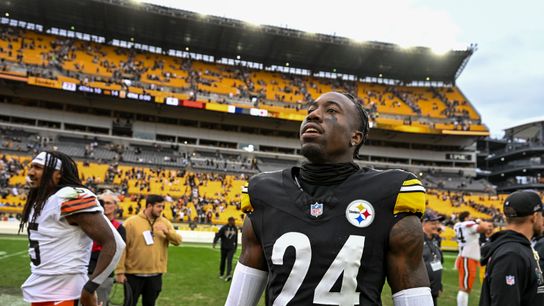
Barry Reeger / Imagn Images
Steelers' Joey Porter Jr. after a win over the Cleveland Browns at home during the 2025 season.
That aging profile is not automatically evidence of bad roster construction. Aaron Rodgers dramatically raises the average by himself at 42, while veterans such as Cameron Heyward remain productive enough that replacing them simply to make the birth certificates look prettier would be ridiculous. Pittsburgh also kept all 10 members of its 2026 draft class on the initial roster, with 11 rookies overall making the team.
Smith's argument becomes more interesting when age is paired with retention. Khan can point to young players throughout Pittsburgh's roster, particularly along the offensive line and defensive front. The larger question is whether enough of those draft investments become foundational players who survive long enough to reach second contracts in Pittsburgh.
Porter was supposed to be one of the easiest examples.
Pittsburgh selected him at 32nd overall, watched him grow into a full-time starter and entered the final year of his rookie deal publicly saying it wanted him to finish his career with the Steelers. Contract negotiations stalled, the organization maintained its policy against negotiating during the season, and Porter never played a 2026 snap for Pittsburgh before the Cowboys trade ended the relationship.
Khan's draft decisions have already drawn scrutiny elsewhere on the roster. Pittsburgh has invested heavily in premium picks under his watch, particularly along the offensive line, and the organization is still trying to determine exactly how many of those selections will become long-term answers.
Steelers Need Khan's Asset Collection To Become A Core
Smith's criticism should not erase what Khan has done well. He has consistently shown an ability to manipulate draft capital, make aggressive trades and avoid becoming emotionally attached to a transaction simply because Pittsburgh once won it. Getting another second-round selection for Porter after the relationship deteriorated is considerably better than allowing an unhappy asset to disappear for nothing.
Eventually, though, draft capital has to stop moving.
The entire purpose of stealing the Bears' second-round pick for Claypool was not to own Pick 32 for one night. It was to turn that pick into a player Pittsburgh could build around. Porter appeared to become exactly that player before contract negotiations collapsed and sent the organization back to collecting future selections again.
Now Khan gets another chance to convert one.
That is what makes Smith's criticism sting more than a generic complaint about an old roster. Pittsburgh already completed the difficult part once. Khan turned Claypool into a premium pick, the Steelers turned that pick into Porter, and Porter became a legitimate NFL starter.
Three years later, the Steelers are holding another second-round pick and looking for the young cornerstone all over again.
The trade tree is still alive. Smith's question is when Pittsburgh finally stops growing branches and gets to keep the fruit.
#SteelerNation