


The Pittsburgh Steelers spent most of Thursday night proving how quickly a defensive problem can become a tackling problem. Coverage calls broke down, Cleveland found space underneath and too many completions were allowed to keep breathing after the catch. Then Pittsburgh changed one piece in the secondary, and suddenly the most basic part of playing defense started looking considerably less complicated.
Taylor Ollason / Pittsburgh Steelers
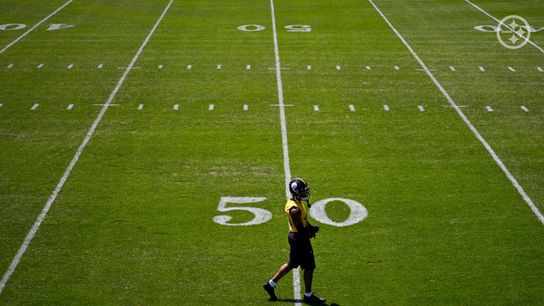
Steelers' Robert Spears-Jennings walks on the field during Organized Team Activities (OTAs) in 2026.
Rob King came away particularly impressed with rookie Robert Spears-Jennings, who replaced Rayshawn Jenkins during Pittsburgh's 27-24 loss to the Cleveland Browns. The seventh-round pick did more than intercept a pass in his most extensive defensive action yet. King noticed something Pittsburgh had been missing all night: when Spears-Jennings arrived at the football, the play generally ended.
That sounds painfully elementary, which is exactly why it stood out. Pittsburgh's defense spent stretches of the first half allowing Cleveland to turn manageable gains into larger problems. Jenkins was eventually pulled after a busted Cover 2 assignment helped produce a 60-yard completion, and Spears-Jennings entered a secondary already dealing with injuries and communication issues.
During a recent discussion, King explained what immediately separated the rookie.
“I thought Robert Spears-Jennings played great. He came in and, you know, I think from that point on, we didn’t see a lot of Rayshawn Jenkins… Robert Spears-Jennings, on a team that struggled with tackling, I didn’t see too many tackling issues with him. I saw a five-yard cross and all of a sudden the play ended. I saw a running back getting three or four yards and then up comes Robert Spears-Jennings and the play ends. You know, sure tackling,” King said.
The numbers back up the eye test. Spears-Jennings finished with seven tackles, six of them solo, and recorded his first career interception when second-year linebacker Jack Sawyer tipped a pass at the line. Pittsburgh challenged the original ruling after a pass-interference flag appeared to erase the turnover, and the interception ultimately stood because Sawyer had touched the football first.
For a player selected 224th overall in April, that is a fairly loud way to announce that defensive snaps no longer need to be treated like charity.
Pittsburgh drafted Spears-Jennings because the physical tools were impossible to ignore. He came out of Oklahoma with 178 career tackles, experience both in the box and deep, and enough range for the coaching staff to believe he could eventually handle multiple safety responsibilities. The question was how quickly a seventh-round traits bet could become trustworthy NFL football.
His early special-teams breakthrough gave him the first answer. Spears-Jennings earned weekly work by running, tackling and handling the dirty jobs young defensive backs usually have to master before a coordinator lets them near meaningful defensive snaps. Cleveland provided the next test.
Scott Galvin / Imagn Images
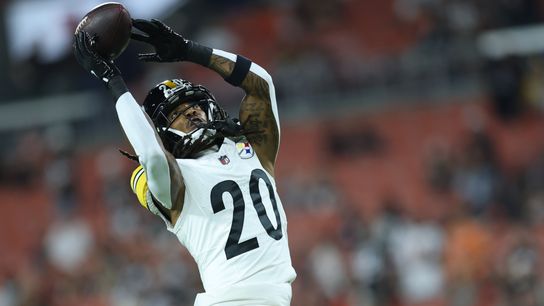
Pittsburgh Steelers safety Rayshawn Jenkins (20) practices before the game at Huntington Bank Field.
The encouraging part was how ordinary several of his best plays looked. King did not praise some spectacular diving breakup or reckless hit that sent everyone on the sideline jumping. He noticed a five-yard crossing route becoming a five-yard gain. He noticed a running back finding three or four yards and then stopping there.
That is winning safety play in its least glamorous form.
Pittsburgh has enough defenders capable of creating highlights. What it cannot survive is turning routine completions into explosives because the first tackler arrives high, late or out of control. A safety who consistently gets the ball-carrier on the ground gives the rest of the defense something far more valuable than a viral collision: predictability.
Spears-Jennings also entered the game under difficult circumstances. Jenkins' communication error had already helped Cleveland create one of the night's biggest plays, while the rest of Pittsburgh's secondary was being shuffled because of injuries. There was every reason for a rookie to play cautiously and simply try not to become the next mistake.
Instead, he looked comfortable enough to attack the football.
That performance has already changed how Mike McCarthy is discussing him. McCarthy said this week that Spears-Jennings is “ready” and expects the rookie to receive more opportunities moving forward. That is a significant jump for someone whose original path to the roster ran primarily through special teams.
Steelers Cannot Let Experience Automatically Win This Decision
One strong night does not make Spears-Jennings a finished NFL safety. Cleveland did not spend four quarters relentlessly testing him in coverage, and seventh-round rookies tend to encounter some ugly lessons once offenses gather enough film to attack them specifically. However, Pittsburgh should not overthink what it saw, either.
At this point, Jenkins' experience should not automatically protect his snaps if Spears-Jennings is tackling better, communicating more cleanly and making plays on the football. Veteran status matters when it produces veteran reliability. When it does not, the depth chart becomes a suggestion.
The Steelers may soon get DeShon Elliott back from injured reserve, which will reshape the safety rotation again. That makes every opportunity Spears-Jennings receives even more valuable. He does not need to prove he deserves a permanent starting job in one week. He needs to make taking him off the field uncomfortable.
King's examples explain why that case is growing. The rookie entered a defense that was missing tackles and immediately started ending plays where they were supposed to end.
Sometimes the most persuasive argument a seventh-round pick can make is also the simplest one. He tackles the guy with the football.
#SteelerNation