


The Pittsburgh Steelers spent Sunday checking the biggest box on their defensive to-do list. One of the NFL’s most dangerous runners never took over, Indianapolis kept settling for field goals, and Pittsburgh walked out of Acrisure Stadium with a 34-22 win. That sounds like the sort of afternoon a defense should happily file away. The longest-tenured voice in the room saw something much less comfortable hiding inside it.

Barry Reeger / Imagn Images
Pittsburgh Steelers safety Jaquan Brisker (3) breaks up a pass during the fourth quarter against the Indianapolis Colts at Acrisure Stadium.
Cameron Heyward is not interested in letting Pittsburgh become a defense that survives mistakes and calls the result good enough. During his recent media availability, the veteran captain rejected the idea that “bend but don’t break” should ever become an identity, even after the Steelers accomplished their first defensive priority by keeping Jonathan Taylor under control.
“You don’t ever want to go into a game saying, ‘Hey, let’s bend, but don’t break.’ That’s just not going to be successful in our league… Only thing I would say to that is let’s get some turnovers. We didn’t get any turnovers the entire game. So, that is one thing that really sticks out,” Heyward said.
The numbers explain why Heyward can appreciate the result without falling in love with the method. Taylor finished with only 45 yards on 15 carries, and the Indianapolis Colts managed 66 rushing yards as a team. Pittsburgh also forced Indianapolis to settle for five field goals and allowed only one touchdown. That is useful defensive football, especially against an offense built around making Taylor the engine.
It was hardly airtight. Indianapolis still produced 332 total yards, including 267 through the air, and finished the afternoon without turning the ball over once. Four completions went for at least 20 yards, while Taylor’s longest run reached exactly 20. The Colts spent enough time moving between the 20s that the defense kept having to win the same argument again once the field compressed.
That is where Heyward’s standard separates itself from the scoreboard. “Bend but don’t break” can sound flattering when the opponent keeps kicking field goals. It becomes a much uglier philosophy when one missed tackle, busted leverage angle or coverage error turns three points into seven. Counting on the red zone to erase earlier mistakes is not a defensive identity. It is a weekly stress test.
Pittsburgh would be making a mistake if it treated shutting down Taylor as proof that the unit has arrived. The run defense deserves credit for winning the matchup everyone spent the week discussing, but the Steelers are supposed to be building something more complete than a group that can dominate one category while conceding explosives elsewhere.
Heyward made that point even more directly when he compared the current group with the defenses he has played on and studied throughout his career.
“The other defenses I’ve been a part of and the defenses I’ve watched in the past, you have to be stingy… You can’t give up those explosive plays because they will come back to bite you… As a leader, as a guy who’s been around this league, we can’t be happy with giving up a 20-yard run,” Heyward said.
There is a reason that message carries more weight coming from him. Heyward is in his 16th NFL season, has captained Pittsburgh’s defense for more than a decade and has seen enough versions of good, average and disappointing Steelers football to recognize the difference between a strong Sunday and a sustainable standard. He also recorded Pittsburgh’s only sack against Indianapolis, so this was not a veteran critiquing everyone else from a safe distance.
Matt Taylor / X
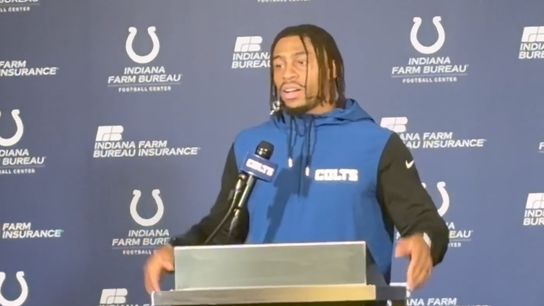
Colts' Jonathan Taylor speaking with the media in the 2026 season.
Takeaways are the other piece Pittsburgh cannot simply order on command. A defense can emphasize punching at the football, disguising coverage and forcing quarterbacks into bad decisions, but turnovers have some volatility built into them. What the Steelers can control is how many chances they create. Pressure, tight coverage, disciplined tackling and long-yardage situations make quarterbacks play closer to the edge. Soft zones, clean pockets and explosive gains tend to do the opposite.
The Colts never gave Pittsburgh the mistake it wanted. Their quarterback threw 44 passes without an interception, and Indianapolis did not lose a fumble. That meant every stop had to be earned without the shortcut a takeaway provides. The Steelers survived it because they tightened up near the goal line. Heyward clearly does not want survival becoming the weekly plan.
Steelers Have To Become Stingier Before The Margin Shrinks
This is the kind of opinion Pittsburgh’s defensive leader should have after a 12-point win. Celebration is easy. Finding the part that can get a team beaten two weeks later is considerably more useful.
Heyward is not arguing that the defense played poorly against Indianapolis. Holding Taylor to 45 yards and repeatedly forcing field goals were legitimate wins. His point is that a defense with Pittsburgh’s expectations should not need to choose between stopping the run, eliminating explosives and creating turnovers. Eventually, the best units do enough of all three that opponents stop finding comfortable ways to move the football.
That is a demanding standard, but Pittsburgh has built and paid this defense to live with demanding standards. “Good enough” is fine when the scoreboard hits zeroes. It becomes dangerous when players start using it as a description of who they are.
Heyward has been around too long to confuse bending without breaking with controlling a game. Against Indianapolis, the Steelers did enough to win. He wants the next version to make the opponent feel like there was nowhere to bend in the first place.
#SteelerNation