


The Pittsburgh Steelers watched Ben Roethlisberger become a franchise quarterback almost immediately, but the finished version did not arrive with the rookie. His early success was built on toughness, improvisation and an ability to survive plays that looked broken. The command that later defined him took years to develop, and Roethlisberger now admits he was determined to become more than a quarterback who flashed once and disappeared.
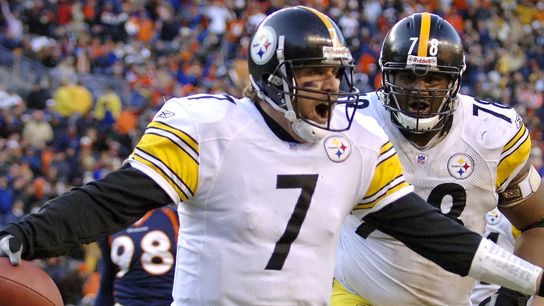
Peter Diana / Pittsburgh Post-Gazette
Former Steelers quarterback Ben Roethlisberger celebrates a touchdown during the 2005 AFC Championship game.
Roethlisberger entered the league capable of creating offense when the structure collapsed. He could escape pressure, absorb contact and turn a lost down into a first down. Those traits made him dangerous before he understood every detail of NFL quarterback play. They also allowed Pittsburgh to win while he learned inside an offense that did not need him to control every decision from the line of scrimmage.
Winning early can hide how much development is still required. Roethlisberger could have leaned entirely on his physical gifts and the strong roster around him. Instead, he wanted to prove his opening success was not temporary. During a recent episode of Footbahlin, he described the mindset that pushed him to keep expanding his game.
“I was trying to not be a one and run guy,” Roethlisberger said.
The line explains why his career became more than an early burst of winning. Roethlisberger did not want to be remembered as a young quarterback who benefited from the right defense, running game and timing. He wanted to understand why plays worked, recognize what opponents were trying to take away and become responsible for finding the answer.
His growth showed up in the areas that are harder to see than arm strength. He learned how to manipulate coverage with his eyes, identify pressure before the snap and understand which matchup gave the offense its best chance. The chaotic style never completely disappeared, but it became one part of a much broader game.
The next step required more control. A quarterback cannot change the offense at the line simply because he wants the authority. He has to prove he understands the protection, personnel, route concepts and defensive look. Roethlisberger said he eventually began pushing for exactly that responsibility.
“Give me more chances to change the play at the line of scrimmage,” Roethlisberger said.
Roethlisberger was no longer asking the coaching staff to trust his talent alone. He wanted the freedom that comes with preparation. If the defense showed pressure against a vulnerable protection, he wanted an answer. If a cornerback gave a receiver favorable leverage, he wanted the ability to attack it. The quarterback who once thrived after a play broke down became capable of fixing the play before it started.
That progression became central to Pittsburgh’s offense. Roethlisberger was often at his best when the tempo increased and he could read the defense without returning to a traditional huddle. The freedom to adjust protections, routes and concepts allowed his experience to become part of the play-calling process rather than something used only after the snap.
His comments also connect to the organization’s more recent quarterback freedom debate. Pittsburgh has spent years trying to replace Roethlisberger’s production, but replacing his control was always going to be more difficult. A playbook can be taught. The authority to recognize a bad call and replace it with the right one has to be earned over time.
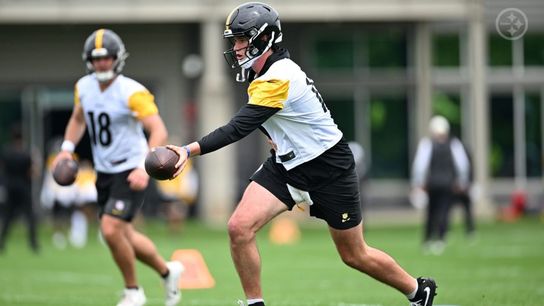
Steelers.com
Steelers' Drew Allar during practice with Will Howard in the background.
The lesson is especially relevant for Will Howard and Drew Allar. Both young quarterbacks are trying to show they can become more than developmental arms. Their preseason opportunities will reveal how they operate the offense, but the larger process will involve learning why the offense is built a certain way and how to respond when a defense disrupts the original plan.
Neither player should be expected to reach Roethlisberger’s level of command immediately. He developed that authority through preparation, mistakes and years of seeing how opponents tried to defend him. The important part is showing the appetite for the responsibility. A young quarterback who only waits for instructions has a ceiling. One who understands the system well enough to eventually challenge a call can begin changing the ceiling.
Steelers Saw Roethlisberger Grow Beyond Backyard Football
Roethlisberger’s improvisational ability made him famous, but it can also simplify how his career is remembered. He was not only the massive quarterback who shook off rushers and created something outside the structure. He became a sophisticated operator who could use formations, cadence and coverage recognition to control a defense before the ball moved.
The transformation required humility. Asking for more control also meant accepting more responsibility when an adjustment failed. Roethlisberger could not blame the original call after changing it. He had to study enough to live with the result and return with a better answer on the next series.
Pittsburgh benefited because its quarterback grew with the job instead of remaining the same player who first entered the lineup. His physical style helped him survive the beginning. His mental command allowed him to stay effective as defenses adjusted and his body changed.
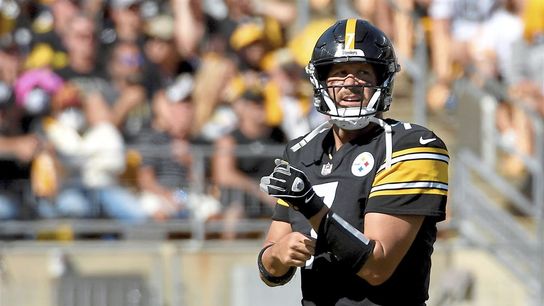
Matt Freed / Post-Gazette
Former Steelers QB Ben Roethlisberger.
Roethlisberger’s reflection offers a clearer view of his career. The early version wanted to prove he belonged. The later version wanted ownership of the entire offense. The distance between those two quarterbacks was created by preparation, trust and a refusal to become a brief success story.
The Steelers are still searching for their next long-term answer at the position. Whoever eventually earns that role will need talent, but talent will only begin the process. Roethlisberger lasted because he kept adding responsibility to his game. He stopped being only the player who rescued broken plays and became the quarterback trusted to prevent them from breaking in the first place.
#SteelerNation