


The Pittsburgh Steelers did not need long to realize their first padded practice had fallen below the standard they wanted from the offensive line. The group left the field feeling flat, then made a collective decision before the next session: more energy, better preparation and a sharper response when the workload increased.
Karl Roster / Pittsburgh Steelers
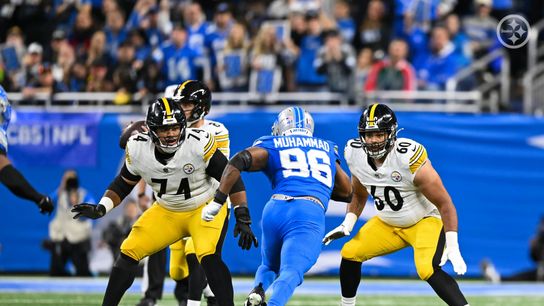
Steelers offensive linemen Spencer Anderson and Dylan Cook look to pass block during Pittsburgh's 29-24 win over the Detroit Lions in Week 16 of the 2025 NFL Regular Season.
Pads change the evaluation for every position, but nowhere is the difference more obvious than in the trenches. Footwork and assignment detail can be studied during non-contact practices. The real test begins when linemen must create movement, absorb power and maintain technique while their bodies begin to tire.
Pittsburgh’s offensive line did not believe it handled that transition well enough. Spencer Anderson, who has spent the offseason working as the first-team right guard, said the criticism came from inside the room rather than being imposed only by the coaching staff.
The line understood the next practice would include additional team periods and more inside-run work. The answer could not be limited to talking about effort. The players had to arrive more hydrated, better conditioned and prepared to sustain their intensity across a heavier schedule.
Anderson explained the group’s self-assessment during a post-practice interview.
“As an O-line, that’s what we kind of came to a conclusion—that it was kind of ‘meh’ for the entire group,” Anderson said. “So, we wanted to come out with more energy. Obviously, we knew we had more team periods, so we had to be more hydrated, more conditioned and more prepared.”
Pittsburgh’s offensive line is too young and too unsettled to waste padded practices. Troy Fautanu, Mason McCormick and Zach Frazier form the returning foundation, but the group is learning new spots and responsibilities under Mike McCarthy. Anderson is trying to secure right guard, while the right tackle competition remains open. Pittsburgh’s official camp preview described the unit as young, promising and still searching for its best combination.
A low-energy day affects more than one player’s grade. Offensive line play depends on five people matching their timing and physicality. If one blocker is late off the ball, a combination block can collapse. If the entire group lacks urgency, the offense cannot establish the tempo McCarthy wants in the running game.
The inside-run periods place those problems under a spotlight. There is little room for disguise when the defense knows the offense is testing its ability to move bodies. Linemen must come off the ball with leverage, keep their hands inside and finish the rep without losing control of their gap.
James Campen has made clear that draft position will not decide the starting five. His standard centers on who can perform the job when real football begins, regardless of how each player entered the league. Anderson’s place with the first unit gives him the first opportunity, but it does not protect him from the same criticism the group directed at itself.
The right guard battle adds urgency to every padded session. Rookie Gennings Dunker was drafted in the third round to bring power and competition inside, while Brock Hoffman offers experience in McCarthy’s system. Anderson cannot win the job by merely being the first player in line. He has to help set a standard the entire unit can follow.
Pittsburgh has already invested heavily in the offensive line, and the group has been discussed as a potential strength. McCormick’s transformation showed how much the offense is counting on its young blockers to become tone-setters rather than unfinished projects.
Jordan Schofield / SteelerNation (X: @JSKO_PHOTO)
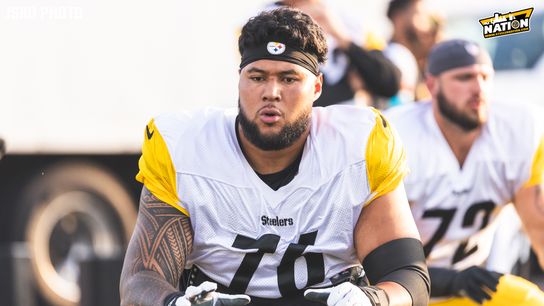
Steelers offensive lineman Troy Fautanu (76) during 2025 training camp in Latrobe, PA.
The second padded practice offered a chance to begin proving the first day was an exception. More team periods demanded sustained communication. More inside-run work forced the line to handle direct, physical challenges. The players could not manufacture energy for one early drill and allow it to disappear once fatigue arrived.
Conditioning becomes part of technique in those moments. A lineman may understand his assignment, but tired legs can raise his pad level and weaken his base. Anderson’s reference to hydration and preparation shows the group recognized that intensity begins before practice. The line had to prepare its body for the workload if it expected the football to improve.
Steelers' Offensive Line Must Make The Pact Last
One stronger practice will not complete the correction. Pittsburgh needs the same urgency when camp becomes repetitive, when soreness accumulates and when preseason games begin taking attention away from daily drills. The value of the players’ decision will come from whether the standard remains visible after the initial response.
The group’s willingness to police itself is encouraging. Campen and McCarthy can demand more, but a line develops its identity when the players recognize a poor performance before a coach has to explain it. Anderson described a room that did not accept an ordinary day simply because the season remained weeks away.
That accountability is especially important with no established veteran at every spot. Fautanu, McCormick and Frazier are entering their third seasons. Anderson is fighting for his first permanent starting role. Rookies are trying to climb the rotation. The unit has to build leadership collectively rather than waiting for one longtime starter to supply all of it. Pittsburgh’s official preview noted that even the group’s veteran options are relatively young, increasing the importance of cohesion and internal standards.
The first padded practice gave the offensive line an early warning. The next one provided a chance to answer it. Pittsburgh will learn much more from the response than it would have from a comfortable opening day.
The Steelers do not need every camp practice to look perfect. They need a group capable of recognizing when “meh” is not enough and changing the tone before the problem becomes a habit.
#SteelerNation