


The Pittsburgh Steelers escaped their opener with the luxury every team wants in September: mistakes to correct without a loss attached to them. Dropped passes can disappear with a better afternoon. Tackling usually gets cleaner once bodies adjust to regular-season speed. Even communication errors can look enormous one Sunday and completely ordinary seven days later. One part of Pittsburgh’s uneven debut, however, is much harder to file neatly under “Week 1.”
Jordan Schofield / SteelerNation (X: @JSKO_PHOTO)
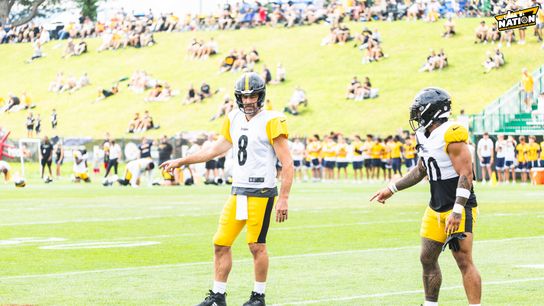
Pittsburgh Steelers quarterback Aaron Rodgers (8) and running back Jaylen Warren (30) during 2026 training camp at Saint Vincent College in Latrobe, PA.
Matt Williamson is considerably less willing to dismiss Pittsburgh’s running game as opening-day rust. The Steelers managed only 58 official rushing yards in their 20-13 victory over the Atlanta Falcons, and Williamson sees that as a more stubborn concern than some of the other mistakes that cluttered an otherwise successful afternoon.
During a recent episode of SNR Drive, Williamson contrasted the rushing struggles with errors he expects to naturally become less frequent as the season develops.
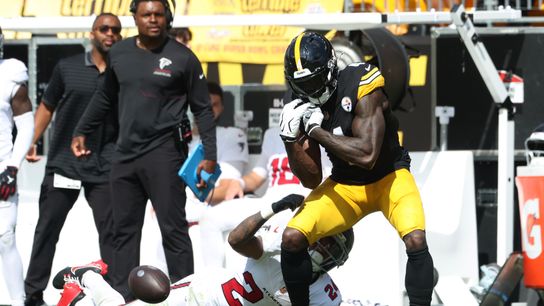
“I would say the Steelers’ run game concerns me a lot. I mean, that’s the one that I’m not confident — or one of them was like Metcalf drops. Like, I don’t think that’s going to happen all year. You know what I mean?” Williamson said.
The distinction is important. DK Metcalf can have a bad afternoon catching the football without Pittsburgh wondering whether its entire passing structure is broken. Drops are costly, particularly when a receiver is being paid to win difficult situations, but they can also be brutally simple. The quarterback delivered a catchable ball. The receiver did not finish it. Try again next week.
A struggling rushing attack requires considerably more detective work.
Jaylen Warren finished with 46 yards on 10 carries, while Rico Dowdle produced 15 yards on eight attempts. Pittsburgh’s official total fell to 58 because of three Aaron Rodgers kneel-downs, but removing victory formation does not suddenly make 61 yards on 18 running-back carries particularly impressive.
There were individual successes. Warren ripped off a 9-yard run late that helped Pittsburgh close the game, and the Steelers finally found enough movement when Atlanta knew the ground attack was coming. That closing sequence was encouraging precisely because so much of the afternoon before it had felt laborious. Pittsburgh did not consistently create the type of clean lanes that allow a backfield to establish rhythm.
That is why Williamson’s concern reaches beyond whether Warren or Dowdle happened to miss a crease. A running game is a group project with an unusually large number of people capable of ruining it. The blocking has to create the proper leverage, the back has to read it correctly, the play design has to attack the defensive picture and the offense has to prevent defenders from treating every handoff like an invitation to sprint downhill.
Pittsburgh failed to consistently satisfy that equation Sunday.
Charles LeClaire / Imagn Images
Steelers' DK Metcalf drops a pass during a win over the Atlanta Falcons to open the 2026 season at home.
The Steelers’ Week 1 offensive issues also forced Rodgers into a much larger passing workload than Pittsburgh probably wants every week. He attempted 40 passes while the offense never established enough success on the ground to make the Falcons consistently respect both possibilities. Balance does not require a perfectly even play-call sheet, but an offense becomes easier to defend when one half of the menu stops frightening anybody.
The offensive line deserves part of the examination without becoming a convenient dumping ground for every unsuccessful carry. Pittsburgh struggled to generate movement early, and several rushing attempts died before the backs had much opportunity to manufacture something. Other plays offered more room than the final result suggested. Fixing the run game therefore cannot be reduced to changing one blocker, feeding one back or circling a different concept on Mike McCarthy’s call sheet.
That uncertainty is what separates the issue from Metcalf’s drops. Pittsburgh knows exactly what fixes a dropped pass: catch the next one. A rushing attack that cannot establish itself requires finding out whether the source is execution, personnel, blocking technique, defensive numbers, play selection or some combination that moves from snap to snap.
Steelers Need More Than A Week 2 Bounce Back
One productive rushing afternoon against New England would certainly quiet the discussion, but Pittsburgh needs evidence that the improvement can travel.
Warren has already demonstrated he can produce in this offense, and Dowdle arrived after consecutive 1,000-yard seasons. The backfield does not lack NFL-caliber runners. That makes the opener more interesting because the Steelers assembled a tandem specifically designed to avoid depending on one player for everything.
The challenge is constructing an environment where either back can actually use those traits. Warren’s burst becomes far less valuable when first contact arrives near the line of scrimmage. Dowdle’s vision and contact balance cannot rescue every rep that begins with defenders occupying the intended lane. No running back gets to carry a toolbox large enough to repair the blocking while accepting the handoff.
Williamson is not predicting Pittsburgh will spend the season unable to run. His concern is that this particular flaw requires more faith than assuming an accomplished receiver will stop dropping passes or that tackling will sharpen after the opener.
That makes Sunday against the New England Patriots more than an opportunity to improve an ugly statistic. Pittsburgh needs to find out whether Week 1 exposed a temporary malfunction or something built deeper into the machinery.
The Steelers already know how to fix a dropped football. Their running game has a much longer troubleshooting menu.
#SteelerNation