


The Pittsburgh Steelers spent most of September learning an uncomfortable truth about new systems: sometimes the first answer is just the first answer. Training camp can stretch for weeks, coaches can watch hundreds of reps and a depth chart can look perfectly reasonable on paper. Then the regular season arrives, somebody gets your quarterback hit, the running lanes vanish and suddenly patience starts looking a lot less noble.
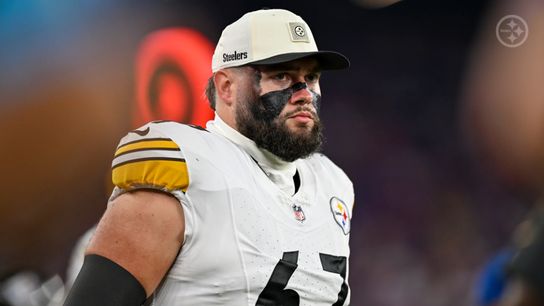
Karl Roser / Pittsburgh Steelers
Steelers offensive lineman Brock Hoffman watches on from the sidelines during a preseason game in August of 2026.
That is why Mark Kaboly and Dorin Dickerson are giving Mike McCarthy credit for what happened next. Pittsburgh replaced Spencer Anderson at right guard with Brock Hoffman and Dylan Cook at right tackle with Max Iheanachor before Sunday's 30-27 win over the Cincinnati Bengals, changing two-fifths of the offensive line for its third game of the season.
The result made the timing look considerably smarter. After allowing four sacks and seven quarterback hits in a 20-3 loss to the New England Patriots, Pittsburgh cut the sack total in half against Cincinnati while producing 411 yards and 30 points. The running game piled up 140 yards before two kneel-downs were subtracted from the final total, and Aaron Rodgers threw for 292 yards and three touchdowns. The offense did not become flawless in seven days, but it stopped looking like every snap required an escape plan.
Pittsburgh had already hinted that a right-side shakeup was coming when Hoffman and Iheanachor began working together during practice. McCarthy later confirmed the decision had been discussed after the New England loss and made earlier in the week. Iheanachor was finally deemed ready for his first NFL start, while Hoffman had been pushing for an opportunity inside.
During a recent discussion, Kaboly and Dickerson argued that the speed of McCarthy's response deserves as much attention as the move itself.
“How often do you see, unless there’s like significant injuries, a head coach take two offensive linemen and say, ‘Nah, you’re out,’ put two new ones in? That doesn’t happen… You don’t see that type of change this early in the season… It’s an admission of making a mistake, which is not a bad thing. I think that’s good leadership. He probably watched the tape of the Patriots game, Mike McCarthy, and went, ‘We’re playing the wrong guys.’… And to then make that change in one week, and boy did it pay dividends,” Kaboly and Dickerson said.
The wording is important because McCarthy never walked to a microphone and announced that his original lineup was wrong. His actions said enough. Coaches are usually much better at explaining why a plan needs more time than volunteering that September has already changed their mind. There are months of evaluation behind a starting lineup, and replacing two players at once can feel like throwing away part of that work.
There was also some injury context with Anderson, who suffered a bone chip in his right leg during the Patriots game. That makes his individual situation more complicated than a simple benching. Cook's spot, however, had already been under pressure, and Iheanachor's return to full football shape gave Pittsburgh a first-round alternative it did not realistically have when the season opened.
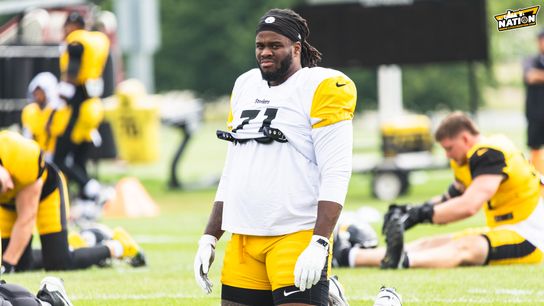
Jordan Schofield / SteelerNation (X: @JSKO_PHOTO)
Steelers offensive lineman Max Iheanachor during 2026 training camp at Saint Vincent College in Latrobe, PA.
What makes the decision notable is that McCarthy did not wait for the calendar to give him permission. Offensive-line continuity is usually treated like something between a football principle and a sacred family recipe. Coaches want the same five players communicating, passing off games and learning each other's tendencies. Constant movement can create its own problems, especially for a group already adapting to a new scheme.
Continuity becomes a much less persuasive argument when the same five are producing bad football. Pittsburgh's protection against New England broke down often enough that Rodgers was pressured on 38.6% of his dropbacks. The right side had been the biggest question entering the year, and Week 2 did nothing to make that uncertainty quieter.
Hoffman and Iheanachor did not solve every issue against Cincinnati. Rodgers was still sacked twice, and one productive Sunday does not permanently settle two starting jobs. What they did provide was evidence that the coaching staff's willingness to interrupt the original plan had value. Pittsburgh ran the ball with authority, created explosive plays and finally gave McCarthy enough stability up front to call an offense rather than manage a weekly emergency.
Steelers Needed McCarthy To Value The Answer Over His Original Plan
Kaboly and Dickerson's larger point is really about leadership. There is no trophy for being correct in May if the evidence changes in September. McCarthy and his staff spent the offseason identifying Anderson and Cook as the best right-side combination available at the time. Two games later, they had enough information to reconsider it.
The harder part for a coach is acting before a bad decision becomes a commitment. Depth charts have inertia. Veterans get the benefit of familiarity, young players are told to wait and staffs can convince themselves that one more week will produce the correction they expected all along. McCarthy skipped that stage.
Now the burden flips to Hoffman and Iheanachor. One good afternoon bought them credibility, not permanent ownership of the jobs. Cincinnati provided the first evidence that Pittsburgh may have found a better combination, and Thursday night will immediately test whether the improvement travels.
McCarthy's best offensive decision of Week 3 may have happened before he called a single play. He looked at a plan that was not working, changed two names and accepted whatever that said about the original choice. Sometimes good coaching is drawing up the right answer. Sometimes it is erasing the wrong one before pride turns the pencil into ink.
#SteelerNation