


The Pittsburgh Steelers have watched the AFC North spend September behaving less like a hierarchy and more like four people fighting over one chair. Nobody has created much breathing room, injuries have already started rearranging depth charts and every weakness feels more expensive because the standings remain packed together. One division rival just decided waiting for its biggest offensive problem to fix itself was no longer an acceptable option.
Bill Streicher / Imagn Images
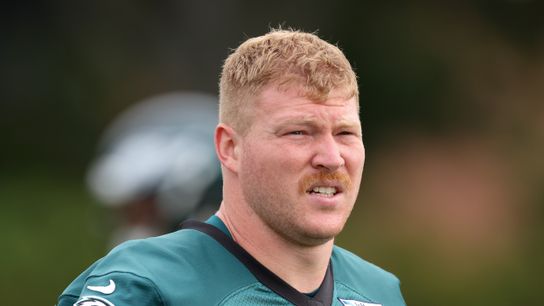
Philadelphia Eagles’ Cam Jurgens participates in training camp at the Jefferson Health Training Complex in 2026.
The Baltimore Ravens acquired Cam Jurgens from the Philadelphia Eagles on Wednesday, sending Philadelphia a 2027 fifth-round pick and a 2028 second-round selection while receiving Jurgens and a 2027 seventh-rounder. It is an aggressive price, but Baltimore had reached the point where its center situation was beginning to resemble an injury report with a snapper attached.
Matt Williamson and Wes Uhler see both desperation and ambition in the deal. The Ravens are fixing an emergency, but they are also spending legitimate future capital because they believe the current roster is capable of chasing something much larger than an AFC North lead.
During a recent episode of The Drive, Williamson and Uhler explained why both descriptions can be true.
“I think it’s a little bit of a desperation move… It’s also a win-now, ‘We can win the Super Bowl’ move… It does make the Ravens better… I don’t think it’s an earth-shattering move to the tectonics of the division or anything,” Williamson and Uhler said.
Desperation is not an unfair word. Baltimore lost longtime center Tyler Linderbaum to Las Vegas during the offseason, then watched three veteran replacements — Danny Pinter, Jovaughn Gwyn and Ethan Pocic — land on injured reserve before October. First-round rookie Vega Ioane had to move over from right guard and start at center simply to keep the operation functioning.
Pittsburgh had actually been watching Baltimore's center problem develop since the spring. The Ravens failed to land one of their preferred options in the draft, and there was already an expectation that the eventual starter might have to come from another roster. Five months later, that prediction became extremely literal.
Jurgens is considerably better than a typical October emergency patch. The 2022 second-round pick made the Pro Bowl in each of his first two seasons as Philadelphia's starting center and helped anchor the Eagles' Super Bowl-winning line in 2024. He is also under contract through 2029 after signing a four-year, $68 million extension, so Baltimore did not surrender a future second-rounder for a half-season rental.
That is where the “win-now” portion becomes interesting. Baltimore is 3-1, tied with Cleveland atop the AFC North, while Pittsburgh sits only one game behind at 2-2. The Ravens already looked like a legitimate contender. They did not need a trade to announce themselves as one. What they needed was to stop a problem at center from sabotaging everything around it.

Matt Krohn / Imagn Images
Ravens' Lamar Jackson after a preseason game during the 2026 season.
For an offense built around Lamar Jackson, instability in the middle is particularly annoying. Protection communication starts there, interior leakage can destroy the pocket before Jackson gets to exploit the edges, and bad center play can turn basic shotgun operation into an adventure no Super Bowl contender ordered.
A 2028 second-round pick is still a serious price. That is not the type of asset a front office should toss into a deal simply because Week 5 feels uncomfortable. But allowing a center crisis to waste a season in the middle of Jackson's prime would be worse roster management than paying a premium to solve it. Baltimore identified a structural problem and attacked it before November could turn urgency into panic.
The move is not flawless. Jurgens has not played at his 2024 level recently, and NFL.com's evaluation of the trade noted that his performance dipped last season and remained uneven through Philadelphia's first four games this year. Baltimore is betting that the player it is acquiring can return closer to his Pro Bowl form once dropped into a more stable role.
That also explains why Williamson and Uhler stopped short of treating the deal like an AFC North earthquake. One good center makes the Ravens cleaner. It does not make them unbeatable.
Steelers Should Respect The Move Without Treating Baltimore Differently
The Steelers already knew Baltimore was dangerous. One trade does not suddenly add Jackson, redesign the offense or transform a bad roster into a contender. The Ravens were 3-1 before Jurgens arrived and had scored 116 points through four games. Pittsburgh's problems in the division did not begin Wednesday afternoon. What changed is that Baltimore removed an obvious weakness without waiting for it to become fatal.
That should matter to Pittsburgh because division races often turn on which team fixes its problems first. The Ravens decided a future second-round selection was worth stabilizing the middle of their offensive line now. The Steelers do not need to panic in response, but pretending the move means nothing would be equally silly.
Williamson and Uhler have the balance right. Baltimore got better. The price reflects both desperation and belief. Neither automatically hands the Ravens the division.
What the trade really says is that Baltimore believes its 2026 season is valuable enough to borrow aggressively from 2028. For a team chasing the same division crown, Pittsburgh should probably notice.
#SteelerNation