


The Pittsburgh Steelers brought home another win from Paris, but one play followed them across the Atlantic. For a few seconds, it looked like the defense had produced something bigger than a stop. Then the celebration disappeared, and a former Pittsburgh star spent Monday explaining why. The win hadn't settled the argument.
Jordan Schofield / SteelerNation (X: @JSKO_PHOTO)
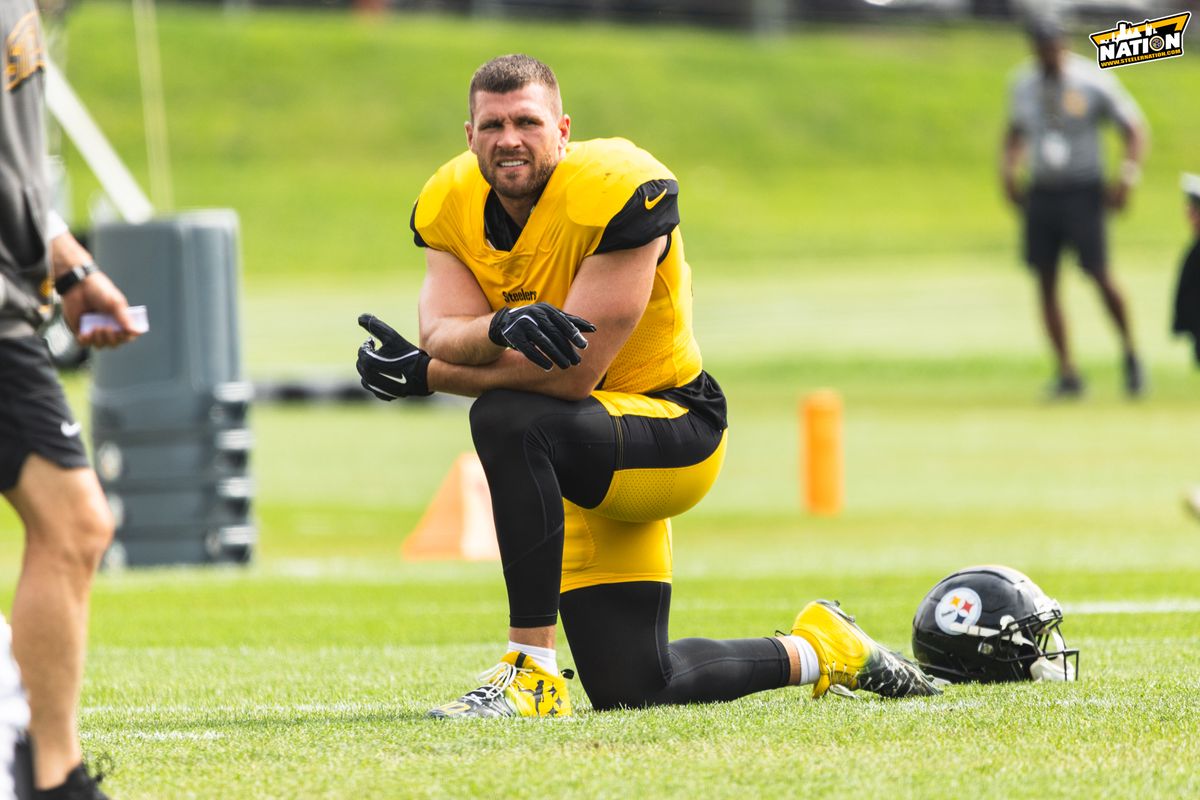
Pittsburgh Steelers star edge rusher TJ Watt (90) during 2026 training camp at Saint Vincent College in Latrobe, PA.
Former Steelers linebacker James Harrison blasted the decision to overturn TJ Watt's apparent strip-sack and fumble recovery during Sunday's 16-10 victory over the New Orleans Saints. Officials initially awarded Pittsburgh the football after Watt brought down quarterback Tyler Shough. An expedited replay review instead ruled Shough down with possession, leaving Harrison questioning the evidence.
The sequence came with 10:49 remaining in the second quarter and Pittsburgh leading 3-0. New Orleans had reached the Steelers' 18-yard line when Watt beat his blocker and got to Shough. As both players went toward the ground, Watt attacked the football, which shifted in the quarterback's grasp. Watt finished with the ball, and the on-field ruling gave Pittsburgh possession.
Then replay intervened. Officials concluded Shough still controlled the ball when his knee touched the turf. The play became a seven-yard sack, forcing third-and-18 instead of a turnover. The Saints gained five yards on the next snap, then kicked a 38-yard field goal to tie the game.
During Monday's Deebo & Joe episode, Harrison made it clear he wasn't buying the explanation.
“That man T.J. Watt get up in that thing. That's a sack, fumble recovery. How do you reverse that? It's beyond me. It's coming out already. All loose. It was moving. It was moving,” Harrison explained.
Harrison had a more specific objection than team loyalty. The call on the field was a fumble, meaning replay needed clear and obvious evidence to change it. The issue wasn't whether the ball eventually escaped. It was whether Shough had already lost control before his knee hit. The angles left room for argument.
Harrison also questioned treating a quarterback's grip differently from a runner's. He believed the movement established lost possession.
“Stole it, bro. It's moving. Like if that's a running back going down, y'all don't… You saw the ball was moving,” Harrison said.
The expedited process makes the dispute particularly awkward. Such reviews can be resolved without sending the referee to a sideline monitor, but the burden to overturn an on-field ruling does not become lighter because the decision happens quickly. If the original fumble call required correction, replay needed to show precisely when Shough still possessed the football. Harrison is asking for that proof.
The accusation becomes more interesting with the record book involved. Watt already has 37 career forced fumbles, tied with former Steelers linebacker Greg Lloyd for the franchise lead. Had Sunday's original ruling stood, Watt would have moved into first place alone with No. 38. Instead, he walked away with a sack and another replay for fans to dissect.
The turnover had immediate implications. New Orleans had advanced into field-goal range and was threatening Pittsburgh's early lead. A recovery near the Steelers' 22 would have ended that opportunity altogether. By reversing possession, the Saints retained enough field position to come away with three points. In a six-point game, that swing counts.
Still, the distinction between a controversial reversal and a proven officiating mistake cannot get lost. A football can move within a player's hands without the player necessarily surrendering control. If Shough maintained possession until his knee hit, the ruling was correct. Harrison's strongest argument concerns the certainty needed to reverse the on-field decision, not an automatic rule that any visible movement constitutes a fumble.
That isn't the only frustrating near-turnover the Steelers experienced in Paris. Cole Holcomb jarred the ball loose from a Saints runner near the goal line, with Patrick Queen involved in the stop. That apparent takeaway also vanished because the runner was down first. The defense kept coming close and leaving empty-handed.
Karl Roser / Pittsburgh Steelers
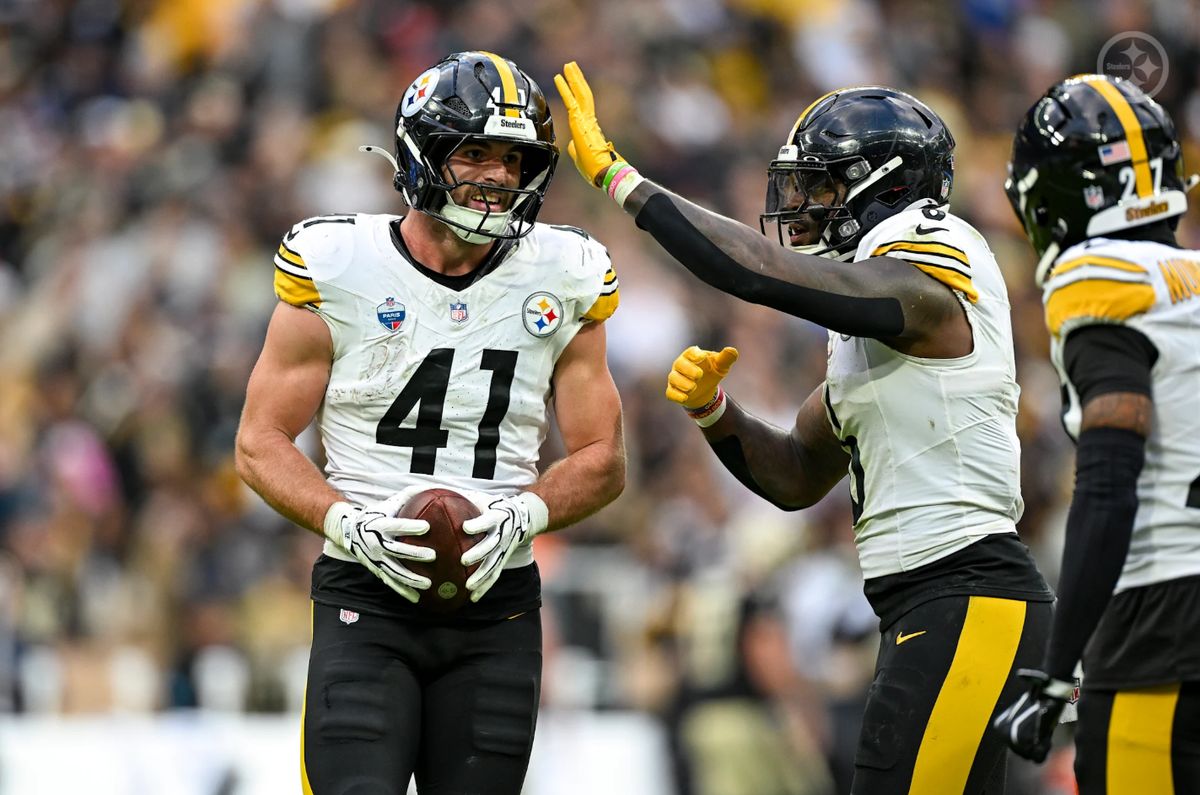
Steelers linebacker Payton Wilson (41) celebrates with Patrick Queen (6) after a big play during the game against the Saints in Paris, France.
Eventually, Payton Wilson delivered one that survived review, intercepting Shough near the goal line in the third quarter. Pittsburgh's defense held New Orleans scoreless after halftime and limited its running game to 18 yards on 17 attempts. Pittsburgh improved to 5-2, but the complaint remained. A stronger opponent might not offer the same margin.
The argument also fits Watt's history with the officials. He has previously explained how he speaks with referees before games about his unusually quick get-off, hoping his timing won't be mistaken for an early jump. This time, the issue wasn't how he reached the quarterback. It was what happened between his hand meeting the ball and Shough's knee meeting the ground.
Steelers Have Every Reason To Question This Replay Standard
Harrison was right to challenge the threshold for changing that call. The NFL built replay around correcting clear mistakes, and a borderline fight over when possession ended should demand more than a persuasive-looking freeze-frame. An expedited decision that turns an on-field takeaway into a routine sack deserves an explanation sturdy enough to survive another look. That's especially true when it also erases a franchise-record play.
None of this requires pretending Watt was officially credited with a forced fumble. He wasn't, and Pittsburgh still won. But asking why the original ruling was reversed isn't sour grapes, either. Harrison saw a defender make a remarkable effort, get the football and watch the result disappear. He believes the league took something away without sufficient proof.
The Cleveland Browns come to Pittsburgh next Sunday, and Watt will have more chances to break Lloyd's mark. Harrison's frustration is unlikely to last only until that happens. Fans can accept corrections backed by conclusive evidence. In Paris, the replay may have ended the play, but it certainly didn't end the argument.
#SteelerNation