


The Pittsburgh Steelers released an initial depth chart that offers a useful first look at the roster, but one line in the backfield may be more misleading than informative. The order suggests a clean hierarchy behind Pittsburgh’s top two runners. Training camp and special teams responsibilities are telling a much different story.
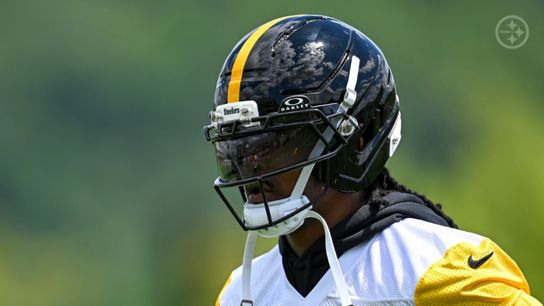
Karl Roser / Pittsburgh Steelers
Steelers running back Rico Dowdle participates in Organized Team Activities (OTAs) in May of 2026.
Jaylen Warren and Rico Dowdle remain the clear leaders of the room. Both have produced as NFL starters, and Mike McCarthy can divide the workload without treating either player like a conventional backup. The real roster pressure begins with the names underneath them.
A printed depth chart can make that competition appear simple. One player is listed third, another fourth and someone else fifth. The final roster will not be decided through a straight ranking of rushing ability. Pittsburgh has to identify which reserve backs can dress on game day and contribute when Warren and Dowdle are handling most of the offensive touches.
Jeff Hathhorn believes the first chart fails to capture that reality. During a recent Steelers discussion, he challenged the placement of Travis Homer near the bottom and questioned whether Kaleb Johnson has done enough to feel secure.
“Here’s the one that I don’t believe: that Travis Homer is the, what, fifth running back?” Hathhorn said. “Because he’s so valuable on special teams… Kaleb Johnson, from what we’ve seen to this point, has only value as a returner… I would be shocked if Homer is not on this roster.”
Homer’s résumé explains the confidence. He has spent seven NFL seasons creating value beyond traditional running back work, recording 46 special teams tackles while appearing in 85 games. Pittsburgh signed him to a one-year deal because the bottom of a depth chart is often built around players who can help without receiving offensive touches.
That skill set becomes more important when the active roster is reduced on game day. A third or fourth running back may receive only a few carries, if any. He can still play on kickoff coverage, punt coverage and return units. Homer has already proved he can handle those assignments against NFL competition, giving special teams coordinator Danny Crossman a dependable option.
The initial depth chart does not fully account for that part of the evaluation. It organizes the offensive position, but it cannot show which reserve is most likely to receive a helmet because he can cover kicks, protect on returns or handle an emergency offensive assignment. Homer may sit behind several backs on paper while holding one of the strongest roster cases in the room. Pittsburgh has acknowledged in past depth-chart releases that special teams value is not fully represented by the listed offensive order.
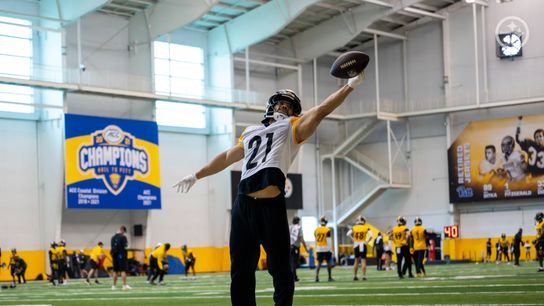
Taylor Ollason / Pittsburgh Steelers
Steelers running back and special teams ace Travis Homer leaps to grab a football while the team goes through Organized Team Activities workouts in 2026.
Johnson’s situation moves in the opposite direction. Pittsburgh selected him in the third round of the 2025 NFL Draft after a productive career with the Iowa Hawkeyes, but his rookie year never developed into a meaningful offensive role. He finished with 28 carries for 69 yards, and his costly mistake on a kickoff against the Seattle Seahawks became the moment that defined his first season.
The new staff gives Johnson a fresh opportunity, but draft status offers less protection than it did a year ago. McCarthy did not select him, and the top two offensive jobs are already occupied. Johnson has to show that he can provide something valuable when he is not carrying the football.
His possible short-yardage path could help separate him. Johnson has the size to handle physical situations and give Pittsburgh a different profile near the goal line or in late-game work. That role only helps if the staff trusts him enough on special teams and without the ball to keep him active.
Returning kicks alone may not create enough separation. Pittsburgh has other return options, and a reserve running back must provide more than one narrow assignment. Johnson has to show he can cover kicks, block, catch the football or become a dependable short-yardage runner.
The comparison with Homer places the roster decision in clear terms. Johnson offers youth, size and remaining developmental upside. Homer offers known special teams production and experience performing a job the Steelers will need every week. The depth chart may list Johnson higher, but the final 53 will reward usefulness rather than draft history.
Steelers Cannot Let The Depth Chart Hide The Real Competition
Pittsburgh’s preseason games should provide a more accurate order. Johnson needs offensive touches that show he has improved from a disappointing rookie year, but his work away from the football may carry even more weight. Homer must continue proving his special teams value while showing he can handle a limited offensive role if injuries force him into action.
The final running back spot will be compared with needs across the entire roster. Pittsburgh may prefer an extra defensive back, offensive lineman or coverage specialist if the last back cannot help in several phases. Johnson is not competing only against Homer. He is competing against every player whose game day usefulness could justify the same spot.
Hathhorn’s skepticism reflects how NFL rosters are actually constructed. The third-best pure runner is not always the third running back kept. Coaches need reserves who can fill multiple assignments, survive injuries and contribute immediately without requiring the game plan to feature them.
Homer has built an NFL career around that reality. Johnson is still trying to prove he can adapt to it.
The initial depth chart gives Pittsburgh a temporary order. It does not give anyone a roster spot. Once special teams, game-day value and preseason performance are included, the back listed fifth may be safer than the player currently standing above him.
#SteelerNation