


The Pittsburgh Steelers already had more defensive linemen than comfortable roster spots when training camp began. That usually leaves a late-round rookie with a simple assignment: stay out of the way of the established names and hope somebody notices. One of Pittsburgh’s newest big men apparently skipped that part of the orientation and started giving the veterans, and the front office, another player to think about.
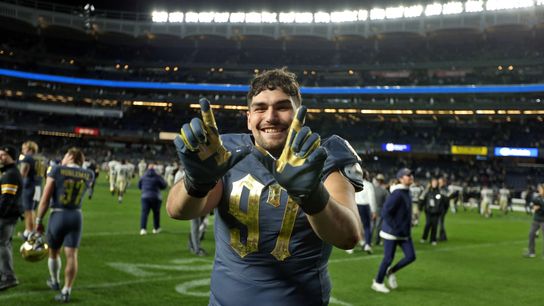
Danny Wild / Imagn Images
Steelers' Gabriel Rubio during his time with Notre Dame.
Gabriel Rubio entered camp without the security attached to Pittsburgh’s higher draft picks. The Steelers selected him 210th overall in the sixth round after an injury-shortened final season with the Notre Dame Fighting Irish, placing him in one of the deepest position groups on the roster. Pittsburgh did not need him to start. It needed him to prove there was a reason not to send him through roster cuts.
Rubio is beginning to build one.
The rookie has caught the attention of Cameron Heyward, which is about as useful an endorsement as a young Steelers defensive lineman can receive. Heyward has spent 15 years learning which traits survive in an NFL trench and which ones disappear as soon as the pads come on. Rubio’s early work has shown him enough of the former.
During his latest media availability, Heyward highlighted the rookie’s pad level, hand usage and ability to disengage from blockers. He has also noticed how Rubio approaches the mental side of the position.
“I think he’s just absorbing,” Heyward said. “You come to a situation where it’s different from college. He’s playing with good pad level, good hands, but he’s also getting off blocks. He’s also asking a lot of good questions. So, it’s a good start for him.”
The physical traits were never especially difficult to locate. Rubio is listed at 6-foot-5 and 321 pounds, which makes hiding in a defensive line meeting approximately impossible. Pittsburgh valued his length and strength during the draft process, while new defensive coordinator Patrick Graham specifically praised his ability to defeat blocks and hold up against the run.
The questions centered on how quickly those traits would translate. Rubio appeared in 39 college games, but started only eight, and injuries limited his final Notre Dame season to six appearances. His college production, 66 tackles, 7 tackles for loss and 1.5 sacks, did not suggest Pittsburgh was drafting a finished product.
Training camp is giving the Steelers a better look at the player underneath those numbers. Rubio does not need to suddenly develop into a double-digit sack threat. His clearest route onto the roster is much less glamorous: play with leverage, occupy blockers, get off them when the ball arrives and make life easier for everyone behind him.
Those are exactly the areas Heyward mentioned.
The asking-questions portion should not be ignored, either. Rookie defensive linemen can possess every physical tool required and still spend August getting introduced to blocking schemes they rarely saw in college. Rubio has to recognize combinations, understand where his help is coming from and know when Pittsburgh wants him controlling a blocker rather than trying to shoot into the backfield.
Asking Heyward questions is a fairly efficient shortcut. If there is a defensive line version of office hours, sitting near an eight-time Pro Bowler is probably a decent place to start.
Rubio’s improvement also makes Pittsburgh’s roster bubble concern more complicated. Before camp, he looked like one of the draft picks with a legitimate chance of landing on the practice squad rather than the initial 53. The defensive line already had several players who appeared difficult to remove.
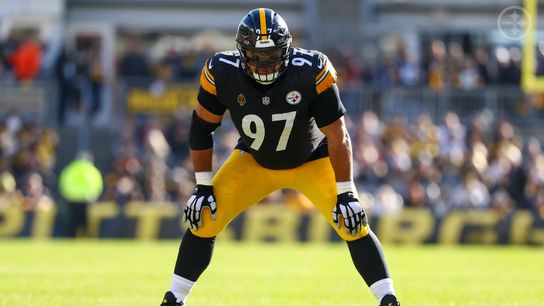
Jared Wickerham / Pittsburgh Steelers
Steelers' Cam Heyward gets ready to make a play during Week 14 against the Cleveland Browns.
Heyward remains the foundation. Derrick Harmon, Keeanu Benton, Yahya Black and Sebastian Joseph-Day give Pittsburgh a deep group before the competition reaches Rubio. Esezi Otomewo, Logan Lee and Dean Lowry add more experience to the fight.
There are only so many large humans a team can take into Week 1.
Rubio’s job is making Pittsburgh uncomfortable with the idea of losing him. A sixth-round pick does not receive a roster spot because the organization would prefer its draft class to look tidy. If an experienced player offers more immediate value, the rookie can be exposed to waivers. If Rubio keeps winning physical reps, that decision becomes riskier.
Special teams could help settle the math. Backup defensive linemen need to contribute on field goal protection and kick-block units, particularly if their defensive snaps will initially be limited. Rubio’s size and length offer obvious potential there, but preseason games will reveal whether he can become dependable enough to justify a game-day helmet.
Steelers May Have A Good Problem Getting Bigger
The preseason should be especially valuable for Rubio because his game is built for actual contact. There is only so much a 321-pound defensive lineman can prove while everyone is being told not to finish the play. Exhibition snaps will force him to handle double teams, maintain his leverage and find the football when opponents are trying to move him for real.
His technique will be tested repeatedly. Tall defensive linemen can lose leverage when their pads rise, and NFL guards will happily turn that mistake into several yards of free transportation. Heyward noticing Rubio’s pad level this early suggests the rookie understands where his size can become a weakness if he does not control it.
The Steelers do not need Rubio to jump established veterans in August. They need evidence that the developmental curve is pointing upward quickly enough to protect him from the waiver wire.
Heyward appears to be seeing it.
A good start does not guarantee Rubio anything, especially in a room this crowded. It does mean the sixth-round rookie is beginning to turn a fairly easy roster projection into something much messier.
For Pittsburgh, that is the kind of math problem teams usually enjoy having.
#SteelerNation