


The Pittsburgh Steelers have spent years trying to build a defensive line deep enough that one grouping does not have to answer every question. Base downs can reward size and discipline, while obvious passing situations can demand different math. With Week 1 here, one of Pittsburgh's more interesting decisions may not be who starts, but which two interior defenders stay on the field when the opponent has little reason to pretend it might run.
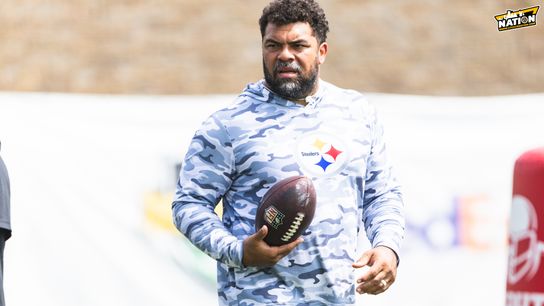
Jordan Schofield / SteelerNation (X: @JSKO_PHOTO)
Pittsburgh Steelers captain Cam Heyward during 2026 training camp at Saint Vincent College in Latrobe, PA.
Matt Williamson believes Cameron Heyward and Keeanu Benton could become Pittsburgh's preferred two-man defensive-line combination when the Steelers are hunting the quarterback. During a recent episode of The Drive on Steelers Nation Radio, Williamson called Benton an underrated pass rusher and currently views him as a better option than Derrick Harmon for that particular job.
“My hunch is, and we don’t know this for sure, but when they have two defensive linemen on the field, I think their ideal two is going to be Cam and Benton for pass rush purposes… I think Benton’s a better pass rusher than Harmon, at least at this stage… Benton is an underrated pass rusher. He’s done that well since he’s entered the league. It’s been the run defense stuff where there’s — you’ve had more to be desired,” Williamson said.
That distinction matters because Pittsburgh does not have to choose one permanent defensive-line hierarchy for every down. Harmon can start, handle early-down work and remain a major part of the front while Benton takes on a different job when the situation turns obvious. Third-and-8 is not asking the same question as first-and-10, and there is no reason the Steelers should answer both with identical personnel.
Benton has always possessed traits that make the passing-down version particularly intriguing. His first step and short-area quickness allow him to attack an interior gap rather than simply hold his ground, and he produced 5.5 sacks in 2025 despite spending plenty of time doing work that did not always showcase those strengths. Pittsburgh spent much of this offseason experimenting with where Benton fits best, including ways to free him from living directly over the center.
Pittsburgh can still use Benton at nose tackle when the front requires it, but asking him to constantly absorb blocks risks turning one of his more disruptive qualities into background noise. When the defense knows the football is likely going backward out of the quarterback's hand, Benton gets permission to think less about surviving the run fit and more about ruining the pocket.
Heyward would make an ideal partner for that job. Even late in his career, he remains Pittsburgh's most accomplished interior disruptor and understands how to manipulate guards, attack half a blocker and create pressure without needing a clean runway. Put another quick interior rusher beside him and an offensive line cannot devote every protection answer toward making Heyward disappear.
The geometry gets more uncomfortable once Pittsburgh's edge rush enters the picture. Two interior defenders capable of collapsing the middle can prevent a quarterback from comfortably climbing away from outside pressure. If the pocket compresses inward while the edges close from both sides, the passer loses the escape route that often turns a good rush into a harmless near-miss.
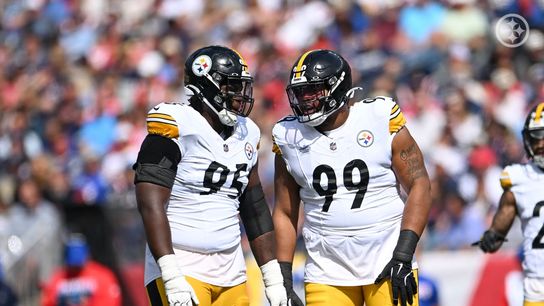
Alysa Rubin / Pittsburgh Steelers
Steelers' Derrick Harmon talks with Keeanu Benton during a road game against the New England Patriots in 2025.
Harmon still belongs prominently in the discussion. Pittsburgh used a first-round pick on him in 2025 because his size, strength and ability to play through contact gave the defensive front a young building block, and his run defense remains a major part of his value. Williamson's point is narrower. In a situation where stopping the run becomes secondary and generating pressure becomes the entire assignment, he currently trusts Benton's rush ability more.
That should not be interpreted as a setback for Harmon. Defensive-line rotations are supposed to create specialized answers. A player can be part of the best base front and still leave the field for a teammate whose skill set better matches third-and-long. Pittsburgh finally has enough young talent up front to make those choices because of strengths rather than desperation.
Benton could benefit from that specialization more than anyone. The Steelers have asked him to handle some of the least glamorous work on the line since he entered the league, and Williamson's evaluation highlights the part of his game that can get lost when the conversation focuses only on whether he is stout enough against the run. He can rush, and obvious passing situations give Pittsburgh permission to emphasize that trait.
Steelers Can Let Benton Attack Instead Of Absorb
The best version of Pittsburgh's defensive-line depth is not seven players taking turns doing the same thing. It is Patrick Graham having enough different tools to change the front based on what the offense is trying to accomplish.
Obvious passing downs could be where Benton's particular tool becomes most useful. Instead of asking him to anchor against a double team that probably is not coming, Pittsburgh can align him where his quickness threatens a guard or center immediately. Heyward beside him gives the offense another interior problem it cannot ignore, while the edge rush gets to attack a pocket that may already be losing its shape.
There will be games where Harmon earns those snaps instead. Matchups change, injuries interfere and a young first-round defender can improve quickly. Williamson was careful to frame the pairing as a hunch rather than something Pittsburgh has officially announced, but the idea fits the strengths he sees in Benton.
Pittsburgh has spent years trying to fix the middle of its defense. On passing downs, the answer might be to stop asking Benton to hold the middle and let him attack straight through it.
#SteelerNation