


The Pittsburgh Steelers have spent months debating what their top young corner is worth to them. A trade would force the rest of the NFL to answer a different question: what is he worth to everybody else? Talent should make that simple. Pittsburgh has a matchup defender capable of making life miserable for top receivers, yet the league around him may be changing faster than the market for his specialty.
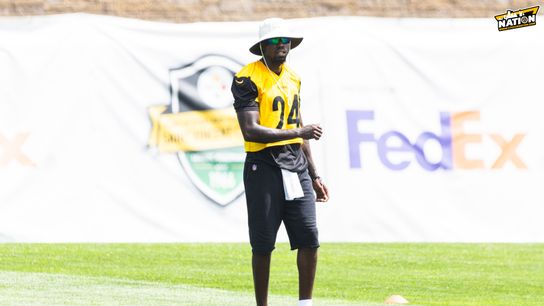
Jordan Schofield / SteelerNation (X: @JSKO_PHOTO)
Pittsburgh Steelers star cornerback Joey Porter Jr. (24) stands on the field while his teammates get a workout in during a 2026 training camp practice taking place at Saint Vincent College in Latrobe, PA.
NFL analyst Steve Palazzolo believes that could complicate Pittsburgh's attempt to find full value for Joey Porter Jr. even if an obvious destination already exists. Detroit makes sense on paper, but Palazzolo sees a larger issue hiding inside the trait that helped Porter become one of Pittsburgh's most important defenders: he is at his best playing aggressive press-man coverage in a league increasingly built around zone.
During a recent Steelers-Patriots preview, Palazzolo explained why the list of teams willing to trade for Porter and then pay him near the top of the cornerback market may be shorter than his talent suggests.
“Detroit [is] the obvious landing spot. The problem he’s dealing with is, as he said, he’s a press-cover corner, man-coverage specialist in a league that’s moving away from that. And there’s not that many teams left who are playing man coverage at the kind of rates that would make Joey Porter Jr. a top-of-the-market corner,” Palazzolo said.
That is a more complicated obstacle than whether Porter can cover. His ability to challenge receivers at the line, disrupt releases and survive isolated assignments is exactly what made him valuable in Pittsburgh's previous defensive structure. A team willing to live in those situations can see a premium solution. A zone-heavy defense may see the same player and hesitate before attaching premium draft capital to a contract near the top of the market.
The league-wide numbers support Palazzolo's premise. Pro Football Focus found NFL defenses played man coverage on only 22.6% of snaps in 2025, the lowest rate in years and down from more than one-third of snaps seven seasons earlier. Through Week 1 of 2026, most clubs again leaned heavily toward zone. Man coverage is not disappearing, but fewer defenses are building their identity around the job Porter does best.
Detroit is an interesting test case. The Detroit Lions entered the season with uncertainty at their second outside-corner spot, which makes adding a proven boundary defender understandable. They also played only 22.1% man coverage in their opener, according to Sharp Football Analysis. One game cannot define an entire defensive identity, but it illustrates why roster need and schematic fit are not automatically the same thing.
Pittsburgh has experienced its own version of that adjustment. The Steelers played zone on every Atlanta dropback in Week 1, a sharp departure from the man-heavy identity that previously allowed Porter to challenge dangerous receivers snap after snap. Porter did not play while continuing his ramp-up from a back injury, and Pittsburgh still held the Atlanta Falcons to 13 points.
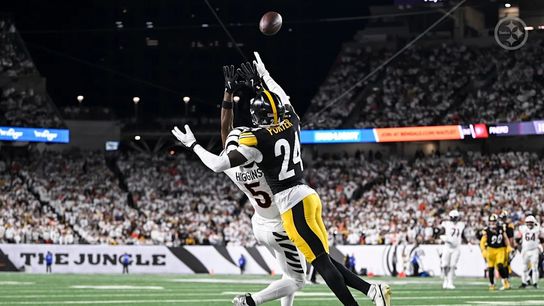
Alysa Rubin / Pittsburgh Steelers
Steelers cornerback Joey Porter Jr. (24) during a regular season matchup between the Pittsburgh Steelers and Cincinnati Bengals.
None of this means Porter suddenly lacks value. Corners who can handle difficult man assignments allow coordinators to devote help somewhere else. If a defense can trust one player outside, it can create pressure, tilt a safety toward another matchup or disguise the structure around him. That freedom is expensive, but an acquiring team would effectively have to pay twice: once in trade compensation and again on Porter's next contract.
That second bill is important. Four cornerbacks signed extensions averaging more than $30 million annually this offseason, and Porter's negotiations have centered on joining the upper end of the position. A potential partner therefore has to like the player, need his skill set, possess the draft capital and feel comfortable writing a massive second contract.
Pittsburgh's trade market has already produced several theoretical destinations, with Detroit among the most logical. Palazzolo's point introduces a filter that should matter more than simply identifying teams that need a corner: what does the defense actually ask its corners to do?
Steelers May Find Porter's Market Depends On More Than Talent
A zone-heavy team could still trade for Porter and adapt. Good coaches adjust to good players, and no modern defense stays in one coverage all season. Porter is not incapable of playing zone simply because press man is his strongest card. The question is whether a club will pay top-market money if its scheme prevents it from maximizing the trait that separates him from cheaper alternatives.
That calculation matters to Pittsburgh because trade value is created by bidders. One interested team gives the Steelers an option; several teams believing Porter is the missing piece creates leverage. If Palazzolo is right that the league's schematic shift leaves only a limited collection of natural fits, Pittsburgh may discover that Porter's value on the field and his price in a trade are not perfectly aligned.
There is an irony to that possibility. Porter became valuable enough to create this contract dispute by specializing in one of football's hardest jobs. He can walk to the line, get in a receiver's face and survive without much help. Those skills do not become less impressive because more coordinators prefer zone, but they could make the shopping list shorter.
Pittsburgh does not need 31 teams to want Porter. It only needs enough genuine bidders to create the return required to move one of its best young defenders. Palazzolo's concern is that finding teams willing to pay for Porter's talent is only half the equation; the harder part may be finding enough teams that still want to play football his way.
#SteelerNation