


The Pittsburgh Steelers can stare at 58 rushing yards from their season opener and assemble a fairly obvious list of suspects. The backs did not consistently find space, the blocking was uneven and a few calls ran directly into bad pictures. Run-game autopsies are rarely that tidy, though. By the time a handoff reaches the running back, the defense may have already won the rep because of what it believes Pittsburgh cannot make it pay for elsewhere.
Jordan Perez / Pittsburgh Steelers
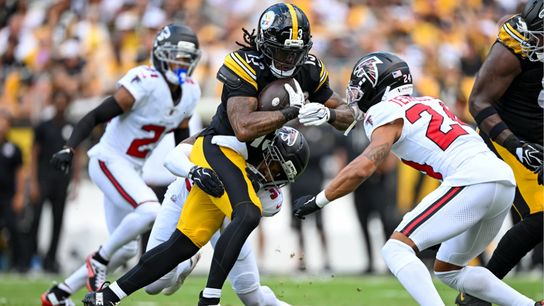
Steelers running back Rico Dowdle runs the ball against the Atlanta Falcons in Week 1 of the 2026 NFL season.
Former Steelers linebacker Arthur Moats believes the problem reaches beyond Jaylen Warren, Rico Dowdle or any single run call. His argument is that Pittsburgh has to create a friendlier rushing environment by hurting aggressive defenses through the air. Until that happens, defenders have little incentive to stop attacking downhill.
Moats used Kenneth Walker III as a comparison point while explaining the difference between having capable runners and actually giving them conditions that allow the ground game to breathe. During a recent episode of The Arthur Moats Experience, he pointed directly to a missed Roman Wilson opportunity against Atlanta as the kind of play that could change how a defense behaves.
“We were hunting some of that on Sunday. We just didn’t have the connections. That’s the only thing… I think of Roman Wilson, man, when he drops the end zone, lands on his back, right? If he’s able to retain that football possession, that’s a touchdown, that’s an explosive, and it changes the feel, right? So now, as a defender, we’re not being as aggressive next time… And now [I'm going to] cook you with this running game… Can Jaylen Warren and Rico Dowdle run the football to a degree like a Kenneth Walker? Yes. But when we throw all of the variables, all the factors in, we aren’t doing that offensively to create that environment right now. And it’s more than just a call,” Moats said.
Pittsburgh ran 21 times for 58 yards in the 20-13 win over the Atlanta Falcons. Warren supplied 46 yards on 10 carries, while Dowdle managed 15 on eight attempts. Moats is looking at why the defense was comfortable playing aggressively before either back ever received the football.
His point is not that every Atlanta run came against a loaded box or that one dropped pass ruined the rushing attack. It is about defensive behavior. When explosive throws are not connecting, safeties can trigger faster, linebackers can attack downhill with less hesitation and underneath defenders can squeeze space without feeling as threatened behind them.
Wilson's missed end-zone opportunity is a clean example because the cost would have extended beyond six points. Wilson still finished with three catches for 26 yards on six targets, but securing a vertical touchdown changes the next conversation in the defensive huddle. A defender who just watched Pittsburgh win over his head has to carry that possibility into the next snap.
Aaron Rodgers had chances to create more of those moments. He finished 24-of-40 for 221 yards and one touchdown, and Pittsburgh repeatedly pushed the ball beyond the safest underneath answers. The connections simply were not consistent enough. When those throws start landing, the benefit does not belong only to the receiving line in the box score.

Karl Roser / Pittsburgh Steelers
Steelers quarterback Aaron Rodgers gets ready to throw in Week 1 of the NFL season against the Atlanta Falcons.
That is where Warren and Dowdle can receive help without changing anything about how they run. A safety taking an extra step backward creates a different aiming point. A linebacker hesitating before inserting into a gap can be the difference between a two-yard collision and a back reaching the second level. One completion downfield can make the next six-yard run easier.
Dowdle's rough Steelers debut naturally attracted criticism because 15 yards on eight carries is impossible to dress up. Pittsburgh signed him after consecutive 1,000-yard seasons because it believed his vision, contact balance and familiarity with this offense could complement Warren. One September afternoon should not erase that evaluation, but it cannot become the default environment the backs are asked to survive.
Steelers Need To Make Defenders Pay Before Asking The Backs To Fix It
The easy response to a bad rushing day is to demand better blocking, better reads and better play-calling. Pittsburgh needs all three. Moats is adding another layer: make the defense regret how aggressively it is trying to stop the run.
That puts pressure on the passing game to convert the opportunities already being created. Rodgers does not need to throw for 400 yards, and Wilson does not need to become a weekly deep-ball specialist. Pittsburgh only needs enough explosive completions that defenders cannot treat every run look like permission to fly toward the line of scrimmage.
The Steelers can also help themselves by avoiding predictable down-and-distance situations. A run on second-and-10 after an incompletion faces a different defense than one following a 17-yard completion. Staying ahead of the sticks keeps the entire playbook available and gives defenders more possibilities to respect.
Warren and Dowdle still have responsibility here. The line does, too. Missed creases and lost blocks do not disappear because a receiver dropped a touchdown. That is not a bailout for either back or the line. Moats' argument is that Pittsburgh's fix has to be bigger than swapping backs or circling a different run on the call sheet.
The most effective way to create room for the running game may be to make defenders afraid of leaving it. Pittsburgh had chances to do that against Atlanta and left too many unfinished.
If those connections start landing, the rushing attack may suddenly look healthier before Warren or Dowdle changes a thing.
#SteelerNation