


The Pittsburgh Steelers do not need to guess whether one New England weakness can change a game. They watched it swing last year's trip to Foxborough, and the memory is fresh enough that nobody on either sideline needs a reminder of how expensive one repeated mistake can become. The Patriots have had nearly a full year to correct it. Pittsburgh has had nearly a full year to remember how profitable it was, which makes Sunday less about discovering a flaw than finding out whether it still exists.

Jared Wickerham / Pittsburgh Steelers
Steelers linebacker Alex Highsmith (56) during a regular season matchup between the Pittsburgh Steelers and the Cleveland Browns.
TJ Watt believes Rhamondre Stevenson's ball security remains something Pittsburgh can attack Sunday, even if the Steelers should expect the New England Patriots to spend the entire week preparing for exactly that. Stevenson lost two fumbles against Pittsburgh last September, helping turn an afternoon in which New England outgained the Steelers into a 21-14 Pittsburgh victory.
During his Friday media availability, Watt explained why last year's success still belongs on the scouting report without becoming something Pittsburgh can simply assume will repeat itself.
“Yeah, absolutely. I mean, takeaways are what we’re here for. But I think each and every week, you’re always talking about the same opportunities. Obviously we were able to get to them last year, but he’s watching the same film we are. So I’m sure they’re really working on ball security this week. But that doesn’t mean that’s not going to be an opportunity for us,” Watt said.
The history is difficult to ignore. Stevenson carried only four times for 18 yards in that 2025 matchup, but both of his fumbles became Pittsburgh possessions. One came at the goal line, where Cameron Heyward knocked the football free and Payton Wilson recovered it in the end zone. New England finished the day with five turnovers despite producing 369 yards to Pittsburgh's 203.
Those numbers explain why Watt is interested without sounding entitled. The Steelers did not dominate every down in Foxborough last year. They survived because their defense repeatedly turned productive Patriots possessions into nothing. A fumble at the goal line is essentially a trapdoor underneath an otherwise successful drive, and Pittsburgh found it more than once.
Stevenson also has evidence that he responded. He finished 2025 with three fumbles, meaning only one came after the Pittsburgh game, and he did not put the ball on the ground during New England's season opener this year. Against Seattle, he handled 23 offensive touches, rushing 18 times and catching five passes without a fumble.
That makes Sunday less about waiting for Stevenson to repeat an old mistake and more about forcing him into an uncomfortable decision. Ball security gets difficult when a runner is fighting for an extra yard, changing hands through traffic or bracing for one tackler while another defender arrives with a different objective. Pittsburgh can create those moments without pretending the football will simply fall out because it did last September.
Karl Roser / Pittsburgh Steelers
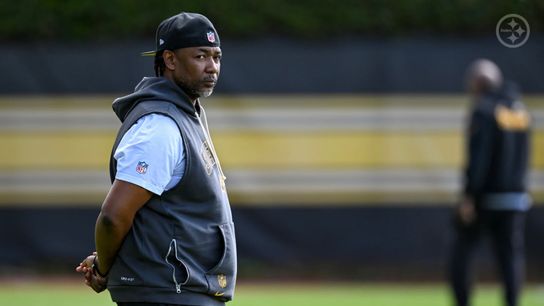
Steelers' Patrick Graham coaches during voluntary veteran minicamp in 2026.
The Steelers' first game under Patrick Graham showed the same appetite for disruption. Pittsburgh intercepted Atlanta twice in a 20-13 victory, including Watt's 35-yard pick-six, and the veteran edge rusher earned AFC Defensive Player of the Week after adding two sacks and three tackles for loss. The defense also forced two fumbles, even though Atlanta recovered both.
That is where Watt's comment fits naturally with Pittsburgh's broader defensive identity. The Steelers' edge-rush pressure can create more than sacks. A quarterback protecting himself from Watt or Alex Highsmith may lose awareness of where the ball is carried. A running back squeezing through traffic can find a second defender arriving after the first one has stopped his momentum. Turnovers often look spontaneous on Sundays because the preparation that created them happened several days earlier.
Last year's matchup is a useful example. Heyward's goal-line strip was not a random bounce Pittsburgh happened to receive. The defense had already identified New England as vulnerable to ball-security pressure, then attacked the football aggressively once the chance appeared. The result erased a possession that had reached the Pittsburgh two-yard line and prevented New England from cashing in after a Steelers turnover.
Steelers Have A Proven Way To Put New England Under Pressure
The tricky part is knowing when hunting the football becomes too aggressive. Pittsburgh still has to tackle Stevenson before trying to steal from him. Miss the runner while throwing an ambitious punch at the ball, and a turnover opportunity becomes an explosive play in the opposite direction.
Stevenson is also too important to New England's offense to assume he will disappear after last year's mistakes. He produced 95 yards from scrimmage in the Patriots' opener, and his five receptions gave Drake Maye another answer underneath when the original concept did not develop cleanly. Pittsburgh has to account for him as both a runner and receiver before it gets to worry about separating him from the football.
That is what makes Watt's approach more convincing than simply pointing at two old fumbles. He knows Stevenson has access to the same tape. He expects New England to emphasize security. Pittsburgh's job is to make all that preparation survive contact.
The Steelers already have a pass rush capable of making New England uncomfortable, and their edge pressure has become part of the Patriots' Week 2 homework. Adding a ball-security problem to that equation gives Pittsburgh another way to make ordinary gains feel fragile and force the Patriots to think about possession on every extra yard.
Last September, Stevenson learned how quickly a promising drive can disappear against this defense. Watt is not expecting him to forget the lesson; he is expecting Pittsburgh to test whether it actually stuck.
#SteelerNation