


The Pittsburgh Steelers spent an entire offseason promising that their offense would look different under Mike McCarthy. Two games into that experiment, the most stubborn problem is beginning to look familiar. Pittsburgh ran the ball better Sunday than it did in Week 1, but “better” did very little for an offense that scored three points, repeatedly lost control of the line of scrimmage, and left Foxborough with far more questions than answers.
Jordan Schofield / SteelerNation (X: @JSKO_PHOTO)
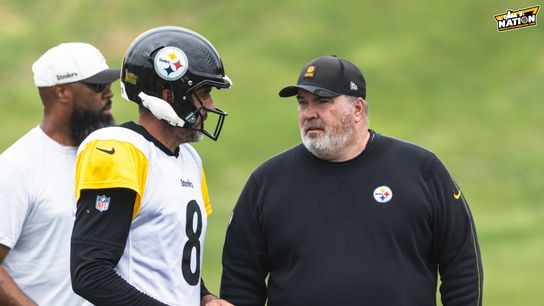
Steelers' Aaron Rodgers (8) converses with Head Coach Mike McCarthy in Latrobe, PA.
McCarthy did not push the blame toward Jaylen Warren, Rico Dowdle or a particular blocking mistake after Pittsburgh's 20-3 loss to the New England Patriots. The Steelers' head coach instead pointed directly at the lack of detail in the rushing attack and put responsibility for fixing it on the coaching staff — specifically himself.
During his postgame press conference, McCarthy acknowledged that the ground game improved in spots without becoming consistent enough to control the matchup.
“We could be cleaner in the run game, I thought we got better in that area, but the consistency of winning in the trenches we need to be better there. The reality of it is the details aren’t there and that’s on coaching. I have to get the detail better,” McCarthy said.
The numbers create the exact distinction McCarthy was describing. Pittsburgh rushed for 91 yards on 23 carries after managing only 58 official rushing yards against Atlanta in Week 1. Moving from the bottom of the league to something closer to functional is progress. Doing it while averaging 3.5 yards per offensive play, converting only two of 12 third downs and failing to reach the end zone makes the celebration fairly brief.
Pittsburgh's problem is not that every handoff is hopeless. There were snaps Sunday where the front created movement and the backs found usable space. The issue is how rarely one successful rep seemed to produce another. A crease on one series could be followed by penetration on the next, leaving the offense without the dependable early-down rhythm McCarthy's system is supposed to use to keep the entire call sheet available.
That inconsistency becomes especially expensive for Aaron Rodgers. New England sacked him four times and repeatedly forced Pittsburgh into obvious passing situations. A productive rushing attack cannot erase every protection issue, but second-and-6 creates a much friendlier offense than second-and-11 after a run is disrupted before it develops. The Steelers spent too much of Sunday asking the passing game to operate after the defense had already narrowed the possibilities.
The word “details” also narrows McCarthy's diagnosis. He did not accuse the offensive line of refusing to play physically or suggest the backs were incapable of producing. Details can mean footwork, aiming points, combination blocks, timing, leverage or making sure the entire front is attacking the same picture. None is glamorous. Missing one can still turn a promising concept into a two-yard collision.
Jordan Schofield / SteelerNation (X: @JSKO_PHOTO)
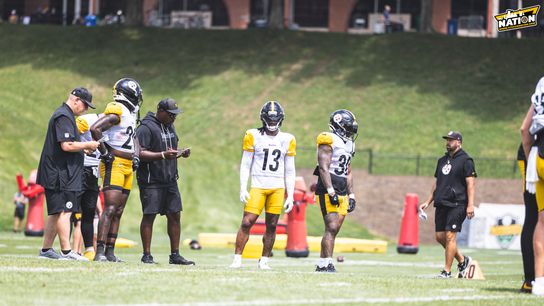
Pittsburgh Steelers running backs Rico Dowdle (13) and Jaylen Warren (30) during 2026 training camp at Saint Vincent College in Latrobe, PA.
The concern is that Pittsburgh was already having this conversation before Sunday. The Steelers' running-game issues were obvious against Atlanta, when Warren and Dowdle combined for only 61 yards on 18 carries before Rodgers' kneel-downs lowered the official total. McCarthy had a full week to make corrections. New England showed improvement existed, but not enough to change the identity of the offense.
McCarthy accepting responsibility carries extra weight because he is not merely Pittsburgh's head coach watching another coordinator's offense struggle from across the headset. He was hired in large part because of what he could build on that side of the football, and he calls the plays. When the details are missing, his fingerprints are naturally closer to the problem than they would be for most head coaches.
There is not a simple personnel button available, either. Warren has already proven he can produce at the NFL level, while Dowdle arrived after consecutive 1,000-yard seasons. Pittsburgh invested heavily in its offensive front and spent the summer talking about how the pieces would fit together. Two games are not enough to declare any of those decisions failures, but they are enough to stop treating the lack of consistency like a one-week accident.
Steelers Need McCarthy's Accountability To Become A Correction
Taking responsibility after a 17-point loss is useful only if the film looks different the following Sunday. McCarthy now has a specific problem to solve: Pittsburgh has to turn isolated successful runs into something the offense can call repeatedly without wondering whether the blocking picture will survive the snap.
That may require changes in technique, personnel usage or which concepts Pittsburgh emphasizes. It may simply require more repetitions for a line still adjusting to a new configuration and system. Whatever the answer becomes, McCarthy effectively removed the easiest excuse when he put the missing details on coaching.
The timing raises the stakes. Pittsburgh is 1-1 and returns home with an offense that has produced only one touchdown through two games. The defense can steal possessions and create short fields, but no sustainable plan involves asking that unit to drag the offense through September while the running game searches for an identity.
McCarthy said the Steelers got better Sunday, and 91 rushing yards support him. The scoreboard supplied the less comfortable half of the evaluation.
Pittsburgh does not need the run game to look improved. It needs it to become dependable. McCarthy just made clear that getting it there starts with him.
#SteelerNation