


The Pittsburgh Steelers have spent more than five decades operating with a coaching stability few NFL franchises can even imagine. Chuck Noll, Bill Cowher, and Mike Tomlin each became defining figures in a different era of Pittsburgh football, but Charlie Batch believes the national standard for all-time coaching greatness is still painfully simple.

Jordan Schofield / SteelerNation (X: @JSKO_PHOTO)
Former Pittsburgh Steelers Head Coach Mike Tomlin roams the practice field as his team works out during a 2025 training camp practice at St. Vincent College in Latrobe, PA.
Batch and Trai Essex discussed CBS Sports’ greatest NFL coaches list on The Snap Count Show, and the Steelers’ coaching history naturally became part of the debate. CBS placed Noll inside the top-10, but Tomlin and Cowher were left out. For a franchise that rarely changes head coaches, the omission is worth digging into.
Batch was not surprised by how the list shook out.
“I’m not surprised that you don’t see Mike Tomlin, you don’t see Bill Cowher only because they do not have the championships,” Batch said.
Pittsburgh fans can argue Cowher and Tomlin from several directions. Cowher brought the Steelers back to national relevance in the 1990s, built one of the league’s most physical identities, reached two Super Bowls, and finally broke through with a title. Tomlin extended the organization’s stability, won early, reached two Super Bowls, and kept Pittsburgh competitive through multiple roster cycles.
The problem comes when these resumes are against the greatest coaches in NFL history. Regular-season success helps. Longevity helps. Culture helps. The top of the list still bends toward coaches who won multiple championships or reshaped the sport.
Noll owns the clearest Steelers case because his résumé does both. He did not only win. He helped turn a losing franchise into a dynasty. His four Super Bowl victories remain the franchise standard, and they still separate him from every Pittsburgh coach who followed.
Cowher’s argument is strong but complicated. He won 149 regular-season games with the Steelers and became the face of a hard-edged era that looked and felt like Pittsburgh football. His teams were frequently in the AFC Championship picture, but several near-misses at home still linger in his legacy.
Winning Super Bowl 40 put him in Canton and secured his place among the franchise’s legends, but one ring makes a top-10 all-time argument difficult when the list is loaded with dynastic coaches.
Tomlin’s résumé creates a different conversation. Pro Football Reference lists him with 193 regular-season wins with Pittsburgh, tying Noll’s franchise total, along with one Super Bowl win and two Super Bowl appearances. His consistency over nearly two decades became one of his strongest selling points, especially in a league designed to punish sustained success. The playoff drought near the end of his Steelers tenure, however, weakened the national perception of his case.
Batch summed up the challenge.
“It’s tough to crack that top 10 right now,” Batch said.
CBS’ list shows why. Six CBS Sports NFL reporters voted on the ranking, which put Bill Belichick at No. 1, Vince Lombardi at No. 2, Bill Walsh at No. 3, Paul Brown at No. 4, Don Shula at No. 5, George Halas at No. 6, Noll at No. 7, Andy Reid at No. 8, Joe Gibbs at No. 9, and Tom Landry at No. 10. That is a brutal field to break into. It includes championship builders, innovators, and coaches whose names define entire NFL eras.
That group leaves almost no room for sentimental cases. Cowher’s Pittsburgh toughness does not outweigh a lack of multiple titles. Tomlin’s regular-season steadiness does not erase the postseason frustration that followed his early success. Even coaches with huge win totals can be squeezed out when the comparison pool includes dynasties.
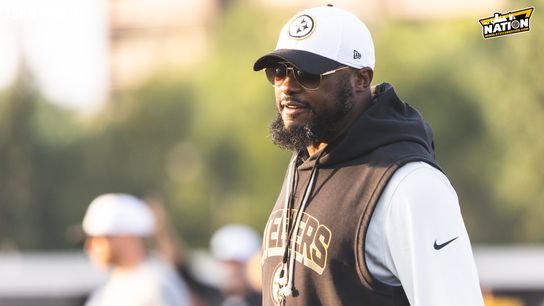
Jordan Schofield / SteelerNation (X: @JSKO_PHOTO)
Former Pittsburgh Steelers Head Coach Mike Tomlin roams the practice field as his team works out during a 2025 training camp practice at St. Vincent College in Latrobe, PA.
Steelers history makes the debate even harsher. Cowher and Tomlin would be worshipped almost anywhere. They are still franchise icons in Pittsburgh, but every Steelers coach gets measured against Noll. The comparison is not always fair, but it is unavoidable because Pittsburgh’s own standard is built around Lombardi trophies.
That is part of what made the transition to Mike McCarthy so significant. The Steelers are not just replacing a coach. They are stepping into another era where the same standard will eventually return. McCarthy is not being asked to preserve vibes or extend regular-season respectability. He is being asked to win in January and, eventually, put Pittsburgh back in championship conversations.
The organization has already been through a major coaching transition, and the lesson from the franchise’s own history is obvious. Longevity matters only if it leads somewhere. Regular-season wins matter only if they eventually create postseason proof. A strong culture matters, but the Steelers’ culture has always been validated by titles.
Batch’s view is not an attack on Cowher or Tomlin. It is a reminder of how elite the all-time coaching discussion becomes. Cowher and Tomlin both had remarkable Steelers careers. Both kept Pittsburgh relevant. Both delivered Super Bowl appearances. Both won a championship. In many cities, that would be enough to stand alone forever.
In Pittsburgh, it still falls short of Noll’s shadow.
Steelers Legends Still Face A Championship Standard
The Steelers have a unique coaching history because the franchise rarely burns everything down. Noll coached from 1969 through 1991. Cowher followed from 1992 through 2006. Tomlin then took over in 2007 and held the job through the 2025 season. Most franchises go through coaches seeking stability. Pittsburgh turned stability into part of its identity.
The downside is that stability can make the final judgment even sharper. When a coach gets that much time in Pittsburgh, the expectation becomes more than competitiveness. Cowher had 15 seasons. Tomlin had 19. Both had enough time to build, reset, adjust, and chase multiple titles. Winning once is still special, but it does not fully satisfy the standard the Steelers created for themselves in the 1970s.
Noll changed the entire franchise. He took a team with no real winning tradition and built one of the most famous dynasties in sports. His players became Hall of Famers. His defense became mythology. His four titles became the benchmark.
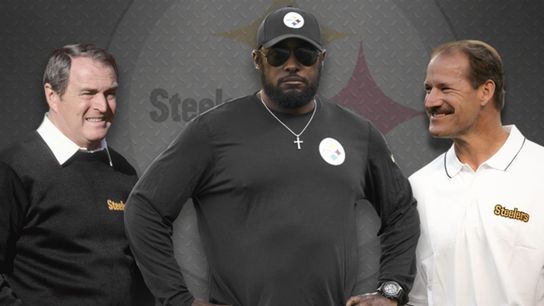
steelers.com
Steelers' only three head coaches since 1969 through 2025 are Chuck Noll, Bill Cowher, and Mike Tomlin.
Cowher restored the Steelers after Noll’s era faded. Tomlin preserved the standard through the modern NFL. Their accomplishments deserve respect, but Batch’s point explains why respect is not the same as top-10 all-time placement.
The national list rewards coaches who either stacked championships or altered football history. Cowher and Tomlin both belong in Steelers history. Noll belongs in NFL history at a different level.
For Steelers fans, the debate will always carry emotion. Tomlin supporters can point to years of winning. Cowher supporters can point to the identity he rebuilt. Noll’s supporters only need to point to four trophies.
Batch’s reaction makes the conversation clear. The top-10 coaching table is crowded and the entry price is steep. Pittsburgh has produced several legendary coaches, but only one owns enough championship weight to sit comfortably with the greatest names ever.
Cowher and Tomlin remain Steelers icons. Noll remains the wall they run into.
That wall is made of Super Bowls.
#SteelerNation