


The Pittsburgh Steelers hired Mike McCarthy to provide the offensive direction the organization consistently lacked near the end of the Mike Tomlin era. After years of predictable performances and stalled development, many fans expected Pittsburgh to completely abandon the system previously run by Arthur Smith.
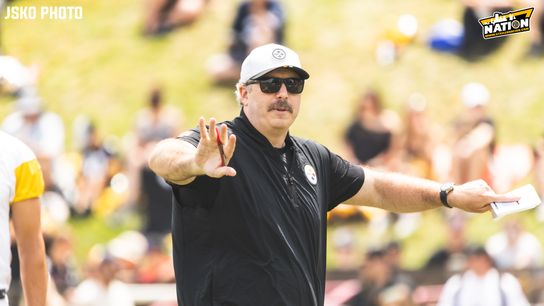
Jordan Schofield / SteelerNation (X: @JSKO_PHOTO)
Ex-Steelers offensive coordinator Arthur Smith during a 2025 training camp at Saint Vincent College in Latrobe, PA.
That expectation made sense. The Steelers won 10 games and captured the AFC North in 2025, but their offense remained inconsistent despite having Aaron Rodgers at quarterback. Pittsburgh averaged only 103.3 rushing yards per game and too often struggled to create sustained momentum. That ranked them 26th in the entire league.
McCarthy's arrival appeared to guarantee a clean break. He is an accomplished offensive coach with extensive history developing quarterbacks, designing passing concepts and building productive units. However, his latest explanation, via Ralph Vacchiano, of Pittsburgh's new offense may frustrate fans who wanted every trace of Smith's system removed.
"It's not like just [Rodgers] and I got back together and dusted off the old playbook," McCarthy told Vacchiano. "There's a lot of language that's changed. And we kept some of the things that were here last year just to try and keep the guys in sync."
That admission will immediately raise questions. If Pittsburgh's previous offense repeatedly failed to maximize its talent, why would McCarthy preserve any part of it? The Steelers finally hired an offensive-minded head coach, only for him to retain concepts and terminology from the system fans wanted replaced.
The frustration is understandable, but McCarthy is not promising to duplicate Smith's offense. Keeping selected language and concepts does not mean preserving the same play-calling tendencies, personnel usage or strategic limitations. It means preventing most of the roster from having to learn an entirely foreign football language.
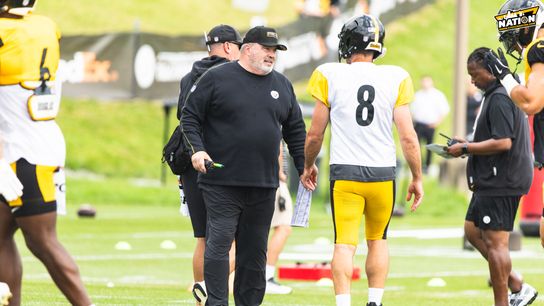
Jordan Schofield / SteelerNation (X: @JSKO_PHOTO)
Pittsburgh Steelers Head Coach Mike McCarthy (left) and quarterback Aaron Rodgers (8) during 2026 training camp at Saint Vincent College in Latrobe, PA.
Rodgers already understands McCarthy's principles from their 13 seasons together in Green Bay. The rest of Pittsburgh's offense does not share that familiarity. Completely installing McCarthy's old playbook would have made the quarterback comfortable while forcing every lineman, receiver, tight end and running back to begin from zero. McCarthy and offensive coordinator Brian Angelichio are attempting to meet the roster in the middle. They can keep terminology that players already understand while changing how those concepts are called, disguised and connected. That could accelerate the installation without limiting the final product.
The approach should help players such as Pat Freiermuth, Darnell Washington, Roman Wilson and Jaylen Warren. Instead of spending the summer translating every assignment, they can focus more attention on execution and understanding what McCarthy wants to accomplish. Still, McCarthy must prove that continuity will not become an excuse for repeating the same problems. Pittsburgh cannot continue underusing Freiermuth, failing to create easy completions or asking Rodgers to rescue possessions after the offense falls behind schedule.
Steelers' Gamble May Be Crazy Enough To Work
McCarthy inherited a 10-win team rather than a completely broken roster. His responsibility is to improve what already exists, not change everything simply to demonstrate that he is different from Tomlin and Smith. The best coaches adapt their systems to their players. McCarthy could have forced Pittsburgh into an offense built around what worked for Rodgers years ago, but that would ignore the quarterback's age and the strengths of the current roster.
Rodgers will turn 43 during the season and needs support from an effective running game, reliable protection and players who can execute without hesitation. Familiar language may help the Steelers play faster while McCarthy gradually introduces the concepts he believes will elevate the unit. This plan could also fail. If Pittsburgh's offense looks too similar to last season, fans will quickly question why the organization made such a dramatic coaching change. McCarthy was hired to produce better results, and continuity will not protect him from that expectation.
The decision initially sounds backward. Steelers fans spent years asking the team to modernize its offense, and now the new offensive head coach is keeping parts of the previous system. It may be frustrating, but it could also be genius if McCarthy preserves what players understand while fixing how everything operates. Pittsburgh does not need a completely new dictionary. It needs better answers. If McCarthy can provide them without forcing the roster to start over, retaining pieces of Smith's offense may become one of the smartest choices of his first season.
Please feel free to share your Steelers takes and thoughts with me on X (@anthonyghalkias) and consider following for more Steelers-related content and discussion. I'm always open to hearing different perspectives, breaking down games, and talking all things Pittsburgh football.
#SteelerNation