


The Pittsburgh Steelers did not leave their season opener feeling like the offense had reached anything close to its ceiling. Drives stalled, catchable footballs hit the ground and several opportunities that could have changed the complexion of the afternoon disappeared before Pittsburgh could capitalize. The final production looked ordinary enough to invite criticism, but a closer examination of the quarterback's performance tells a considerably more encouraging story.
Jordan Schofield / SteelerNation (X: @JSKO_PHOTO)
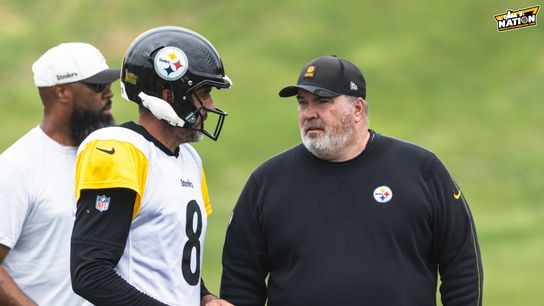
Steelers' Aaron Rodgers (8) converses with Head Coach Mike McCarthy in Latrobe, PA.
Aaron Rodgers may have played better against the Atlanta Falcons than Pittsburgh's uneven offensive output suggested. During a recent postgame review, the analysts pointed toward multiple dropped passes and a potential missed defensive pass-interference penalty on a deep shot to DK Metcalf as examples of quality throws that never became production on the stat sheet.
“Rodgers made a few good throws that were dropped. I mean, that was a big part of the offense being inconsistent… He had a bomb to A.J. Terrell and DK Metcalf and A.J. Terrell, I think, just dives, grabs hold of his arm… That was an egregious missed call… that is pass interference by definition and they didn’t call that. I mean, that’s a huge play that they didn’t get any credit for,” the analysts said.
The distinction is important because quarterback evaluation becomes lazy very quickly when every incompletion gets placed in the same column.
Rodgers certainly had throws he would like back. Pittsburgh's offense was not consistently sharp, and the veteran was part of that inconsistency. The point is that several other incompletions required very little correction from the quarterback. If the football arrives where it should and the receiver fails to finish the play, the box score punishes Rodgers for a problem that began after the throw left his hand.
That was especially noticeable with Metcalf. Pittsburgh spent much of the offseason trying to improve the connection between its quarterback and top receiver after their first year together produced too many stretches where the pairing felt slightly out of sync. Week 1 still included some frustration, but not all of it originated with Rodgers.
The deep opportunity the analysts highlighted is a perfect example. Rodgers gave Metcalf a chance downfield and the coverage became physical as the ball arrived. The officials allowed the play to continue without a flag, leaving Pittsburgh with an incompletion instead of either a significant gain or a penalty that could have dramatically changed the possession.
Rodgers himself focused on several missed opportunities after the victory. Pittsburgh had chances to produce considerably more explosive offense than it ultimately managed, which makes the Week 1 film more interesting than simply looking at the final passing total and deciding the entire operation struggled.
The analysts returned to that point when discussing Rodgers' afternoon.
“I thought Rodgers had a couple nice ones… and then he made a few good throws that were dropped,” they said.
Drops have an especially annoying effect on an offense trying to establish rhythm. A well-timed completion on early downs can keep the entire playbook available. Put the same football on the ground and Mike McCarthy suddenly has to call the next play from a much less friendly down-and-distance situation.
Barry Reeger / Imagn Images
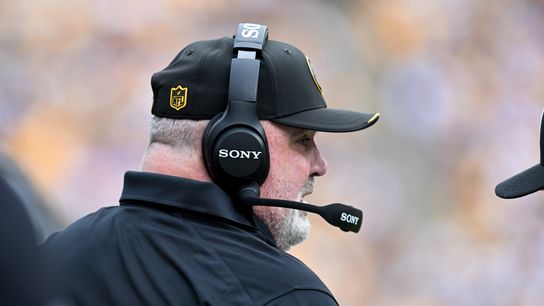
Mike McCarthy looks on during a Week 1 game against the Falcons.
That problem compounds on third down. A quarterback can make the correct read, beat the coverage and deliver an accurate pass only to watch the drive end because the final part of the transaction never occurs. The offense looks ineffective collectively even if the process from the quarterback was exactly what Pittsburgh wanted.
That does not mean Rodgers deserves to be excused for everything that went wrong. The Steelers need cleaner quarterback play along with better protection, more reliable receiving and a running game capable of preventing the offense from becoming too dependent on his arm. Week 1 offered enough problems to keep McCarthy's offensive meetings busy.
The useful part is that Pittsburgh does not appear to be fixing a quarterback who suddenly cannot make the required throws.
Rodgers still showed the willingness to attack downfield rather than retreat into a game built entirely around safe completions. That aggressiveness matters because Metcalf's physical ability becomes far less useful if the quarterback stops giving him opportunities to win vertically after one or two failed connections.
The same principle applies throughout the receiver room. Michael Pittman Jr, Roman Wilson and Pat Freiermuth all give Rodgers different answers, but those options only help if Pittsburgh consistently completes the final step when the quarterback puts the football where it belongs.
Steelers Have Easier Problems To Fix Than A Broken Quarterback
The Week 1 offense was inconsistent. Nobody needs to dress it up as something else simply because Pittsburgh escaped with a win.
There is a major difference, however, between an offense struggling because its quarterback cannot create opportunities and one wasting opportunities the quarterback already created.
The latter is considerably easier to live with in September.
Receivers can clean up drops. Timing should improve as the same combinations accumulate actual regular-season snaps. McCarthy can adjust concepts that did not work against Atlanta, and Pittsburgh can continue searching for better balance instead of asking Rodgers to carry such a large portion of the operation.
Rodgers has corrections of his own to make, but the analysts saw enough quality throws to believe the final numbers undersold how well he actually played.
Pittsburgh's offense did not look finished in Week 1.
The encouraging part is that its 42-year-old quarterback did not look like the reason why.
#SteelerNation