


The Pittsburgh Steelers spent the offseason treating their defensive line like one of the roster's biggest reasons for optimism. Pittsburgh had the established star, several young investments and enough depth to rotate players without dramatically changing what the front could accomplish. Week 1 mostly justified that confidence, but it also supplied an early reminder that a talented young group can still have plenty to clean up once real football replaces August projections.
Alysa Rubin / Pittsburgh Steelers
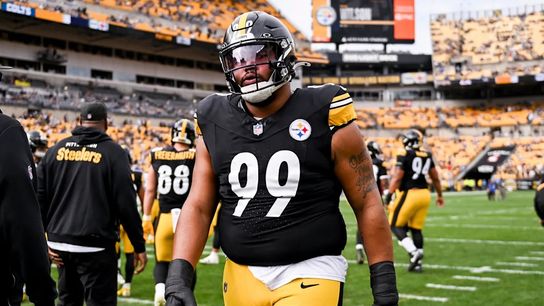
Steelers' Derrick Harmon before regular season game against the Colts in the 2025 NFL season
Insider Christopher Carter came away encouraged by Pittsburgh's defensive front as a whole following its 20-13 victory over the Atlanta Falcons, although he saw an uneven afternoon from Derrick Harmon and Yahya Black. Keeanu Benton, meanwhile, provided some of the more promising interior flashes.
“Cam Heyward was really good. All the linebackers were pretty good. I thought there were some moments—I got to look back at the film—I thought there were some moments Derrick Harmon could have been better. Same for Yahya Black. I thought Keeanu Benton flashed a little bit, but all in all I thought this was the defensive front that you needed to control this game regardless of how well or poor the offense played,” Carter said.
That is probably a healthy assessment for Pittsburgh after one game. The Steelers do not need Harmon and Black to look like finished products in September, but both occupy roles significant enough that ordinary growing pains will be visible. Harmon is entering only his second NFL season, while Black went from a fifth-round developmental piece in 2025 to a much larger part of the rotation this summer.
Their responsibilities are also not particularly forgiving. Pittsburgh wants its interior linemen to absorb blocks, maintain run fits and create enough disruption that the linebackers behind them can play quickly. A defensive lineman can execute plenty of useful snaps without generating a sack or tackle for loss, but one lost gap can become much more noticeable when a talented runner reaches the second level untouched.
That made the Atlanta matchup a difficult opening exam. Bijan Robinson is capable of finding daylight even when the defensive structure initially looks correct, and Pittsburgh spent much of Sunday trying to keep one of the league's most dangerous backs from turning small mistakes into explosive gains. The Falcons still found production through Robinson, but Pittsburgh's front made enough disruptive plays to keep the game under control while the offense struggled to sustain possessions.
Harmon remains one of the central pieces in that effort. Pittsburgh selected him in the first round in 2025 because his size and strength gave the defense another legitimate building block against the run, and his rookie season produced 27 tackles and three sacks despite missing time early. The next stage is turning those encouraging stretches into steadier down-to-down football.
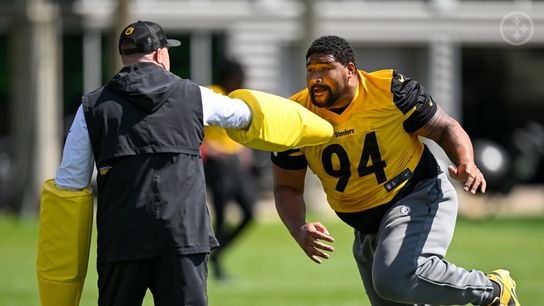
Black's development presents a slightly different challenge. At 6-foot-5 and roughly 330 pounds, he gives Pittsburgh the kind of mass it has lacked at times in the middle. The Steelers spent the summer increasing his workload and asking him to become more technically reliable rather than surviving solely through size. Carter seeing moments that need improvement in the opener hardly destroys that progress. It simply shows the education did not end when training camp did.
Karl Roser / Pittsburgh Steelers
Steelers' Yahya Black working out during the 2026 offseason during voluntary workouts.
Benton flashing provides the other side of the conversation. Pittsburgh spent much of the offseason trying to put him in situations that better highlight his ability to penetrate rather than forcing him to live exclusively as a traditional nose tackle. His potential passing-down role alongside Cameron Heyward was already an intriguing possibility before the season began.
Carter's early impression suggests some of that thinking may translate.
Benton has always shown more juice as an interior pass rusher than his position label sometimes suggests. He posted a career-high 5.5 sacks last season, and Pittsburgh now has enough size elsewhere to let him attack more frequently instead of making him the automatic answer for every dirty interior assignment. If Black continues developing as an anchor and Harmon becomes steadier, Benton can increasingly be deployed where his quickness becomes a problem.
Heyward remains the standard holding all of it together. Carter specifically identified the veteran as having a strong opener, which gives Pittsburgh some breathing room while the younger linemen develop around him. The Steelers are not asking three inexperienced players to collectively figure out the front without guidance. They have one of the league's most accomplished defensive tackles setting the baseline beside them.
Steelers Need The Young Pieces To Catch Heyward
The best outcome for Pittsburgh is not Harmon, Black or Benton becoming Heyward overnight. It is each one becoming dependable enough at his particular job that the Steelers can rotate the front without losing its identity.
Week 1 showed why that still requires patience.
There were encouraging snaps, mistakes worth correcting and a veteran centerpiece playing well enough to keep the entire operation stable. That is a much healthier problem than Pittsburgh wondering whether the talent exists at all.
Harmon and Black will get cleaner with experience. Benton already appears positioned to benefit from the different bodies surrounding him. The Steelers can afford some individual imperfections as long as the collective continues controlling games the way Carter believed it did against Atlanta.
Pittsburgh's defensive line passed its first test. The younger pieces just left enough on the film to make sure nobody mistakes passing for acing it.
#SteelerNation