


The Pittsburgh Steelers made one of the strangest roster bets in the NFL before the season began. At the time, the logic was easy enough to defend. Quarterbacks are valuable, young ones are difficult to hide, and Pittsburgh believed it had four worth protecting. The problem with roster insurance is that the premium gets paid somewhere else, and one overlooked part of the team may finally be showing where the bill lands.
Jordan Schofield / SteelerNation (X: @JSKO_PHOTO)
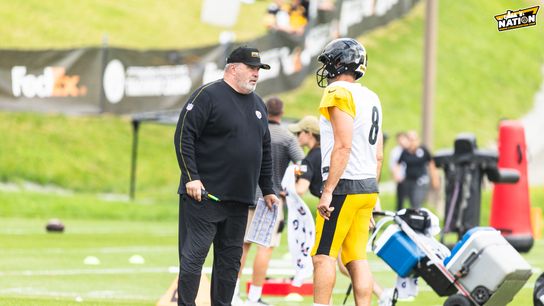
Pittsburgh Steelers Head Coach Mike McCarthy (left) and quarterback Aaron Rodgers (8) during 2026 training camp at Saint Vincent College in Latrobe, PA.
Insider Mike DeFabo believes Pittsburgh's decision to carry four quarterbacks creates a hidden cost on special teams. The Steelers kept Aaron Rodgers, Mason Rudolph, Will Howard and Drew Allar on the initial 53-man roster, protecting every quarterback they valued but eliminating a spot that could have gone to another player capable of helping in the kicking game.
During a recent discussion, DeFabo explained where he believes the unusual roster construction hurts Pittsburgh most.
“The four quarterbacks part, you know, where that’s going to hit you the most is going to be on special teams. You know, you’re taking a body away there. So, yeah, you’re absolutely right,” DeFabo said.
That is the less glamorous side of keeping four quarterbacks. Rodgers is obviously the starter, while Rudolph provides experienced insurance behind him. Howard, now in his second NFL season, and rookie Allar are developmental investments Pittsburgh was unwilling to expose to another organization. General Manager Omar Khan openly acknowledged after cutdowns that the Steelers simply liked the entire room enough to keep everyone. It is defensible quarterback management. It is also expensive roster math.
Pittsburgh's initial 53 included 26 offensive players, 24 defenders and three specialists. The fourth quarterback is not competing with another quarterback for that final spot in practical terms. He is competing with a defensive back, linebacker, running back, tight end or receiver who might spend every Sunday covering punts, running down kickoffs and filling multiple special-teams units.
That matters because Mike McCarthy has preached the exact opposite roster philosophy almost everywhere else. Pittsburgh's own post-cutdown analysis noted that McCarthy wants the vast majority of the roster capable of handling two jobs and contributing on all four downs. Players near the bottom of his depth chart are valuable specifically because they can survive on offense or defense while providing immediate usefulness to Special Teams Coordinator Danny Crossman.
A fourth quarterback is the exception. He offers enormous theoretical value at football's most important position and virtually no special-teams value at all.
Jordan Schofield / SteelerNation (X: @JSKO_PHOTO)
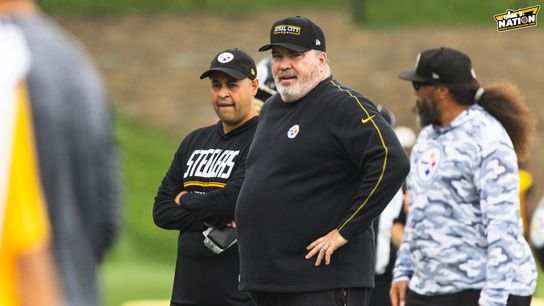
Pittsburgh Steelers Head Coach Mike McCarthy alongside General Manager Omar Khan during 2026 training camp at Saint Vincent College in Latrobe, PA.
The Steelers knew about that tradeoff before September. Rodgers even acknowledged it after the roster was finalized, noting that carrying four quarterbacks necessarily takes a spot from somewhere else while defending Pittsburgh's belief that all four belonged among its best 53 players. The organization consciously chose long-term quarterback protection over an additional body elsewhere.
Four games later, DeFabo's point deserves more attention because Pittsburgh has not exactly been stealing games with hidden yardage. Rookie Kaden Wetjen has yet to break a return longer than 27 yards, and the Steelers drafted him in the fourth round specifically because Crossman viewed him as an elite dual-return prospect. Pittsburgh's return-game investment has yet to produce the field-flipping plays envisioned in April.
The missing roster spot does not mean some anonymous 54th player would have magically fixed the return game. That would be too convenient. Returners need blocking, coverage units need disciplined lanes and plenty of special-teams mistakes have nothing to do with roster construction. DeFabo's argument is about margin.
Players such as rookie Eli Heidenreich made Pittsburgh's roster partly because their versatility extends into special teams. Seventh-round safety Robert Spears-Jennings earned early opportunities there because his speed, physicality and tackling translated immediately. Those are the types of players who become disproportionately useful when a roster is squeezed.
Adding one more player from that mold gives Crossman another option when somebody gets injured, struggles in coverage or needs to be removed from a unit. It creates competition for jobs where effort, tackling and assignment discipline can decide 20 hidden yards at a time.
Steelers Are Paying A Luxury Tax For Quarterback Security
Pittsburgh's decision still might prove brilliant. Rodgers is 42, making veteran insurance more valuable than it would be behind a 25-year-old starter. Rudolph can step into an NFL game immediately, while Howard and Allar give the organization two developmental swings at solving the much larger quarterback question waiting beyond this season. Losing either young passer on waivers just to preserve a fifth linebacker would look foolish if one eventually becomes a starter. But the fourth quarterback cannot remain a sacred roster decision if the rest of the team keeps paying for it.
That is the part Pittsburgh has to evaluate honestly. A roster spot is not free simply because the player occupying it has future value. Every protected developmental quarterback means one fewer player available somewhere else, and special teams is often where teams feel that subtraction first because its best contributors usually come from the bottom half of the depth chart.
The Steelers decided quarterback insurance was worth the sacrifice. DeFabo's point is that Pittsburgh should not pretend there was no sacrifice at all.
#SteelerNation